 Denzil Otieno
Product-Led Growth (PLG): Definition, Strategy, Benefits, and Examples
PLG stands for product-led growth: a model where the product drives acquisition, activation, retention, and expansion. Definition, examples, how it works.

PLG stands for product-led growth: a go-to-market model where the product itself drives customer acquisition, activation, retention, and expansion, replacing many of the functions that sales and marketing traditionally own.
When a user signs up, explores your product, and upgrades to a paid plan without ever speaking to a salesperson, that is product-led growth working as intended. The term was coined in 2016 by Blake Bartlett at OpenView to describe the model behind companies like Slack, Dropbox, and Atlassian.
For SaaS companies, it has become one of the most efficient ways to grow because the product does the qualifying, converting, and retaining at a scale no sales team can match. The mechanics are straightforward: users get access through a free trial or freemium plan, experience value on their own terms, and upgrade when they are ready.
This self-serve motion reduces the cost of acquiring each new customer while generating behavioral data that tells you exactly where users find value and where they drop off. This article breaks down how PLG works, what separates it from sales-led growth, the components that make it function, and how to measure whether it is working for your business.
Key takeaways:
- PLG stands for product-led growth: the product, not a sales team, drives acquisition, activation, retention, and expansion.
- Users qualify themselves through product usage. Sales steps in only when behavior signals buying intent.
- The model fits products that show value fast; it struggles when setup is heavy or the buyer never touches the product.
- Freemium, free trials, usage-based, and hybrid pricing are the four standard PLG monetization models.
- Activation rate, conversion to paid, expansion revenue, and net dollar retention are the numbers that tell you if PLG is working.
What Is Product-Led Growth (PLG)?
Product-led growth is a go-to-market strategy where the product is the primary driver of acquisition, activation, retention, and expansion. Rather than building a sales or marketing motion first and plugging the product in later, PLG companies build the product in a way that naturally pulls users in and demonstrates value quickly.
Users convert into paying customers through their own experience with the product, not through a pitch.
In a product-led organization, every team, from marketing to sales to customer success, aligns around the product as the main growth lever. Marketing drives people to try the product directly rather than capturing them through a form and handing them to sales.
Sales only steps in when product usage signals that a user is ready to buy.
What makes PLG distinct from other growth models is how it qualifies users. Instead of relying on demographic data or a discovery call, PLG uses self-serve discovery and actual product usage to determine who is ready to buy.
This is what makes it particularly powerful for subscription-based software-as-a-service companies, where the product can be accessed, explored, and evaluated without any human involvement on the vendor side.
What Does PLG Stand For?
PLG stands for "product-led growth." The abbreviation is standard across the SaaS industry, and you will also see it in variations like PLG motion (the self-serve journey itself), PLG company (a business built on the model), and product-led sales or PLS (the hybrid where sales works leads that product usage has already qualified).
The term is attributed to Blake Bartlett at OpenView Venture Partners, who coined it in 2016. The model itself is older: Dropbox, Slack, and Atlassian were all growing this way before the industry had a name for it.
What Is PLG in Marketing?
PLG in marketing is a fundamental shift in how customer acquisition works, where the product replaces the traditional funnel as the main way to win and convert customers. In a conventional sales and marketing setup, teams spend most of their energy generating marketing qualified leads through gated content, paid campaigns, and outbound outreach.
In a PLG model, that energy goes into getting users into the product as fast as possible and making sure they experience value before any commercial conversation happens.
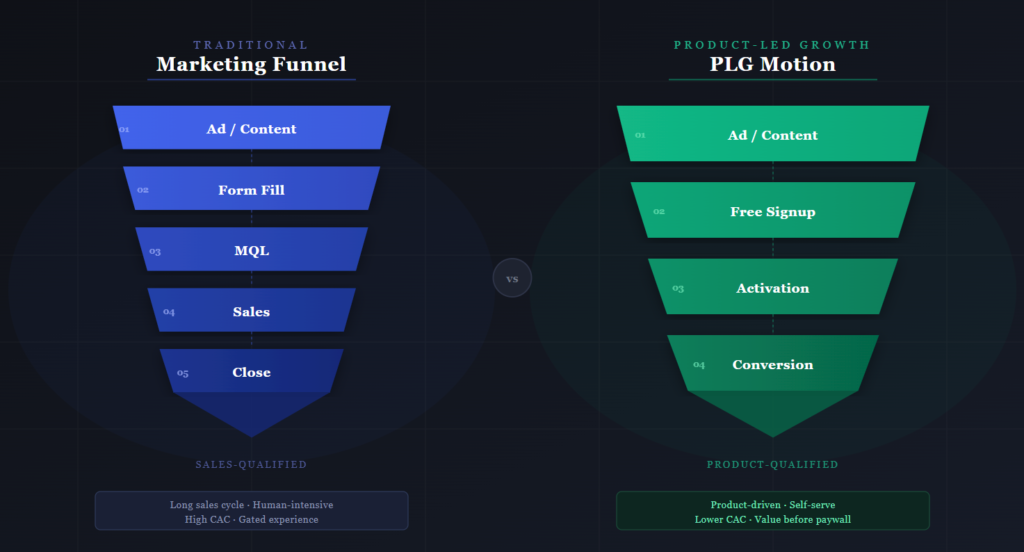
When marketing is aligned with PLG, its primary job becomes getting the right users into the product and making sure they reach value as quickly as possible. Instead of optimizing for form fills and demo requests, PLG marketing teams focus on:
- Driving user acquisition through channels that lead directly to a signup or free trial
- Creating educational content that helps users understand the product before and after they sign up
- Supporting onboarding by reducing the gap between signup and the moment a user gets their first meaningful result
- Using in-product guidance to nudge users toward features that drive activation and retention
This also means demand generation looks different in a PLG company. Rather than gating resources behind forms to capture contact details, PLG marketing teams make content, tools, and product access freely available because the product itself is what converts.
The less friction between a potential user and the product, the faster they can experience the value that drives them to pay.
How Does a Product-Led Growth (PLG) Strategy Work?
The customer journey in a PLG strategy follows a clear motion where each stage is designed to move users forward through their own experience with the product. Unlike a sales-led model where a rep guides the prospect through each step, PLG relies on the product to do that work.
Understanding how each stage connects helps explain why the model is so efficient at scale.
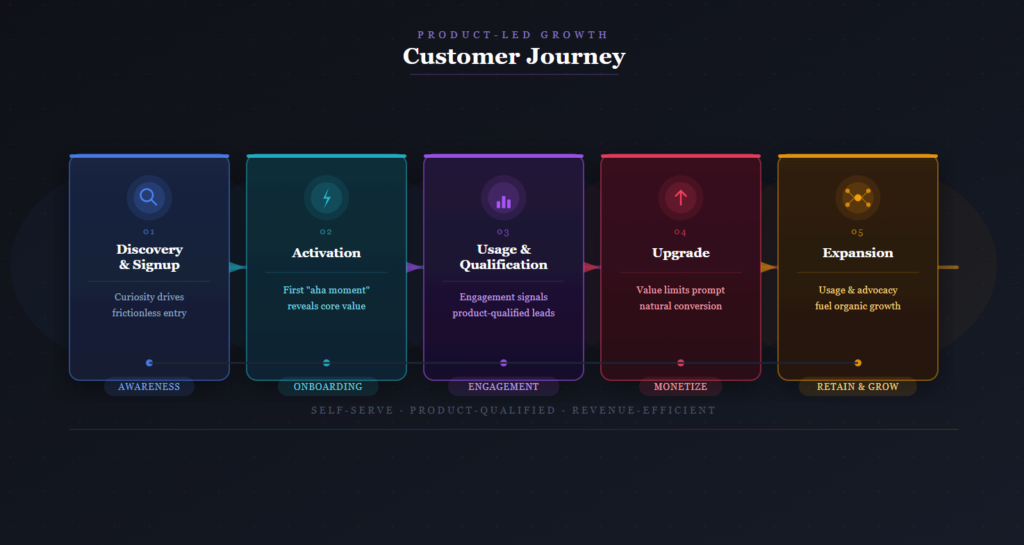
Step 1: Discovery and Signup
Users typically find a PLG product through word of mouth, organic search, or a colleague sharing it with them. They land on a page, see a clear value proposition, and sign up without needing to book a call or wait for a demo. The barrier to entry is intentionally low because the goal is to get users into the product as fast as possible.
Step 2: Activation
This is where the product has to deliver on its promise. Activation happens when a user completes a key action that gives them their first real experience of the product's value, whether that is sending their first message, creating their first report, or completing their first workflow. The faster a user reaches that moment, the more likely they are to continue using the product.
Step 3: Usage and Qualification
Unlike traditional models where qualification happens before the product is ever touched, PLG uses actual product behavior to determine who is ready to buy. A free trial or freemium model gives users access to the product, and how often they log in, which features they use, and how many teammates they invite tells you more about their intent than any discovery call could.
This behavioral data is what product-led sales teams use to prioritize who to reach out to and when, and data connector tools like Windsor.ai make it easier to pull that data together across multiple sources in one place.
Step 4: Upgrade
When a user hits the limits of a free plan or realizes they need more advanced features to get more value, the upgrade path needs to be seamless. A self-serve checkout experience means users can upgrade on their own without waiting for a sales conversation, which shortens the time between intent and conversion significantly.
Step 5: Expansion
Expansion in a PLG model is driven by value realization rather than a renewal call. As users get more value from the product, they naturally invite more teammates, use more features, and grow into higher tiers.
A reverse trial, where users get temporary access to a paid plan before being moved to a free tier, is one way PLG companies accelerate this by letting users experience the full product before asking them to pay for it.
What Is the Difference Between Sales-Led Growth (SLG) and PLG?
Sales-led growth and product-led growth are not just different tactics, they are fundamentally different beliefs about how value should be communicated to a potential customer. In a sales-led growth model, the assumption is that a prospect needs to be educated, nurtured, and guided by a human before they can understand whether the product is right for them.
Buyers increasingly disagree with that assumption. Gartner's 2026 sales survey found that 67% of B2B buyers prefer a rep-free experience, up from 61% a year earlier. PLG is the go-to-market answer to that preference.
In a PLG model, the assumption is that the product can do that job better and faster than any salesperson can.
The difference shows up in every part of how the business operates, from how leads are generated to how deals are closed.
| Sales-Led Growth | Product-Led Growth | |
|---|---|---|
| Entry point | Demo request or sales call | Free trial or freemium signup |
| Qualification | Sales rep discovery call | Product usage and behavior |
| Role of sales | Leads the entire buying process | Steps in after usage signals intent |
| Go-to-market activities | Outbound, paid media, account-based marketing | Self-serve, word of mouth, in-product virality |
| Conversion trigger | Sales pitch and proposal | User reaching value in the product |
| Expansion | Renewal and upsell calls | Driven by usage growth and team adoption |
The reality is that most mature SaaS companies end up running a hybrid model. PLG handles the high-volume, self-serve segment while a sales team focuses on enterprise accounts that require more customization, security reviews, or stakeholder alignment.
In this model, account-based marketing and outbound sales do not disappear, they just become more targeted because the product has already done the work of proving value before sales ever gets involved.
Key Components of a Product-Led Growth Strategy
A PLG strategy is only as strong as the building blocks underneath it. Product management teams that execute PLG well do not treat it as a single initiative, they build it into every layer of how the product works, from the moment a user signs up to the moment they expand into a higher plan. Each component below plays a specific role in making the product the primary driver of growth.
1. Frictionless Onboarding
The job of an onboarding flow is to get users to value as fast as possible with as little effort as possible. Every additional step in the setup process is an opportunity for a user to drop off before they have seen what the product can do for them.
A strong self-service onboarding experience gives users a clear first action, minimal configuration requirements, and an immediate sense of progress that pulls them further into the product.
The metric that matters most here is the initial activation rate, which measures how many users complete the key actions that indicate they have experienced the product's core value. A low activation rate is almost always a sign that the user onboarding experience is asking too much of the user too soon.
2. Product-Driven User Experience
In a PLG model, user experience is not just a design concern, it is a growth lever. A product that is intuitive enough to sell itself needs to make its most valuable self-service features easy to find and easy to use without any external guidance. When users can discover and adopt features on their own, the product grows without requiring additional investment in sales or support.
In-app messaging and in-product tooltips play a supporting role here by surfacing the right guidance at the right moment. The goal is not to overwhelm users with tutorials but to remove the small points of friction that would otherwise cause them to stop before they reach value.
A well-designed customer experience inside the product reduces churn and increases the likelihood that users will invite others.
3. Freemium or Free Trial Models
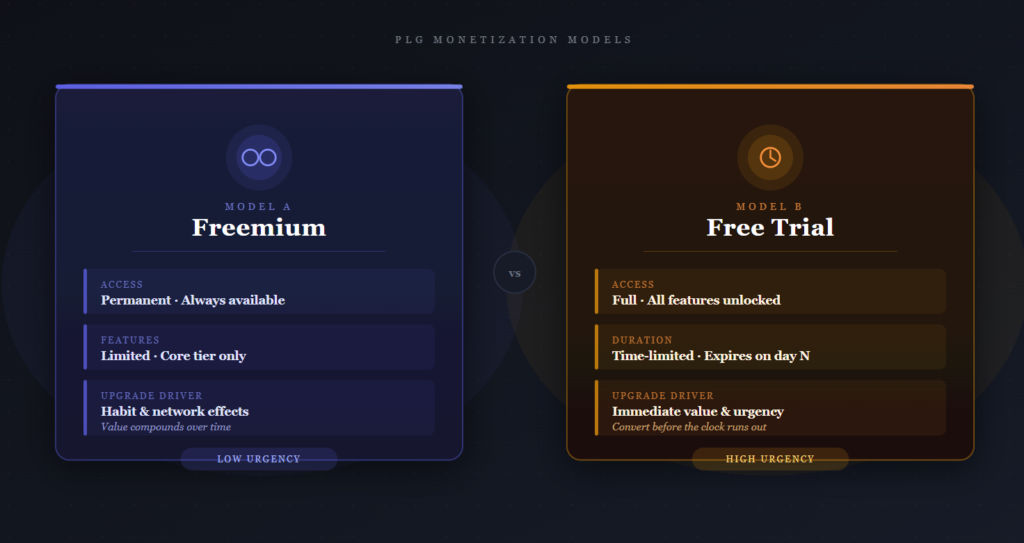
The choice between a freemium model and a free trial comes down to where your product's value is most obvious. Self-service trials give users full access to the product for a limited time, which works well when the product's value is immediately apparent and the upgrade decision is straightforward.
Freemium subscriptions give users permanent access to a limited version, which works better when the product has strong network effects or when users need more time to build habits before they are ready to pay.
The key to making either model work is designing upgrade triggers that feel like a natural next step rather than a paywall. A viral freemium product is one where the free experience is valuable enough to drive word of mouth but limited enough that users who get serious about the product will always find a reason to upgrade.
Freemium and trials are the entry points, but PLG monetization spans four standard models, and many companies combine them:
| Pricing model | How it works | Best fit |
|---|---|---|
| Freemium | Free tier forever, paid tiers unlock more | Network-effect products, long evaluation cycles |
| Free trial | Full access for 7–14 days, then paid | Products whose value shows up fast |
| Usage-based | Price scales with consumption (seats, events, storage) | Products where usage maps cleanly to value |
| Hybrid | Free tier plus usage-based paid tiers, often with sales for enterprise | Most scaled PLG companies end up here |
4. Viral and Organic Growth Loops
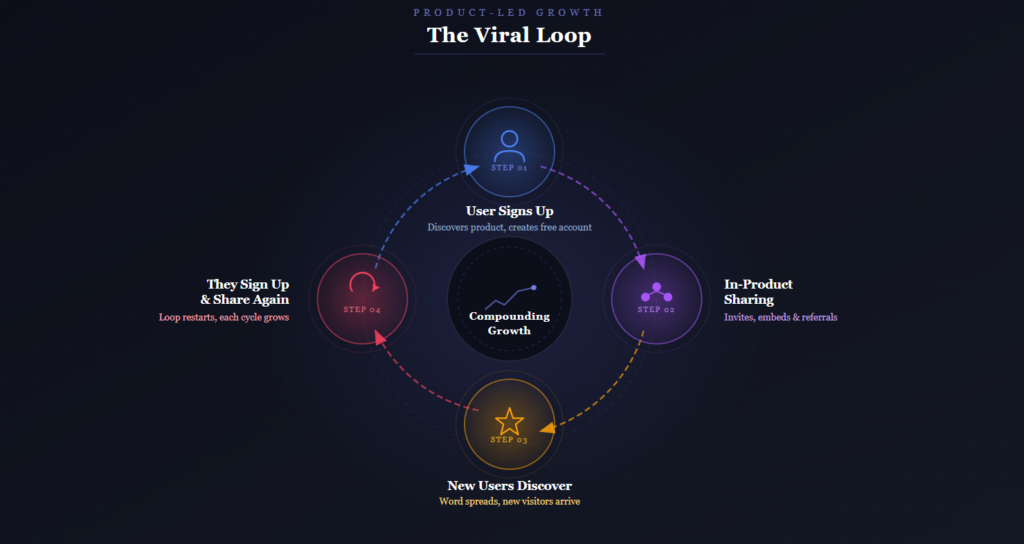
Viral growth loops are built into the product in a way that makes sharing a natural part of using it. When a user shares a document, invites a teammate, or publishes something created with the product, they are exposing it to a new potential user without any marketing spend required.
These growth loops compound over time, meaning each new user has the potential to bring in more users through the same in-product actions.
Brand advocates emerge naturally in products that deliver consistent value, and their word of mouth carries more weight than any paid campaign. Social proof through reviews, case studies, and public usage reinforces this effect by giving new users the confidence to sign up and engage without needing a sales conversation to validate their decision.
5. Customer Success Built Into the Product
In a traditional SaaS model, customer success is a team of people who check in on accounts, run training sessions, and manually guide users toward value. In a PLG model, much of that work is built directly into the product through in-product education, automated guidance, and contextual prompts that respond to what a user is doing in real time.
In-product campaigns triggered by user behavior can nudge users toward features they have not yet tried, re-engage users who have gone quiet, and celebrate milestones that reinforce the habit of using the product.
This automated approach to customer activation does not replace human customer success entirely, but it means the team can focus their time on the accounts that genuinely need hands-on support rather than spending it on tasks the product can handle on its own.
What Are the Key Benefits of Adopting a PLG Approach?
The reason so many SaaS companies are moving toward PLG is not because it is a trend, it is because the business outcomes are measurably better when the product drives growth. From customer acquisition to customer experience, every part of the business performs differently when the product is doing the heavy lifting.
1. Lower Customer Acquisition Costs (CAC)
In a sales-led model, paid media, outbound campaigns, and brand management all require significant and ongoing investment to keep the pipeline full. PLG reduces this dependency by turning the product itself into the acquisition channel.
When users discover the product organically, sign up for free, and convert based on their own experience, the cost of acquiring each new customer drops significantly without sacrificing volume.
2. Higher Customer Retention
Retention in a PLG model is driven by habitual product usage rather than a contract or a relationship with a sales rep. When users stay because the product is embedded in their daily workflow, net revenue churn stays low and Net Dollar Retention grows as users expand their usage over time. The product earns retention every day rather than once at renewal.
3. Faster Scaling
A product-led organization can scale without hiring sales and support teams in proportion to revenue growth. Because the product handles acquisition, onboarding, and a significant portion of retention on its own, the business can grow its user base without the operational overhead that typically comes with scaling a sales-led company.
4. Improved Product Development
PLG generates a continuous stream of behavioral data that shows exactly how users interact with the product, which features they use most, where they drop off, and what drives them to upgrade. This gives product teams clearer signals than surveys or anecdotal user feedback alone, allowing them to prioritize improvements that have a direct impact on activation, retention, and conversion.
5. Increased Customer Lifetime Value (CLTV)
Usage-based billing models, which are common in PLG companies, naturally align revenue with the value a customer gets from the product. As users get more value, they use more, and as they use more, they pay more. This creates a compounding effect where customer lifetime value grows alongside product adoption rather than being capped by a fixed contract negotiated at the start of the relationship.
Examples of Product-Led Growth Companies
The fastest way to make the definition concrete is to look at who runs this model and how:
| Company | Free entry point | What drives the upgrade |
|---|---|---|
| Slack | Free workspace | Message history limit hits once Slack is the team's backbone |
| Dropbox | Free storage tier | Storage limits, plus referral bonuses that spread the product |
| Calendly | Free booking link | Team features; every link sent doubles as a product demo |
| Figma | Free design files | Multiplayer collaboration pulls whole teams in |
| Atlassian (Jira) | Low-cost self-serve plans | Bottom-up team adoption, transparent online checkout |
Each of these companies embeds acquisition in normal product use: sharing a file, sending a link, inviting a teammate. For a deeper breakdown of the mechanics behind each example, see the product-led growth strategy framework.
What Types of Businesses Are Best Suited for a PLG Strategy?
PLG is not a strategy that works equally well for every business. It fits best when the product can demonstrate its value quickly, when users can get started without heavy configuration, and when the customer journey from signup to value is short enough that people do not need a guided sales process to get there.
Below are the types of businesses where PLG tends to work best.
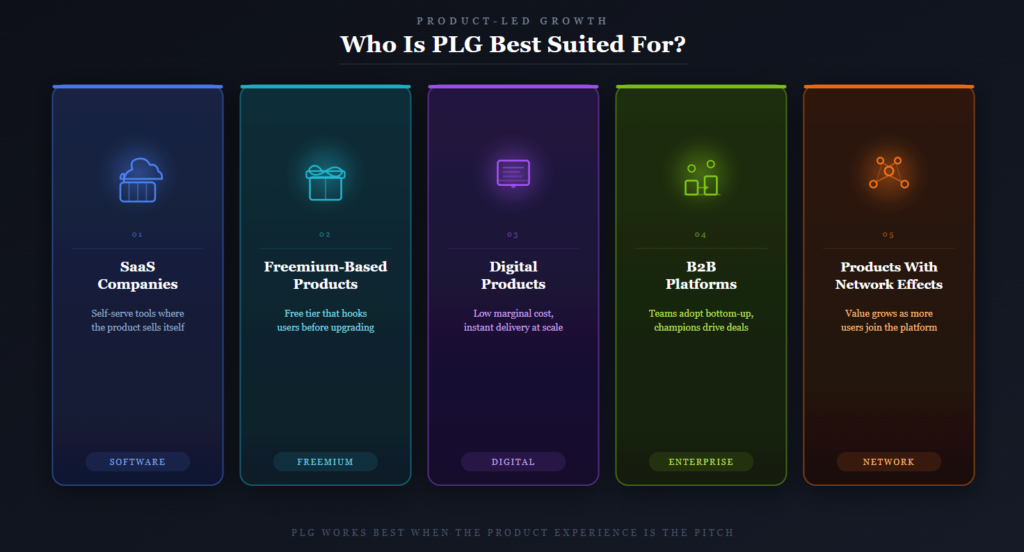
1. SaaS Companies
Subscription-based software-as-a-service businesses are the most natural fit for PLG because the product is delivered digitally, can be accessed instantly, and does not require physical setup or implementation. The recurring revenue model also means that retention and expansion are just as important as user acquisition, which is exactly what PLG is designed to optimize for.
2. Freemium-Based Products
Products that can offer a genuinely useful free tier without giving away the entire business case for upgrading are well positioned for PLG. The free experience drives organic discovery and word of mouth while the paid tier captures users who have already proven through their behavior that they find the product valuable.
3. Digital Products
Any digital product where a user can sign up, explore, and experience core value within a single session is a strong candidate for PLG. The lower the barrier between a new visitor and their first meaningful result, the more effectively the product can drive its own growth without relying on sales or marketing to bridge that gap.
4. B2B Platforms
B2B platforms work well with PLG when the end user and the buyer are different people. An individual contributor discovers the product, uses it, gets value from it, and eventually becomes the internal advocate who pushes for a company-wide subscription. This bottom-up adoption pattern is one of the most reliable user acquisition motions in B2B SaaS.
5. Products With Network Effects
Products that become more valuable as more people use them are particularly well suited to PLG because growth is built into the core product experience. Every new user who joins makes the product better for existing users, which creates a compounding acquisition loop that gets stronger over time without requiring additional marketing spend to sustain it.
Common Challenges When Implementing a PLG Strategy
PLG puts a different kind of pressure on the business than a sales-led model does. Instead of the challenges sitting primarily in the sales org, they spread across product, engineering, support, and leadership. Understanding these challenges before you run into them is what separates companies that execute PLG well from those that adopt the model in name only.
1. Product Development Pressure
In a PLG model, the product is the salesperson, which means it has to be good enough to convert users on its own. This puts enormous pressure on product and engineering teams to continuously improve onboarding, reduce friction, and ship features that drive activation and retention.
The product roadmap can no longer be driven purely by enterprise requests or founder intuition; it has to respond to what the data shows about where users are succeeding and where they are dropping off.
2. Customer Support Demands
When a product is open to anyone through a free tier, the volume of support requests increases significantly. A large share of these users are in the early stages of evaluating the product and need help getting started, but they are not yet paying customers.
Without a scalable support model built around self-serve resources, in-product guidance, and automated responses, support teams can get overwhelmed quickly without a corresponding increase in revenue to justify the cost.
3. Balancing Free and Paid Features
One of the hardest decisions in PLG is deciding what to give away for free and what to put behind a paywall. Give away too little and users never experience enough value to want to upgrade. Give away too much and there is no compelling reason to pay.
Finding this balance requires ongoing experimentation and a clear understanding of which features drive the upgrade decision versus which ones simply make the free experience more comfortable.
4. Attribution and Analytics
PLG growth often comes from organic, word of mouth, and product virality, which are notoriously difficult to attribute to a specific channel or campaign.
Without a solid product analytics infrastructure, it becomes nearly impossible to understand which acquisition channels are driving the highest quality users, where in the product metrics tracking users are finding value, and which behaviors predict conversion.
Tools like Windsor help PLG teams connect data across marketing channels and attribution sources in one place, making it easier to see which efforts are actually driving signups and conversions. Investing in product analytics early is not optional in a PLG model; it is what makes every other decision in the strategy more accurate.
5. Organizational Alignment
PLG requires every team to think differently about their role. Sales teams used to owning the entire buying process have to learn to let the product qualify users before they get involved. Marketing teams have to shift from lead generation to activation and adoption.
Leadership has to be willing to invest in product improvements that drive growth indirectly rather than hiring more salespeople to hit short-term targets. Without this alignment, PLG initiatives stall because the rest of the organization is still optimizing for a different model.
Key Metrics to Measure in a PLG Strategy
In a sales-led model, success is measured by leads generated, deals closed, and pipeline created. PLG shifts the measurement framework toward product usage because that is where the real signal lives.
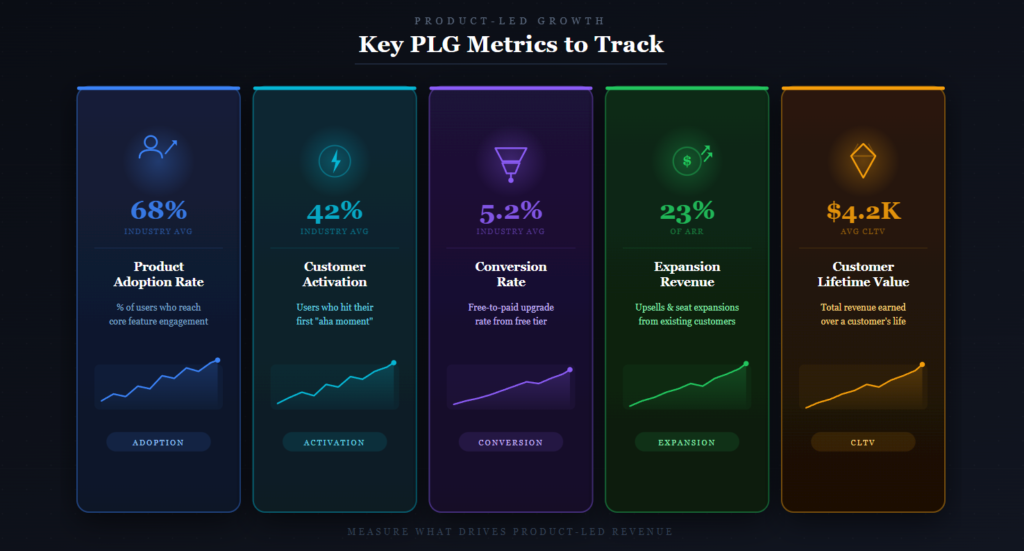
1. Product Adoption Rate
Product adoption rate measures how many users are actively engaging with the product's core features over a given period. It tells you whether users are getting enough value from the product to build a habit around it, which is the foundation everything else in PLG is built on.
A low adoption rate is usually a signal that users are signing up but not finding their way to the features that matter. Fixing this almost always starts with the onboarding experience.
2. Customer Activation
Customer activation measures how many users complete the specific actions that indicate they have experienced the product's core value. These actions vary by product but they are always tied to the moment a user shifts from curious to genuinely engaged.
The initial activation rate is one of the earliest indicators of whether your onboarding is working. If users are signing up but not activating, no amount of marketing spend will fix the underlying problem.
3. Conversion Rate
In PLG, conversion is measured by how many free users become paying customers, and the most reliable predictor of that conversion is product usage. Product-qualified leads are users whose behavior inside the product signals they are ready to buy, making them far more likely to convert than a lead generated through a form fill or a paid ad.
Tracking conversion at the PQL level rather than the MQL level gives sales teams a much sharper view of where to focus their time and energy.
4. Expansion Revenue
Expansion revenue measures how much additional revenue you generate from existing customers through upgrades, seat additions, and plan changes. Net Dollar Retention captures this by showing whether your existing customer base is growing or shrinking in revenue terms, independent of new customer acquisition.
A Net Dollar Retention above 100% means your existing customers are generating more revenue over time, which is one of the strongest indicators of a healthy PLG motion.
5. Customer Lifetime Value (CLTV)
CLTV measures the total revenue a customer generates over the entire duration of their relationship with your product. In a PLG model, CLTV grows as users adopt more features, invite more teammates, and move into higher pricing tiers driven by usage rather than upsell calls.
Tracking CLTV alongside your other growth metrics gives you a complete picture of whether your PLG strategy is building long-term business value or just driving short-term signups.
Best Practices for Implementing a PLG Strategy
Knowing what PLG is and actually executing it well are two different things. The companies that get the most out of a product-led model are the ones that treat it as an ongoing operational discipline rather than a one-time strategic decision. These are the practices that make the biggest difference in practice.
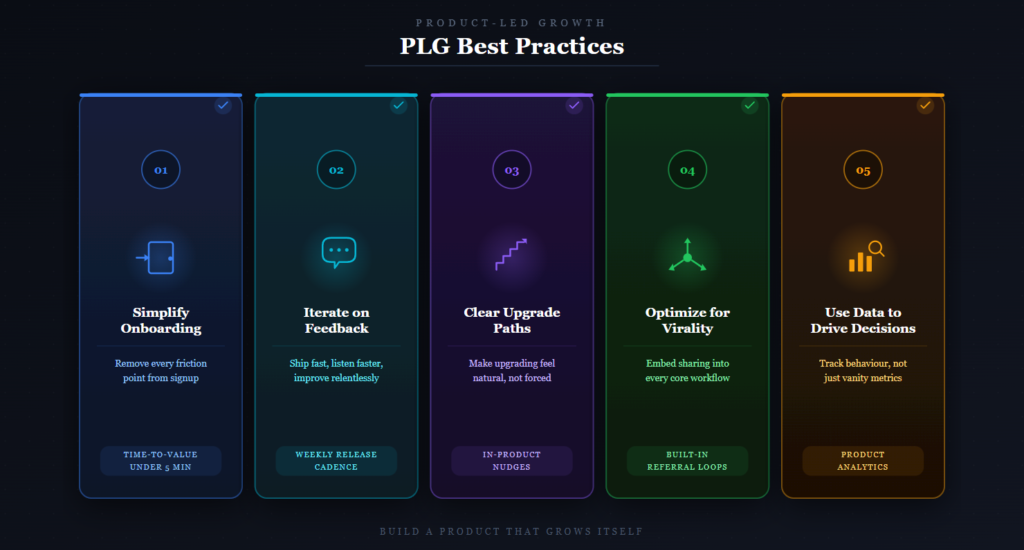
1. Simplify Product Onboarding
The goal of onboarding is not to teach users everything about the product, it is to get them to their first meaningful result as fast as possible. Every step you remove from the setup process is a step closer to activation. Audit your onboarding flow regularly and ask whether each step is genuinely necessary or just something that feels important internally.
2. Iterate Based on User Feedback
User feedback tells you what users think about the product, but behavioral data tells you what they actually do. The most effective PLG teams combine both signals to identify where users are getting stuck and what changes are most likely to improve activation. Treat every product update as a hypothesis and measure its impact before moving on.
3. Offer Clear Upgrade Paths
Users should never have to wonder what they get by upgrading or how to do it. The upgrade path should appear at the exact moment a user hits a limitation or discovers a feature they want access to. No-code solutions for self-serve checkout and plan management make this easier to implement without requiring engineering resources every time.
4. Optimize for Viral Growth
Viral growth is designed into the product through features that make sharing and collaboration a natural part of the user experience. Look for moments where inviting a teammate or sharing an output makes the product more valuable for the person doing the sharing, and make those moments as frictionless as possible.
The goal is to make growth a byproduct of normal product usage rather than a separate referral program.
5. Use Data to Refine Your PLG Strategy
Usage insights are the most reliable guide for improving a PLG strategy over time. Tracking how users move through the product, where they drop off, and what behaviors precede conversion gives you a clear picture of what is working. Without this data, PLG decisions default to guesswork, and guesswork at the product level is expensive to undo.
Conclusion: Is Product-Led Growth Right for Your Business?
Product-led growth is not the right go-to-market strategy for every business, but for the ones it fits, it is one of the most efficient and scalable models available. It works best when the product can demonstrate its value quickly, when users can get started without heavy hand-holding, and when the core experience is strong enough to convert and retain customers on its own.
The most important factor before committing to PLG is product readiness. A product that is difficult to set up, slow to deliver value, or confusing to navigate will not grow itself no matter how well the rest of the strategy is executed. PLG amplifies what is already in the product, which means it rewards companies that invest in the user experience and punishes those that do not.
If your product can get a new user to a meaningful result within their first session, you have the foundation for a PLG strategy. The rest, from onboarding to pricing to expansion, can be built and refined over time as long as that core experience holds up.
Frequently Asked Questions
What does PLG stand for?
PLG stands for product-led growth. It is a go-to-market model in which the product itself, rather than a sales or marketing team, is the primary driver of customer acquisition, activation, retention, and expansion. Users try the product through a free trial or free tier and upgrade once they have experienced its value.
What is PLG in marketing?
In marketing, PLG means the product replaces the traditional lead-generation funnel as the main conversion engine. Instead of optimizing for form fills and demo requests, PLG marketing drives people directly into the product, supports fast onboarding, and nurtures activation, because the product experience is what converts users into customers.
What is the difference between product-led growth and sales-led growth?
In sales-led growth, a sales rep guides prospects through demos, discovery calls, and proposals before they touch the product. In product-led growth, users start in the product self-serve, and buying intent is qualified by their actual usage. Sales steps in only when product signals show an account is ready, typically for expansion or enterprise deals.
What is a PLG company?
A PLG company is a business, usually SaaS, whose growth model is built around self-serve product adoption: free access at the entry point, in-product onboarding and upgrades, and teams that operate on product usage data. Slack, Dropbox, Calendly, Figma, and Atlassian are well-known examples.
When does product-led growth not work?
PLG struggles when a product needs heavy configuration before showing value, when the buyer never uses the product personally, or when time to value is inherently long. In those cases a sales-led or hybrid motion works better, and many companies run PLG for smaller accounts alongside sales for enterprise deals.