 Denzil Otieno
Content Isn’t Education — It’s the Bridge Between Your Product and Its Promise
Information explains problems but doesn't resolve uncertainty. Content converts when it bridges your product to its promise and shows how the outcome becomes real.

Information alone does not create trust.
You can explain a problem clearly and still lose the user. You can teach them how something works and still fail to convince them that your product is the right way forward. Learning is not the same as believing.
This is the gap most content ignores.
Users read, nod along, and leave unchanged because information explains the problem, but it does not resolve uncertainty. It tells them what is possible without showing how that possibility becomes real for them.
That is where content usually breaks.
Your product makes a promise. Better results. Less friction. A clearer outcome. But between that promise and the user’s belief sits doubt. Content that only educates stops short of closing that distance.
Content’s real job is not to teach. It is to translate.
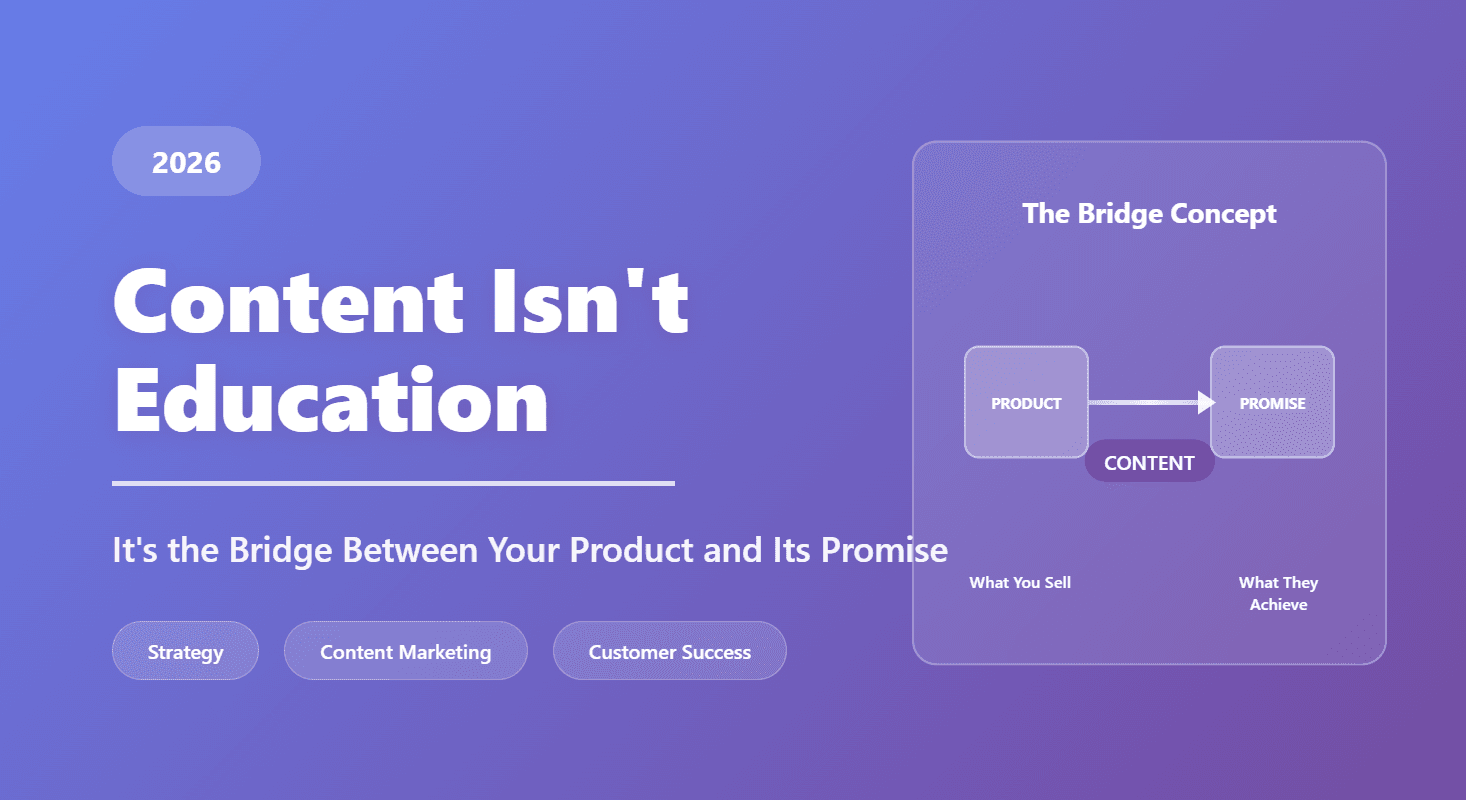
Content needs to show how your product’s promise becomes a real outcome for the user. Not just that change is possible, but how that change actually happens. That is why content works best when it acts as a bridge.
Content is the bridge between your product’s promise and the user’s belief.
When that bridge is missing, users stay on the side of understanding without crossing into trust. When it is built well, choosing your product stops feeling risky and starts feeling reasonable.
This article breaks down how to build that bridge deliberately, using product-led content that turns explanation into confidence and clarity into action.
The Gap Between Your Product’s Promise and User Understanding
Your product makes a promise, whether you state it clearly or not.
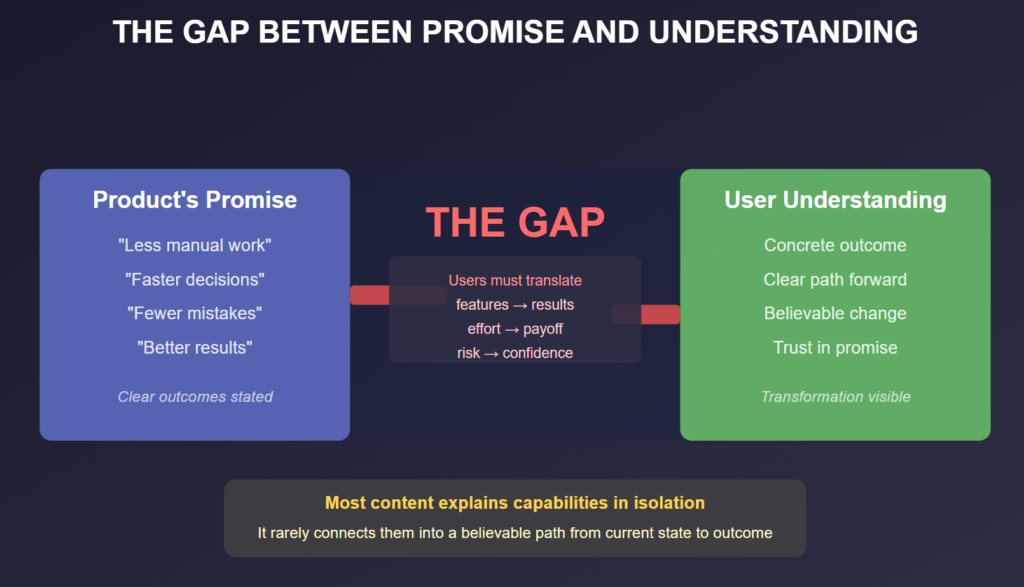
That promise is not the feature list. It is the outcome the user expects after using the product. Less manual work. Faster decisions. Fewer mistakes. Better results. The promise lives in outcomes, not features.
This is where understanding often breaks down.
Users can read your content, understand what the product does, and still hesitate. Not because they are confused, but because they cannot picture the change clearly enough to trust it. They know what the product is. They are unsure what it will do for them.
This hesitation is not irrational. It is protective.
Most content explains capabilities in isolation. It lists benefits, walks through steps, or describes workflows. But it rarely connects those pieces into a believable path from the user’s current state to the promised outcome.
As a result, the promise stays abstract.
Users are left to do the translation themselves. They have to imagine how features turn into results, how effort turns into payoff, and how risk turns into confidence. Many do not make that leap.
This is the real gap.
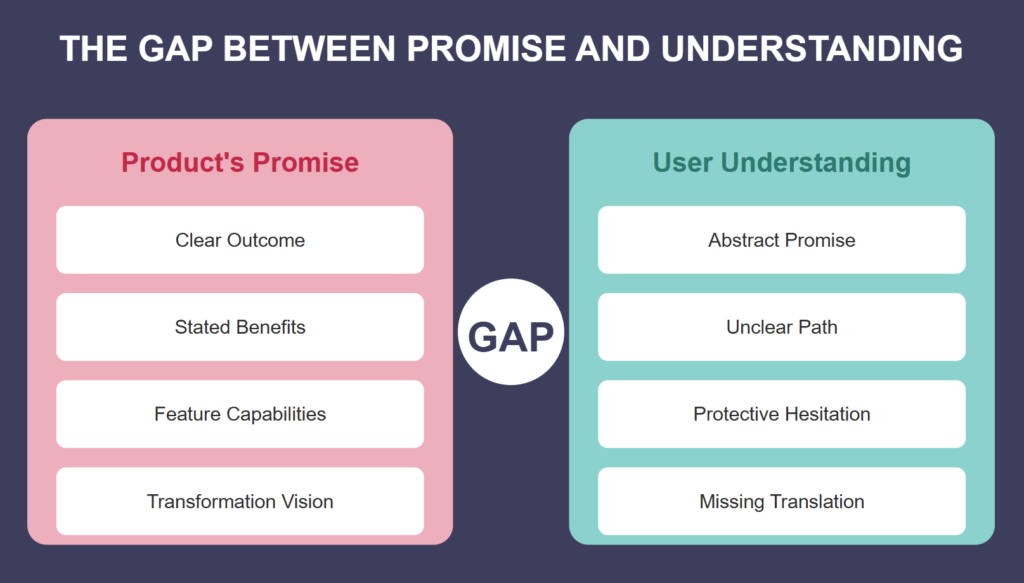
It is not a lack of information. It is a lack of clarity around transformation. Until users can see how the product changes their situation, the promise feels distant, even if it sounds attractive.
Content that closes this gap does not persuade harder.
It explains better.
It makes the outcome feel concrete, the path feel understandable, and the promise feel reachable. That is when understanding turns into belief, and belief turns into action.
Content as a Bridge, Not a Lesson
Once you see the gap, the role of content becomes clear.
Content is not there to teach users everything they need to know. It is there to help them cross from interest to confidence. Content works when it acts as a bridge, not a lesson.
A lesson explains concepts. A bridge moves someone from where they are to where they want to be. That movement is what most content misses.
Your content’s real job is practical.
-
To translate value: Features and benefits only matter when users understand what changes in their day-to-day work. Content should turn product capability into a clear outcome the user can recognize.
-
To reduce uncertainty: Users hesitate when the path feels unclear. Good content shows what happens first, what happens next, and where the product fits. It removes guesswork without overselling.
-
To make outcomes feel reachable: Promises feel real when users can picture themselves getting there. Content should show progress, not perfection. Small wins matter more than big claims.
When content does this well, it stops sounding like education.
It starts feeling like guidance.
And that is when users move forward, not because they were convinced, but because the path finally makes sense.
Why “How-To” Content Isn’t Enough
Instructions explain actions. They do not explain outcomes.
You can tell a user what to do and still fail to change what they believe. This is why how-to content rarely changes behavior on its own. It shows steps without resolving the uncertainty that sits underneath them.
Guidance and understanding are not the same thing.
Guidance tells users what to click. Understanding tells them why it matters. Without that context, instructions feel mechanical. Users may follow along, but they do not gain confidence in the product behind the steps.
This is where trust breaks.
Most how-to content assumes belief already exists. It moves straight into execution without addressing whether the user trusts the promise enough to act. As a result, users can finish the tutorial and still hesitate to commit.
They learned how something works.
They did not learn why it will work for them.
That is the limitation of instruction-led content.
Without showing how actions lead to outcomes, learning stays isolated from belief. And when belief does not change, behavior rarely does either.
What Product-Led Content Actually Does
Product-led content is not louder or more persuasive.
It is clearer.
Instead of pushing users toward a conclusion, it shows them how change happens and lets understanding do the work.
1. It Turns Outcomes Into Steps
Big promises feel distant when users cannot see the path.
Product-led content breaks outcomes into visible steps. It explains what changes first, what follows, and where the product fits in that progression. This turns results from an idea into a process the user can understand.
When the path is clear, the outcome feels achievable.
2. It Makes Value Visible Before Use
Most users hesitate because value is abstract until experienced.
Product-led content makes value visiblebefore activation. It shows how the product behaves in real situations, what decisions it supports, and what problems it removes. Users do not have to imagine the benefit. They can recognize it.
This reduces friction before commitment.
3. It Removes Fear Without Hype
Hype asks for belief. Clarity earns it.
Product-led content reduces fear by explaining tradeoffs, limits, and real use. It replaces vague claims with understandable mechanics. Users trust what they can follow.
When fear drops, choice feels safer.
That is what product-led content does differently.
It does not convince.
It clarifies.
And clarity is what moves users forward.
How to Build Content That Bridges the Gap
If content is the bridge, this is how you build it.
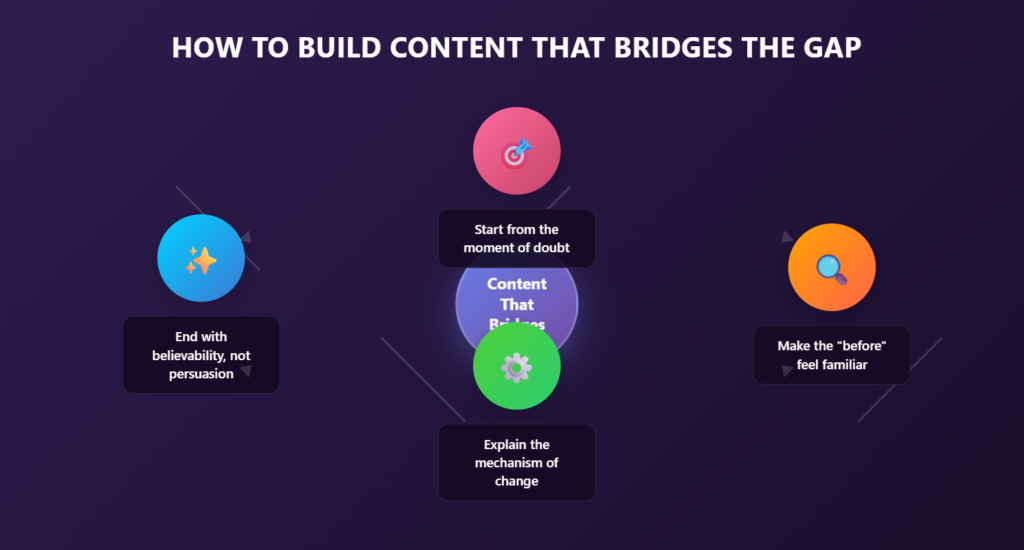
Not with more words. With better sequencing. Each part below removes a specific form of doubt and replaces it with clarity.
Start From the Moment of Doubt
Every user hesitates somewhere.
Your job is to find that moment and write for it. Start where confidence breaks, not where features begin. Ask yourself what the user is unsure about right before they decide to leave, delay, or compare.
Content that starts after doubt has already set in feels late. Content that meets doubt directly feels useful.
Make the “Before” Feel Familiar
Users trust what they recognize.
Describe the “before” clearly enough that the user sees themselves in it. Name the friction, the workaround, the frustration, or the uncertainty they live with today. Do not rush past this.
If the current state does not feel accurate, the promised outcome will not feel believable.
Explain the Mechanism of Change
Promises without mechanics sound like marketing.
Show how change actually happens. What does the product do first? What does it replace? What decisions does it simplify? This is where most content stays vague and loses trust.
When users can follow the mechanism, they stop guessing. Understanding replaces hope.
End With Believability, Not Persuasion
Persuasion asks for agreement. Believability earns it.
Close by reinforcing what now makes sense, not by pushing for action. When the path feels clear and the outcome feels reachable, users move on their own.
This is the system.
Start with doubt.
Ground the present.
Explain the change.
Leave the user confident, not convinced.
That is how content bridges the gap between promise and belief.
Product-Led Stories as SEO and Trust Assets
Trust is the real bottleneck in search.
Users rarely avoid products because they lack information. They hesitate because choosing feels risky. This is where product-led storiesreduce friction in a way generic content cannot.
Product-led stories work because they replace claims with context.
Case studies reduce risk by showing outcomes in real situations. They answer the question users care about most: has this worked for someone like me? By grounding results in decisions, constraints, and tradeoffs, case studies make success feel repeatable, not exceptional.
Feature narratives reduce risk by explaining behavior, not capability. Instead of listing what a feature does, they show how it fits into a workflow and what problem it removes. Users stop guessing how the product might help and start understanding where it fits.
Use-case breakdowns reduce risk by narrowing uncertainty. They focus on a specific scenario and walk through how the product supports it. This helps users self-qualify. They can quickly tell whether the product applies to their situation or not.
Search systems respond to the same signals.
Content that reflects real experience, clear outcomes, and consistent context is safer to reuse in answers. Product-led stories strengthen EEAT by demonstrating experience, not asserting expertise.
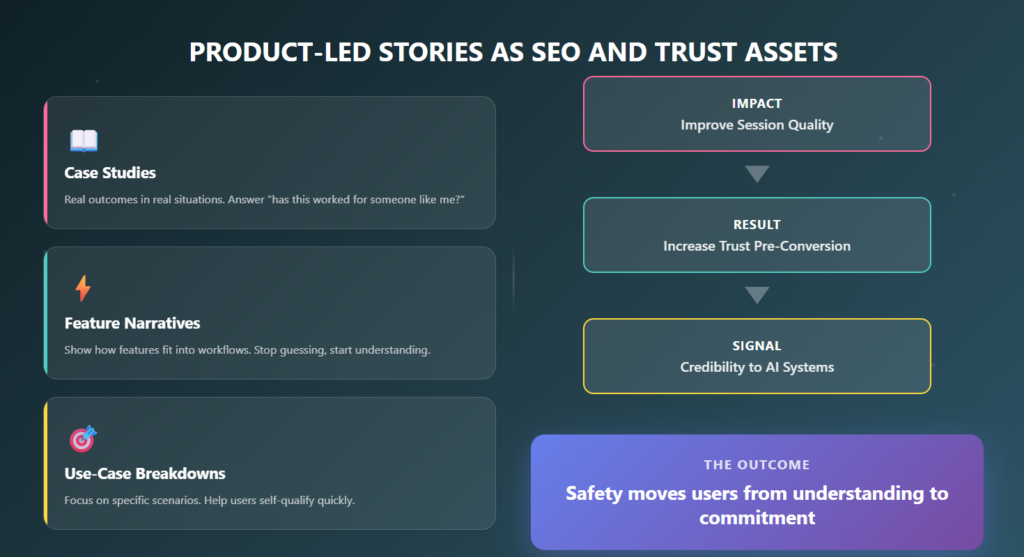
This is why these assets matter for SEO.
They improve session quality.
They increase trust before conversion.
They signal credibility to AI systems selecting sources.
Product-led stories do not persuade harder.
They make choosing feel safer.
And safety is what moves users from understanding to commitment.
Closing — Content Is the Translator of Value
Your product already creates value.
Content decides whether that value is understood.
When content fails, it is not because users lacked information. It is because the connection between promise and outcome was never made clear. The bridge was missing.
Content is the translator between what your product does and what users believe will actually happen.
The cost of not building that bridge is quiet but expensive. Users stay uncertain. Decisions get delayed. Products get compared on surface-level features instead of real outcomes.
Publishing more content does not fix this.
Strategic ownership does.
When you treat content as a system that explains change, reduces risk, and builds belief, it starts doing real work for the business. It stops chasing attention and starts supporting decisions.
That is the difference.
Not more articles.
Not louder messaging.
Content that translates value clearly enough to be trusted.
That is how content earns its place in growth.
Keep reading