 Denzil Otieno
PLG SaaS: A Complete Guide to Product-Led Growth in SaaS Companies
PLG SaaS companies use the product itself as the primary growth engine, driving acquisition, activation, retention, and expansion without a sales-led motion.

Growth in SaaS used to follow a predictable path where you hired sales reps, ran demand generation campaigns, booked demos, and hoped enough of those conversations converted into paying customers. The model worked for a long time, but it was expensive, heavily dependent on headcount, and difficult to scale without proportionally increasing costs.
Product-led growth challenges that assumption by shifting the engine of growth from your sales team to your product itself. Instead of building a motion around the product, you build the growth motion inside it, so the product acquires users, activates them, and expands revenue with far less friction.
This guide covers exactly how PLG SaaS works, the mechanics behind it, the metrics that matter, and how to honestly assess whether it is the right go-to-market strategy for your company.
What Is PLG SaaS?
PLG SaaS refers to subscription-based software-as-a-service companies that use the product itself as the primary engine of growth, rather than relying on traditional sales or marketing motions to drive revenue.
Product-led growth is a go-to-market strategy where the product drives acquisition, activation, retention, and expansion by delivering value early and consistently, without requiring a sales conversation to move users forward.
This model fits naturally in SaaS because users are not making a one-time purchase, they are committing to ongoing engagement, which gives the product repeated opportunities to demonstrate value, deepen adoption, and earn continued investment.
That ongoing relationship is also what separates a product-led organization from a sales-led one, because the product owns the growth motion rather than the sales team driving users toward it from the outside.
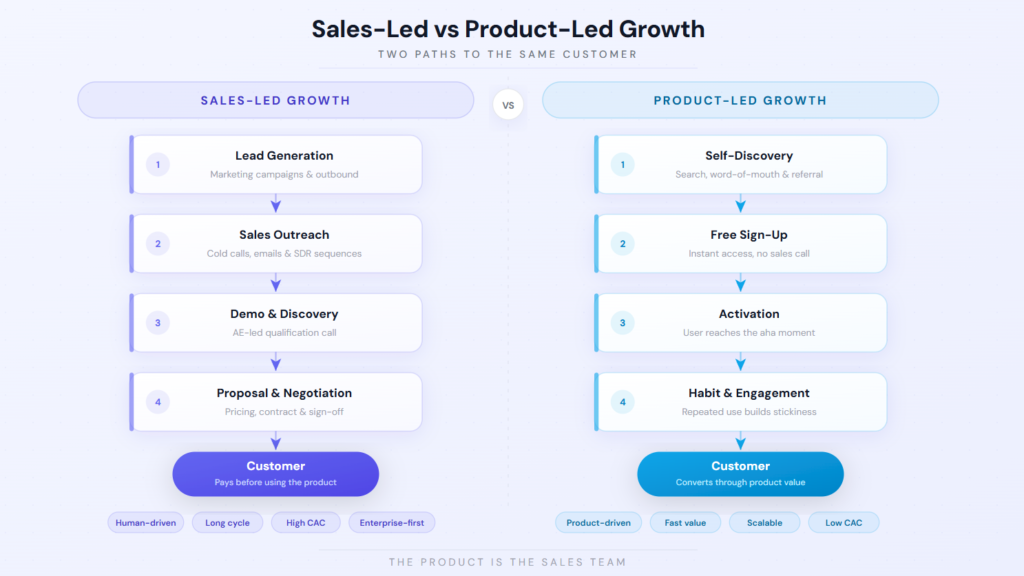
PLG SaaS vs Sales-Led SaaS
The core difference between sales-led growth and product-led growth is where the buying journey begins. In a sales-led model, a prospect fills out a form, books a demo, and experiences the product only after a rep has walked them through it. In a PLG model, the product is the first touchpoint and the experience itself drives the decision to buy.
This changes how leads are defined and qualified. Sales-led teams work with marketing qualified leads, users who have shown interest through content, ads, or campaigns. PLG teams work with product-qualified leads, users who have already tried the product and demonstrated through their behavior that they are ready to convert.
The downstream impact on the sales cycle and customer acquisition costs is significant. When users arrive already activated, sales cycles are shorter, conversion rates are higher, and the cost of acquiring each customer drops because the product is doing work that would otherwise require a full sales motion.
That said, most mature SaaS companies do not sit purely in one camp. Product-led sales is the hybrid approach where PLG handles the initial acquisition and activation, and a sales team steps in to close larger accounts or expand existing ones.
Here is a quick side-by-side comparison:
| Sales-Led | GrowthProduct-Led Growth | |
|---|---|---|
| Entry point | Demo or sales call | Free trial or freemium |
| Lead type | Marketing qualified leads | Product-qualified leads |
| Sales cycle | Longer | Shorter |
| CAC | Higher | Lower |
| Expansion driver | Sales and renewals team | Product usage and value |
The Core Foundations of PLG SaaS
Every PLG SaaS company is built on a set of foundations that determine how well the product can carry the growth motion on its own. Get these right and the entire system compounds, get them wrong and even a great product will struggle to convert and retain users at scale.
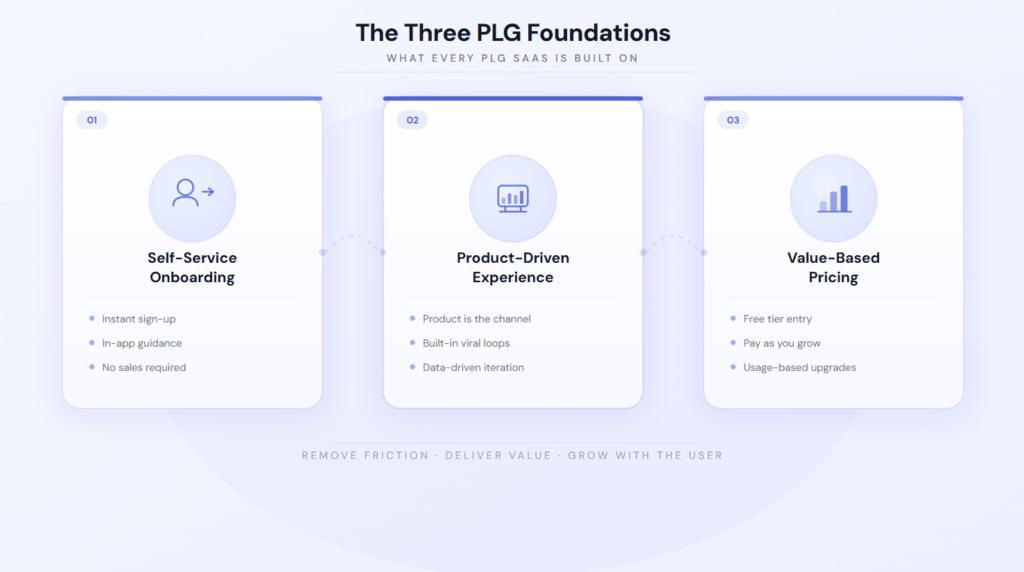
1. Frictionless Self-Service Onboarding
Self-service onboarding is the entry point of every PLG model, and how well it works determines whether users stay or leave before they ever see the product's value. The goal is to get users to that value as fast as possible, with minimal setup, no sales assistance, and no unnecessary friction standing in the way.
The onboarding flow needs to be designed around time-to-value, meaning every step should move the user closer to the moment they realize the product works for them. The longer that journey takes, the more users drop off before the initial activation rate has a chance to build.
Self-service trials let users explore the product on their own terms, while a reverse trial takes a different approach by giving users full access to paid features upfront and then moving them to a free tier when the trial ends. Both formats work, but the right choice depends on how quickly your product can demonstrate meaningful value.
2. Product-Driven User Experience
The user experience in a PLG company is not just a design concern, it is a growth driver. When users find the product intuitive and the value obvious, they engage more, return more often, and are far more likely to convert and expand without any external push.
In-app messaging and contextual guidance play a big role in keeping users moving forward, especially during the early stages when they are still learning the product. Rather than overwhelming users with feature tours, the best product teams deliver targeted nudges at the right moment based on where users actually are in their journey.
A/B tests are how PLG teams consistently improve activation and customer experience over time. Small changes to onboarding steps, messaging timing, or feature visibility can have an outsized impact on how many users reach their first meaningful moment with the product.
3. Value-Based Pricing and Monetization
Pricing in a PLG model is not about packaging features, it is about aligning cost directly with the value propositions users are already experiencing. When users understand exactly what they are paying for and why it matters to them, the path from free to paid becomes much shorter.
The freemium model and the free trial are the two most common entry points, and they serve different purposes. Freemium subscriptions keep users in the product indefinitely on a limited tier, building habit and dependency over time, while a free trial creates urgency by putting a time limit on full access.
Usage-based billing takes this further by tying cost directly to consumption, so users pay more as they get more value and less when they do not. This model lowers the barrier to entry, reduces the risk users feel when signing up, and naturally expands revenue as accounts grow.
How the PLG SaaS Growth Engine Drives Acquisition, Activation and Retention
A PLG growth engine works because each stage feeds the next, with acquisition creating the users who activate, activated users driving retention, and retained users expanding revenue and pulling in new ones. Understanding how these three stages connect is what separates teams that scale predictably from those that optimize each stage in isolation.
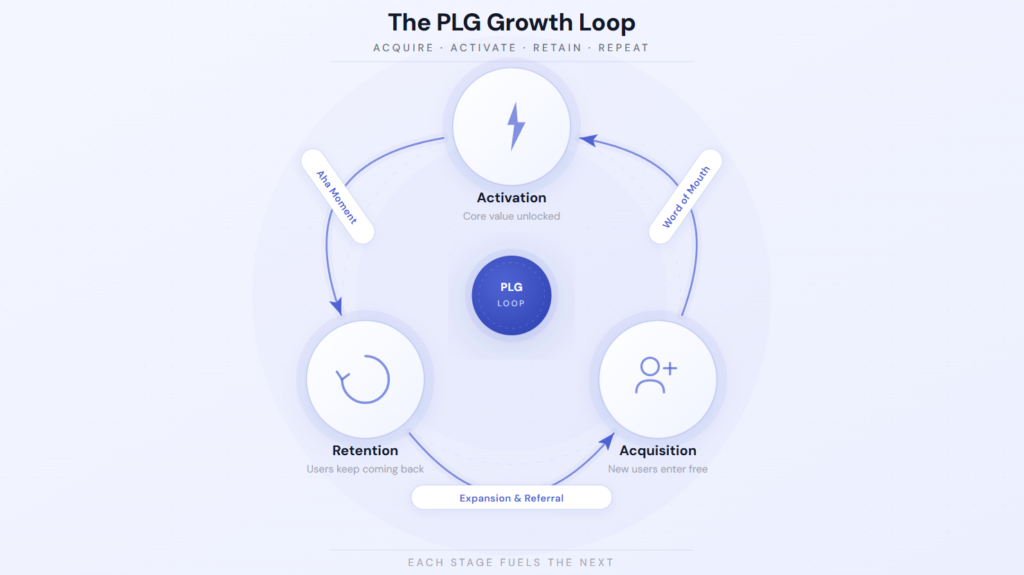
User Acquisition Through Product Value
In a PLG model, user acquisition happens because the product delivers an experience worth sharing, and that experience becomes the primary demand generation channel. Users discover the product through other users, reducing the dependence on paid campaigns and outbound sales to fill the top of the funnel.
This is where viral growth loops come in. When a user invites a colleague, shares an output, or simply talks about the product, they pull new users in organically, and those users repeat the same cycle. The stronger the loop, the more customer acquisition compounds over time without a proportional increase in spend.
Brand advocates and social proof accelerate this further by giving prospective users real validation from people already inside the product. A strong growth loop powered by genuine product value is one of the most durable acquisition advantages a SaaS company can build.
Customer Activation and Product Adoption
Customer activation is the moment a user experiences enough value to commit to the product, and everything in the PLG model is designed to get users there as efficiently as possible. That moment, often called the "aha moment," is the clearest signal that onboarding has worked and the user is genuinely engaged.
From there, product adoption rate measures how deeply and consistently users are building the product into their workflows. Teams that track behavioral data and usage insights can identify exactly where adoption accelerates, where it stalls, and what actions separate users who stay from those who churn.
Product metrics tracking turns those signals into action. When product teams can see which behaviors predict long-term retention, they can redesign onboarding, adjust in-app guidance, and prioritize features that drive users toward deeper adoption faster.
Retention and Expansion Revenue
Retention in PLG is measured by how much revenue stays and grows, not just how many users remain active. Net revenue churn captures what is lost from downgrades and cancellations, while Net Dollar Retention shows the full picture by factoring in the expansion revenue generated from upgrades, upsells, and cross-sells within the existing customer base.
When NDR sits above 100%, the existing customer base is growing on its own, which means revenue growth does not depend entirely on new customer acquisition. That dynamic is one of the clearest signs that a PLG model is working as intended.
Customer Lifetime Value extends this view further by showing the total revenue a customer generates over their entire relationship with the product. In a healthy PLG SaaS company, CLTV grows as users expand their usage naturally, driven by the product delivering increasing value over time rather than a sales team pushing upsells manually.
Advanced PLG SaaS Models for Enterprise Growth and Smarter Analytics
As a PLG motion matures, the natural next step is extending it into enterprise accounts and building the analytics infrastructure that makes growth predictable rather than reactive. These two moves, combining sales with product and grounding decisions in data, are what separate early-stage PLG experiments from companies that scale it into a repeatable system.
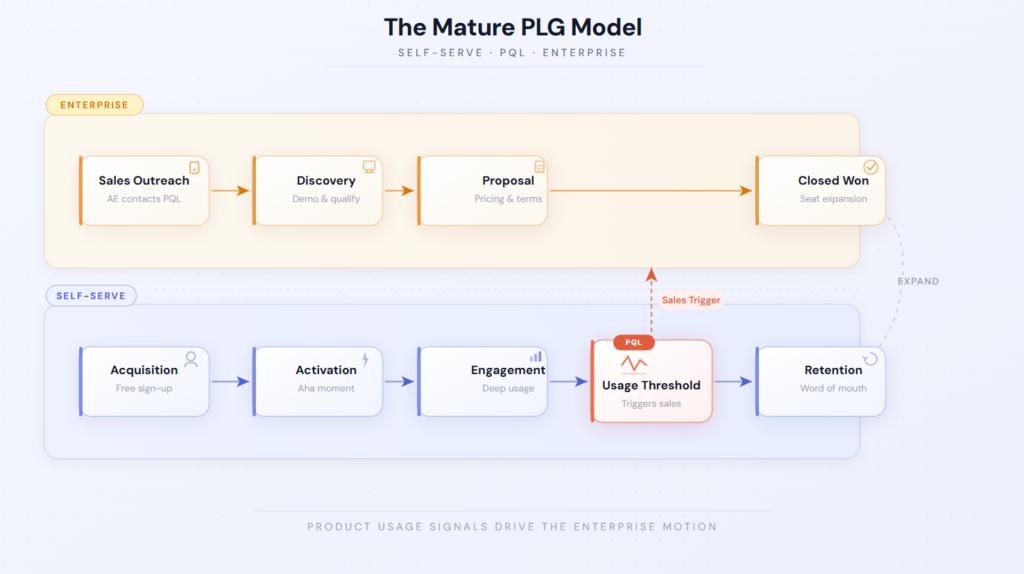
Hybrid PLG + Sales Approaches
Hybrid PLG models combine the self-serve efficiency of product-led growth with the relationship depth of a sales team, and for many SaaS companies this is where the most sustainable growth happens. The product handles acquisition and activation while sales focuses on accounts that show the highest expansion potential.
Product-led sales works by using product behavior as the trigger for sales outreach rather than relying on form fills or marketing campaigns. When a product-qualified lead inside an enterprise account reaches a certain usage threshold, that is the signal for a sales rep to engage, not a cold outreach sequence.
Enterprise sales in a PLG context is less about convincing and more about accelerating a decision that the product has already started. Adapting PLG for larger accounts means layering in the right go-to-market activities, such as security reviews, procurement support, and executive alignment, on top of a product experience that has already proven its value.
Leveraging Product Analytics for Predictable Growth
Product analytics gives PLG teams the visibility to understand what users are doing inside the product, where they are dropping off, and which behaviors predict long-term retention and expansion. Without this infrastructure, growth decisions are based on assumptions rather than signals.
A strong product analytics infrastructure connects behavioral data, revenue data, and the customer journey into a single coherent view, so teams can identify predictive expansion signals before an account churns or before an upsell opportunity is missed. This is where tools like Windsor.ai become valuable, pulling data from 325+ sources into one place so PLG teams can track growth metrics across the entire funnel without stitching spreadsheets together manually.
Building this foundation early means the entire growth engine becomes more predictable over time, because decisions around activation, retention, and expansion are grounded in real usage patterns rather than gut feel.
How to Operationalize PLG in Your SaaS Company
Operationalizing PLG means building the internal structure, roles, and tools that allow the product-led motion to run consistently rather than relying on individual heroics or one-off experiments. It is the difference between a company that practices PLG and one that is genuinely built around it.
Building a Product-Led Organization
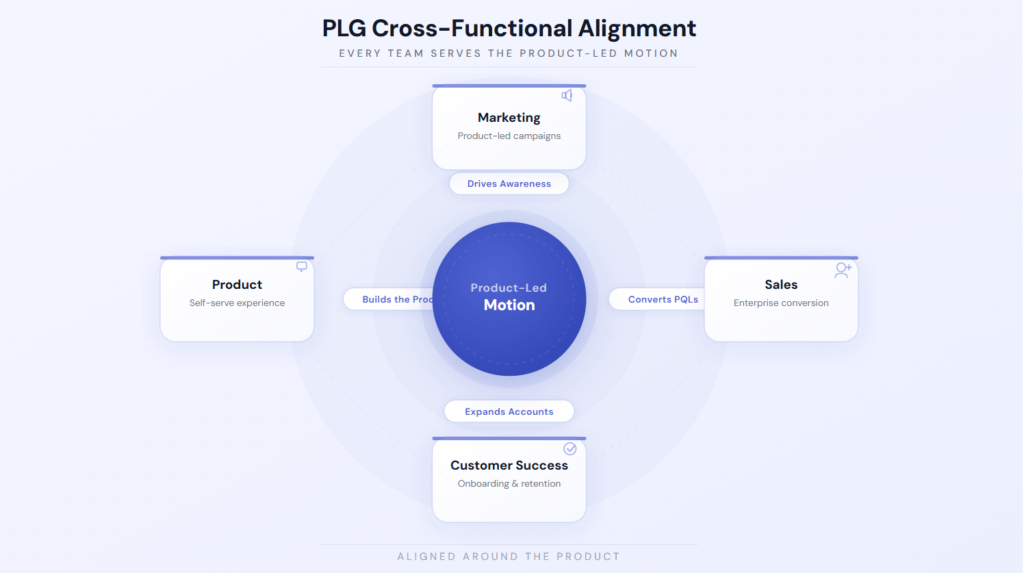
A product-led organization succeeds when product, sales and marketing, and Customer Success are all working from the same understanding of how the product creates value. When these teams operate in silos, the user experience becomes inconsistent and growth stalls at the exact points where alignment should be strongest.
Product management sits at the center of this motion, owning the roadmap decisions that directly impact acquisition, activation, and retention. As PLG matures, roles across the organization evolve to reflect this, with Customer Success shifting from reactive support toward proactive expansion, and sales focusing on accounts the product has already warmed up.
Cross-functional alignment is what keeps this working at scale. Teams need shared metrics, shared visibility into user behavior, and a shared definition of what a successful customer looks like at every stage of the journey.
Tools and Technology Stack for PLG SaaS
The right tools give PLG teams the infrastructure to experiment, measure, and act on what users are actually doing inside the product. Product analytics platforms form the backbone of this stack, tracking behavior, surfacing drop-off points, and connecting usage patterns to revenue outcomes.
In-product campaigns and communication tools allow teams to deliver contextual guidance, upgrade prompts, and onboarding nudges directly inside the product experience rather than relying on email sequences that users ignore. Unified data platforms bring behavioral, demographic, and revenue data together from hundreds of sources so every team is working from the same source of truth.
No-code solutions for experimentation give product and growth teams the ability to test changes, run flows, and iterate on the user experience without waiting on engineering resources, which is critical for maintaining the speed that PLG demands.
Measuring True PLG SaaS Performance
The metrics that matter in PLG are the ones tied directly to how the product moves users from discovery to revenue. Growth metrics built around vanity numbers like page views or signups tell you very little about whether your PLG motion is actually working.
The core metrics every PLG SaaS team should track are:
- Initial activation rate: the percentage of new users who reach a meaningful first moment of value inside the product
- Conversion rate: how many free or trial users cross over into a paying plan
- Net Dollar Retention: whether your existing customer base is growing, shrinking, or holding steady over time
- Viral coefficient: also known as the K-factor, this measures how many new users each existing user brings in organically
- PLG Index: a composite signal that combines activation, retention, and expansion data to give a broader view of PLG health
These metrics work together rather than in isolation. A high activation rate with low conversion points to a pricing or value communication problem, while strong conversion with poor Net Dollar Retention suggests the product is not delivering enough ongoing value to justify continued spend.
Common Challenges in PLG SaaS
Scaling a PLG model comes with a specific set of problems that most teams only discover after they are already inside them. Understanding these challenges early makes the difference between a growth engine that compounds and one that creates operational drag.
The most common ones PLG teams run into are:
- Balancing free vs paid features: giving away too much reduces upgrade incentive, while giving away too little prevents users from experiencing enough value to convert
- Support load: a large free user base generates significant customer support demand from users who may never pay, which strains resources if not planned for early
- Attribution complexity: in PLG, users touch multiple channels before converting, making it difficult to accurately attribute revenue and optimize spend without the right data infrastructure
- Scaling product teams: as the product becomes the primary growth driver, product management and engineering teams face increasing pressure to ship faster without compromising the customer experience
- Enterprise security and compliance: moving upmarket with a PLG motion means meeting security and compliance requirements that self-serve products are rarely built for from the start, which slows down enterprise sales cycles significantly
None of these challenges are reasons to avoid PLG, but they are reasons to plan for it with the same rigor you would apply to any other growth motion.
Is PLG SaaS the Right Model for Your Company?
PLG SaaS works best when your product can deliver meaningful value quickly, without requiring a long implementation process or significant hand-holding to get users to their first win. If a new user can sign up, explore, and experience something genuinely useful within minutes, the foundation for a product-led motion is already there.
A go-to-market strategy built purely around PLG tends to work best for:
- Products with a short time-to-value where users can self-serve from day one
- Tools that naturally spread within teams or organizations through usage
- Companies targeting a broad user base where high-touch sales would be too expensive to scale
When the deal size is larger, the buying process involves multiple stakeholders, or the product requires significant configuration, a hybrid model is usually the stronger choice. PLG handles the initial motion and builds product familiarity across the organization, while sales steps in to close, expand, and manage the relationship at the account level.
The honest strategic readiness question is whether your product can carry the weight of the growth motion on its own. If users need significant guidance to reach value, if the product experience has meaningful gaps, or if your pricing structure does not support self-serve conversion, investing in those areas before going all-in on PLG SaaS will produce far better results than the strategy itself ever could.