 Denzil Otieno
How to Make Product Value Visible in the First 10 Minutes
Users decide in their first session whether a product is worth returning to. Make value visible in the first 10 minutes by showing a clear outcome right after each action.


Most products lose users because value is not visible early.
The first session is where users decide whether a product is worth returning to. That decision is not driven by explanations or feature tours. It is driven by evidence. Users look for a clear change connected to the reason they signed up.
The first 10 minutes decide whether that evidence shows up.
In this window, users are not trying to understand everything the product can do. They are testing one thing: did my action produce a result I care about? If nothing changes in a way they can clearly recognize, the product stays unproven.
Unproven products are easy to leave.
This is why activation fails even when onboarding is complete. Users follow steps, but they do not see outcomes. Progress may exist inside the system, but it is hidden from the user.
Making product value visible in the first 10 minutes means showing a clear outcome immediately after action. When users can see what changed and why it matters, continuing is no longer a hope. It becomes a decision.
Why the First 10 Minutes Shape Perceived Product Value
Product activation in SaaS is decided early, before users understand the product in full.
The first interaction shows whether the product moves the user toward the goal they came in with. The result that appears next becomes the reference point they use to decide whether the product is worth continuing with, and later experiences are judged against it.
During this session, users pay attention to what happens after their first meaningful action, like filling out a form or taking a free trial. They look for a visible step toward the goal that brought them in, not a tour of everything the product offers.
A well-designed product makes it easier to see that step, but it cannot replace the need for a clear result. While a polished interface reduces friction, perceived value comes from users seeing a meaningful change.
Time matters because delay breaks the connection between the user’s first action and the result they expect. When that result does not appear quickly, confidence drops before their trust can form.
Seeing a meaningful result early builds confidence. Seeing it late creates doubt. In the first 10 minutes, usefulness has to be demonstrated through results.
Early Drop-Off Reflects Missing Value Signals
When value is not visible early, drop-off follows a clear pattern.
Drop-off starts when early actions do not lead to visible progress.
Users leave when early interactions fail to produce a visible step toward the goal that brought them in. Without that signal, continuing to use the product feels unjustified.
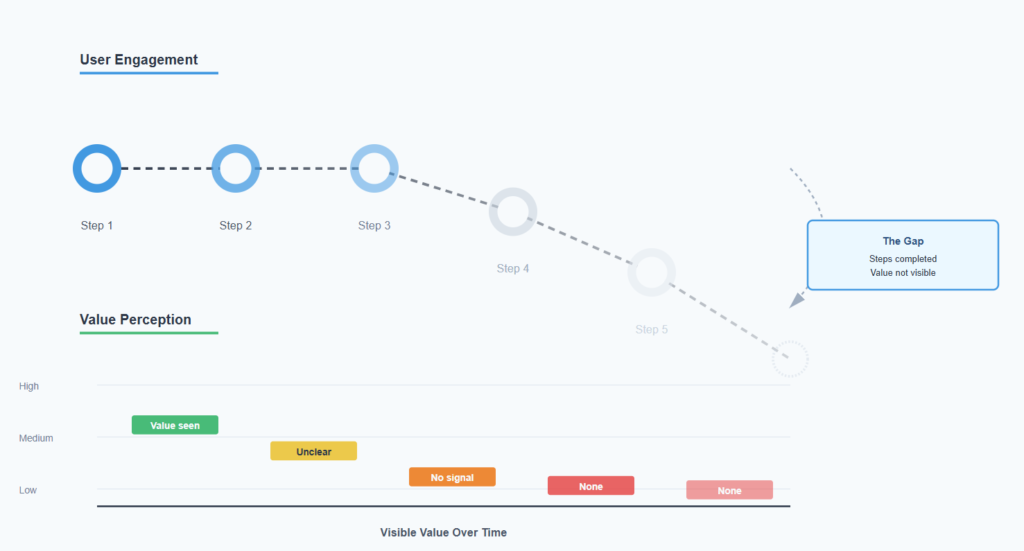
Setup Activity Without Outcome
Many onboarding flows walk users through setup steps that do not lead to any noticeable change.
Users complete actions, adjust settings, and move forward, but nothing improves in a way they can clearly recognize. The product records progress, while the user sees no result.
This creates a misleading sense of progress for the team. Users finish setup having followed the steps, but they do not see any progress toward their goal.
Guidance Without Momentum
Clear instructions help users follow steps, but they do not make progress visible.
Progress becomes visible only when a user sees a clear change after taking an action. If completing a step does not produce an observable improvement, the instruction feels disconnected from any result.
When onboarding focuses on explaining steps instead of producing an early change, users complete actions without seeing any result. Even with clear guidance and good usability, drop-off increases because actions never lead to visible progress.
How Users Evaluate Progress in the First Session
Users evaluate progress by looking for change tied to their goal.
Early in the session, users check whether taking an action produces a visible step toward their goal. They are looking for proof that the product can improve their situation through the actions they take, not through what features the product offers.
Fit is assessed through relevance to the user’s goal. Users look at the result of their action and ask whether it addresses the problem that brought them in and whether it reflects their context. Generic improvement is not enough.
Visible change matters because it answers that question. When users can see what improved after their action, they no longer need to guess whether the product fits their problem.
When actions repeatedly fail to move users closer to their goal, they stop expecting the product to help and decide to leave.
The first session works when users can see progress toward the goal they came in with. When that progress is missing, they leave before the product has a chance to prove its value.
Common Patterns That Delay Early Value
Early value is delayed in predictable ways that repeat across products and onboarding flows, even when usability is strong.
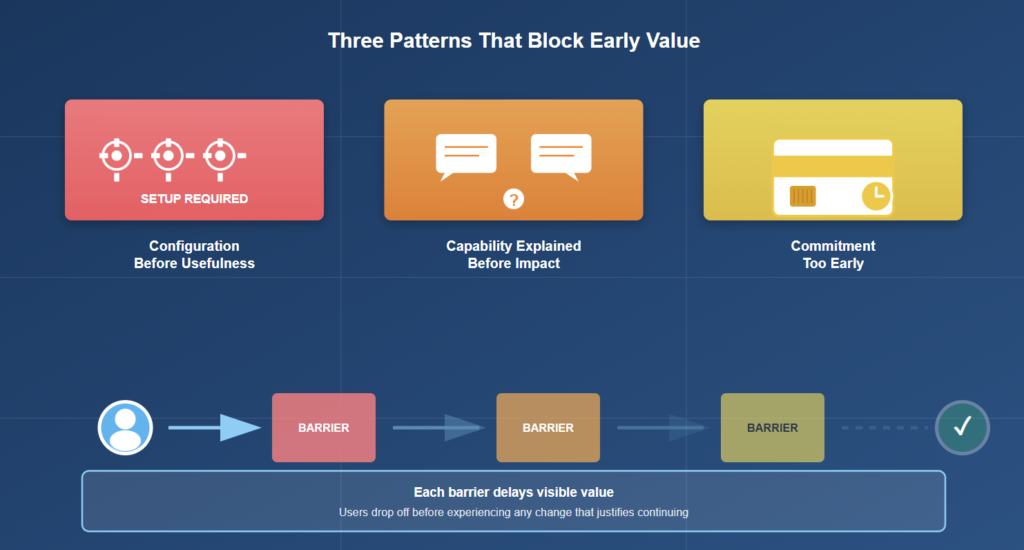
1. Configuration Before Usefulness
Many products start onboarding by asking users to complete setup before they are guaranteed any change toward their goal.
Users are prompted to create profiles, choose settings, connect tools they already use, import data, or define preferences. These steps require effort, but they do not change the user’s situation in any noticeable way.
This sequence interferes with the user’s decision to keep going. Users finish setup without seeing any change that proves their effort is paying off. When their actions do not lead to a visible outcome, they conclude the product may not be worth continuing with.
Capability Explained Before Impact
Some products explain what they can do before showing what actually improves.
Users are shown feature descriptions, tours, or tooltips that outline capability, but nothing changes as a result of interacting with them, leaving users with an understanding of what the product could do rather than a result they can see.
If users take action and nothing changes, explanations do not matter.
Commitment Requested Too Early
Products ask for commitment before users see any change tied to the problem they came to solve.
They prompt users to upgrade, invite teammates, or invest more time before anything has changed for them. These requests introduce friction while users are still deciding whether the product is worth the effort.
Without seeing any change after completing setup or early actions, users have no reason to commit further, which makes even small requests feel premature.
What “Visible Value” Means During Early Use
Product value visibility means making change observable.
Product value visibility means showing a clear change after a user takes their first meaningful action toward the problem they signed up to solve. That change should show that the product moved them closer to the outcome they came for.
Early value only matters when the change users see is tied to the reason they signed up. Movement inside the product does not count unless it brings them closer to the outcome they came for, because progress that is generic or disconnected does not establish relevance.
For early value to be clear, the change has to be explicit. Users should not have to infer progress from secondary signals or interpret messages to understand what improved; the product needs to show what changed after the user’s action and how that change moves them closer to the outcome they came for.
When the product clearly shows the result of the user’s last action, such as data appearing or a task completing, the user knows their effort led somewhere, which makes continuing feel reasonable.
Designing Early Use Around Outcomes
Reducing time to value requires rethinking what the first session is designed to accomplish.
Many SaaS onboarding flows are organized around completeness. Steps are sequenced to introduce features, gather information, and prepare the system. That approach moves users through the product, but it does not guarantee they will see a result early.
Designing around outcomes changes the organizing principle of early use. Instead of asking what the user needs to set up or learn, the product asks what result it can surface first. The goal of the first session is not coverage, but proof that the product can produce a meaningful outcome.
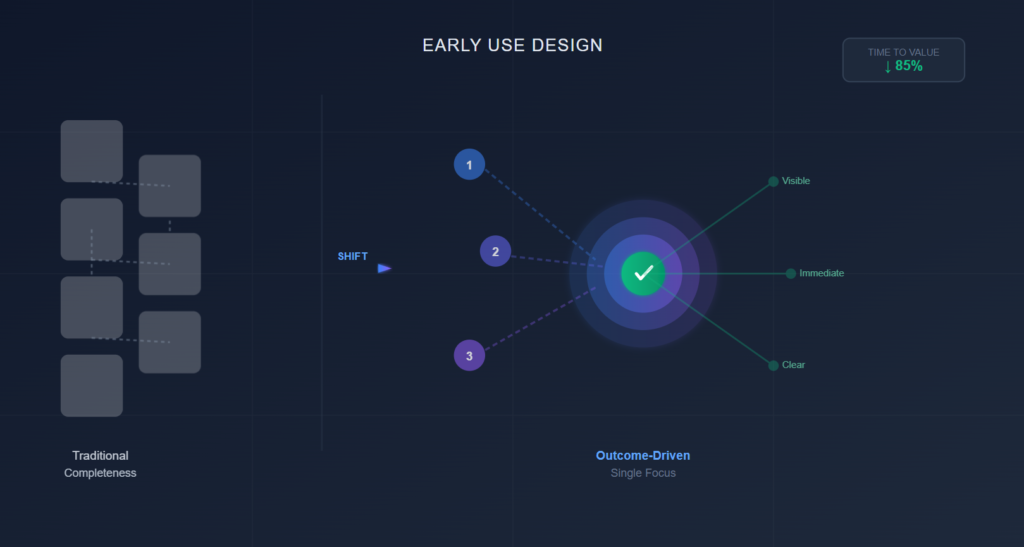
Anchoring the Session to a Single Outcome
Early use works best when it is anchored to one clear outcome the user can recognize.
Choosing a single outcome focuses attention and effort because it gives the user something concrete to evaluate. Instead of wondering whether the product is generally useful, the user can judge whether it delivered the specific result they came for.
Value becomes harder to spot when everything is introduced at once. A focused outcome stands out, creates a clear reference point, and allows the user to decide quickly whether the product is worth continuing with.
Sequencing Actions to Reveal Impact
Actions in the first session should be ordered by how quickly they produce a visible change.
Steps that create a noticeable result for the user belong first, while steps that only prepare the system can wait. If an action does not change what the user can see or do, it does not earn a place in the first 10 minutes.
This prioritization directly shortens time to value by ensuring users encounter visible improvements within minutes rather than after lengthy setup, allowing them to understand the product's benefit immediately and adopt it faster.
Signals That Early Value Is Not Clear
When early value is unclear, it shows up in how users behave.
An activation audit should focus on what users do during the first session and whether they return afterward. The signals below appear when interaction happens without a perceived payoff:
- Users complete onboarding but do not return
- Activation events occur late in the session, after extended exploration
- Users browse features without committing to a core action
- Repeated questions surface around what the product actually does
These signals point to the same issue: users went through the product and completed actions, but they did not see a change that made continued use feel justified, because the results of their interaction never became clear.
Making Value Clear Without Over-Explaining
Value becomes clear when the product shows results before it explains itself.
Explanation alone does not answer the question users care about. They can understand how a product works and still wonder whether it helps them. Clarity comes from seeing a direct link between what they did and what changed.
That is why outcomes need to appear before mechanics. When a user takes an action and immediately sees a change, the product demonstrates its usefulness before describing how it works. Explanation becomes easier to absorb once value is visible.
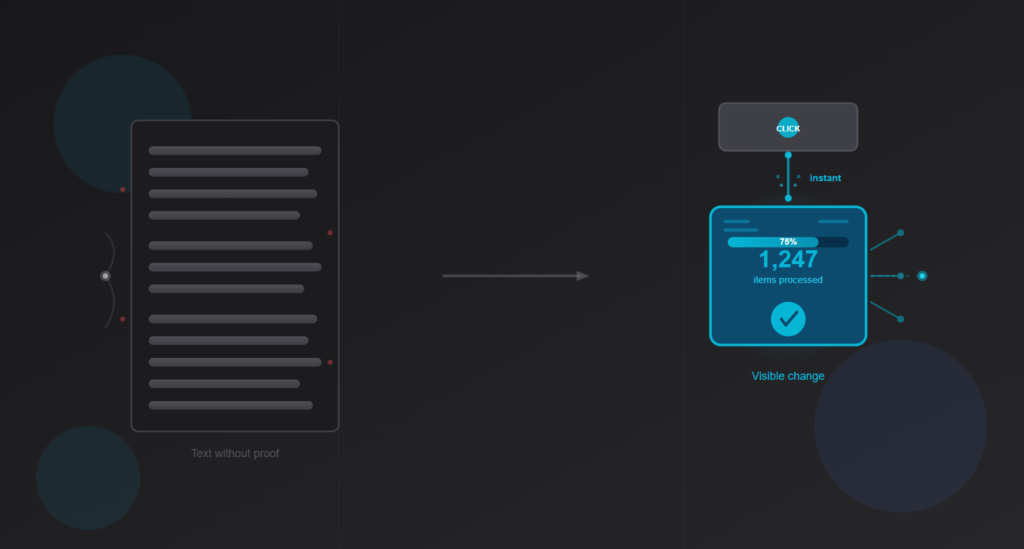
This means the product's behavior should do most of the communication. Changes in state, visible movement toward a goal, or newly unlocked capability show relevance through what happens, not through what the product claims.
In the first session, cues matter more than copy because users are watching for change; visual confirmation or immediate results reduce uncertainty faster than text ever could.
Value is clear when users can see the result of their action without needing to be told what happened. Once outcomes lead the experience, explanation no longer has to prove anything. It becomes optional reinforcement rather than required justification.
The Role of the First 10 Minutes in Activation
The first 10 minutes decide whether a product earns continued use.
During this window, early interaction acts as proof. Users do not need a full tour or a complete understanding of the product. They are looking for evidence that what they just did led to a meaningful change in their situation.
That evidence is what drives continuation. When users can see progress toward the goal that brought them in, uncertainty fades and returning makes sense. When no such signal appears, activation stalls even if the experience is polished and easy to use.
This changes how activation success should be measured. Completion rates, setup progress, and feature exposure matter less than whether users can point to what changed after their first session. If nothing stands out as different, activation has not actually happened.
The first session is also a commitment moment. Once users see value, coming back becomes a rational choice rather than a hopeful one. The product stops feeling like something to try and starts feeling like something worth investing time in.
Keep reading