 Denzil Otieno
Turning Product Insight into a Founder Narrative That Sells
A framework for turning product insight into a founder narrative that sells: four narrative types, where to deploy them, and the mistakes that break belief.


Did you know that products don’t actually sell themselves?
Okay, that’s not entirely true.
They do sell themselves.
Just not in the way founders wish they did.
The tech world keeps repeating a quiet lie: if the features are strong enough, the market will eventually figure it out.
And that if you ship faster, add one more integration, one more feature, then people will suddenly connect the dots and say, “Ah yes. This is what I need."
The honest truth is: They won’t!
People don’t buy features first.
They buy meaning.
Then use the features to justify a decision they’ve already made.
And the space between what a product does and what it means is where the founder narrative lives.
A founder narrative captures the moment personal experience meets product insight. It explains why a problem mattered enough to solve, what you noticed others missed, and how that insight became something customers can feel in their daily work or business.
This isn’t a nice-to-have.
Stories change outcomes in measurable ways. Research from Stanford shows that people are up to 22 times more likely to remember information when it’s delivered as a story rather than isolated facts.
Which means your roadmap slide, feature list, or pricing page isn’t competing with better copy. It’s competing with how the human brain is wired.
It gets more uncomfortable from there.
Data from Electro IQ shows storytelling can increase conversion rates by up to 30% and improve product perception by more than 2700%, simply by changing how people understand the product.
That’s the gap most founders overlook.
Insight builds understanding.
Narrative turns that understanding into relevance.
Once insight enters someone else’s world, it gains context. It feels connected to their work, their day, their decisions. That alignment follows how the brain builds trust, retains meaning, and decides what stays memorable.
And that’s where the real advantage shows up.
The Psychology and Data Behind Why Stories Work
Stories follow the brain’s default settings.
That’s what the next section unpacks.
The Human Brain is Wired for Narrative
When someone hears a list of facts, the brain shifts into triage.
What matters. What can wait. What can be ignored entirely.
It’s efficient.
And emotionally flat.
But when someone hears a story, that internal sorting quiets down. The brain stops scanning for relevance and starts following along.
Neuroscience research summarized by Lobo Digital shows why. Stories activate emotional and memory systems at the same time. Meaning and recall are formed together, in a single motion, without extra effort from the listener.
That’s where oxytocin enters the picture.
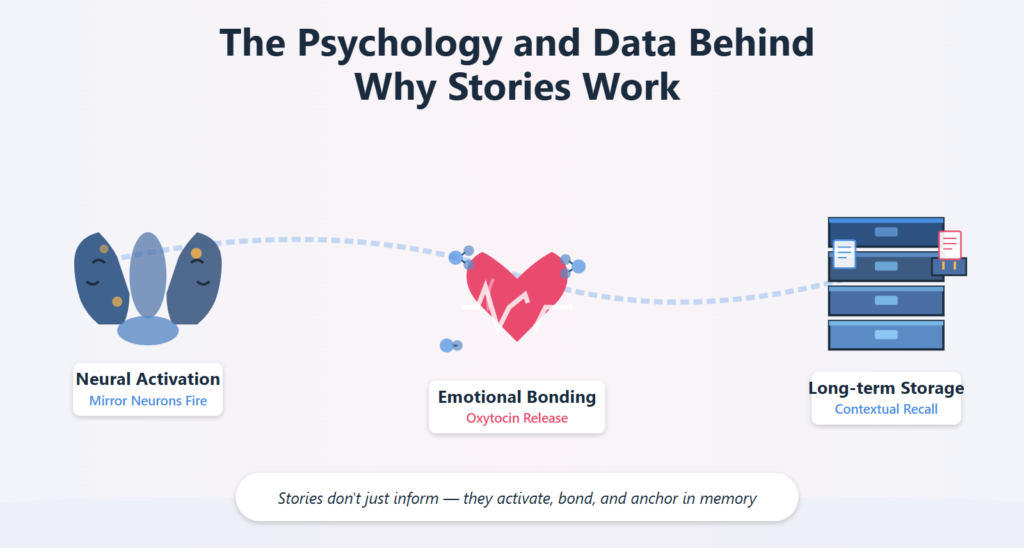
Well-structured stories trigger the release of oxytocin, the hormone associated with trust and social bonding. This is why a strong founder narrative rarely feels like persuasion. It feels familiar. The listener isn’t evaluating claims yet. They’re asking a softer question first: does this make sense to me?
Then there are mirror neurons.
These neurons fire when we watch someone else experience something. So when a founder talks about hitting a wall, noticing a pattern, or realizing something wasn’t working, the audience’s brain runs that moment internally. They don’t just grasp the insight. They experience it.
That’s the real difference between facts and narrative.
Facts ask for attention.
Stories create involvement.
Research also shows that people forget isolated statistics quickly, but remember the same information when it’s woven into a story. Which means that context gives the data somewhere to live.
Statistical Evidence from Marketing and Business
If this were just psychology, it would still matter.
But it shows up clearly in performance data too.
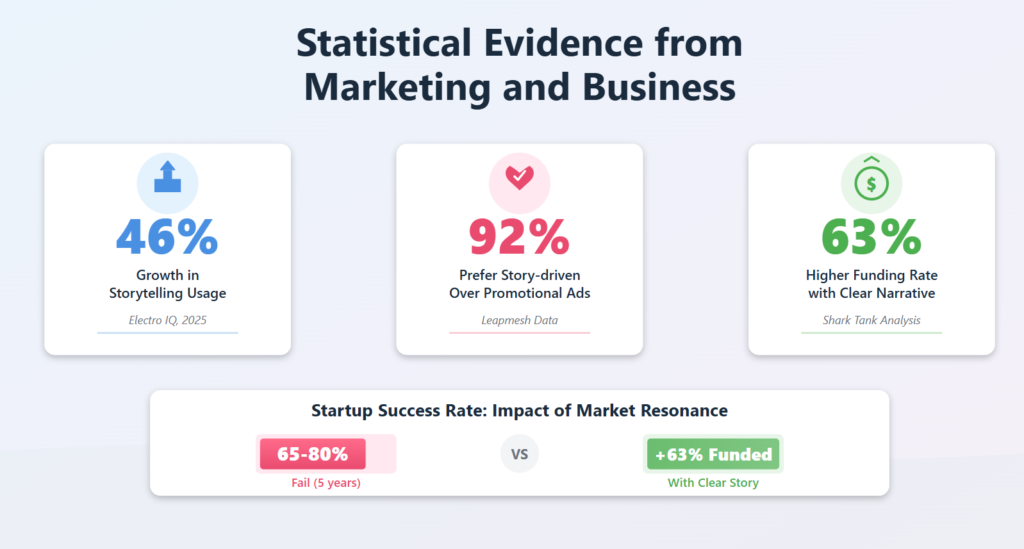
According to Electro IQ, the use of storytelling in marketing grew by 46% over 2025 as teams responded to declining performance from feature-led messaging.
Consumer behavior confirms the shift.
Data compiled by Leapmesh shows that 92% of consumers prefer ads that feel like stories rather than direct promotional messages, because stories help people understand where a product fits into their world without added effort.
Now look at the failure side.
Between 65% and 80% of startups fail within their first five years, according to aggregated industry data. Storytelling isn’t the sole cause, but lack of market resonance is one of the most consistent contributors. Products solve real problems, yet fail because their value never becomes obvious outside the founding team.
Even in environments where numbers are supposed to dominate, narrative still wins attention.
Research published on ResearchGate analyzing Shark Tank pitches found that founders who paired solid fundamentals with a clear narrative increased their chances of securing funding by roughly 63%. Investors weren’t ignoring metrics. They were responding to clarity. To conviction. To a story that made the numbers easier to believe.
The takeaway is simple, even if it’s uncomfortable.
Stories don’t outperform facts because they’re softer.
They outperform because they’re processed faster, remembered longer, and trusted sooner.
Turning Product Insight into Narrative: The Framework
If stories work because of how the brain processes information, then the next question becomes obvious.
What exactly are you turning into a story?
Because not everything deserves one.
From Insight to Story Arc
Product insight is not feedback.
It’s not data.
And it’s definitely not a dashboard screenshot.
Product insight is the meaning extracted from all of that.
It’s the moment you stop reporting what happened and start understanding why it happened.
For example, “80% of users drop off at onboarding step three” is data.
Realizing they drop off because they don’t yet trust the output is insight.
“Page speed improved by 30%” is a metric.
Seeing that speed removed hesitation and changed how users explored the product is insight.
Insight always points to tension. Something didn’t behave the way you expected. Something worked better than it should have. Something failed too consistently to ignore.
That tension is where narrative begins.
Every effective founder story follows a simple arc, whether you name it or not.
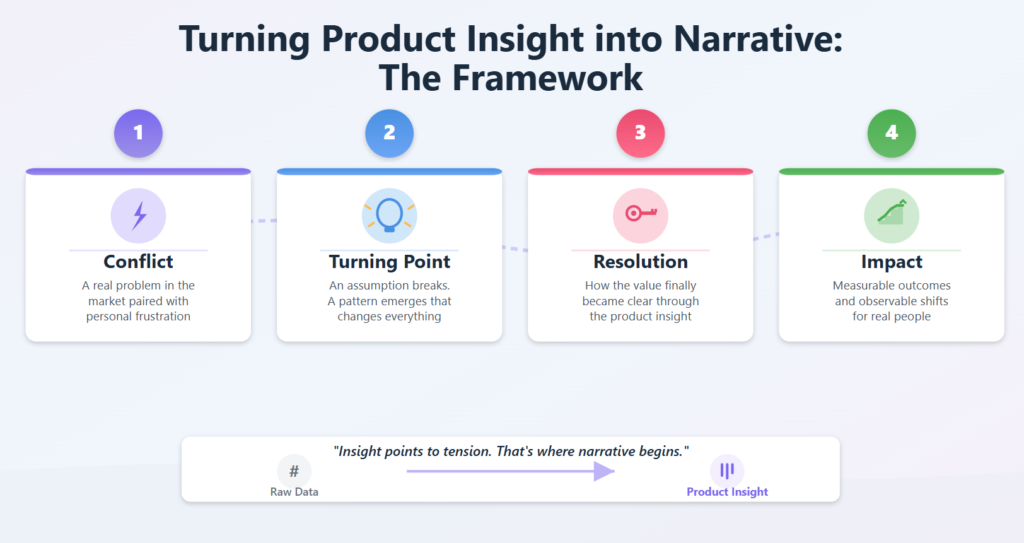
First comes conflict.
A real problem in the market. Often paired with a personal frustration you couldn’t dismiss.
Then the turning point.
The moment an assumption broke. A pattern emerged. Or a small detail changed how you saw the problem entirely.
Then resolution.
Not “we built a product,” but this is how the value finally became clear.
And finally, impact.
What changed for people once that insight made its way into the product. Measurable outcomes. Observable shifts. Proof that the story doesn’t end with you.
Without this arc, insight stays internal.
With it, insight becomes transferable.
The CORE Narrative Model for Founders
If the story arc gives you structure, the CORE model gives you focus.
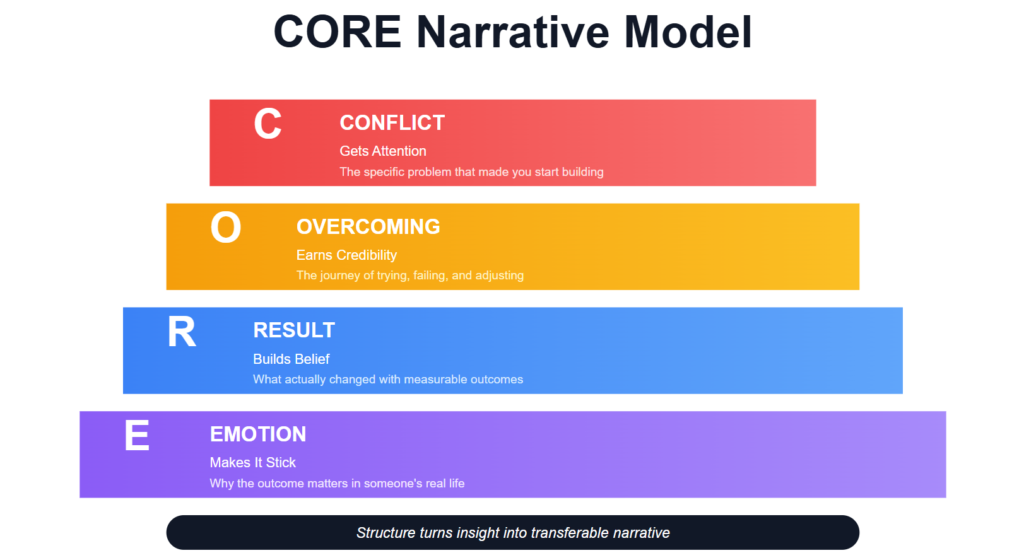
Conflict comes first.
Not a vague market gap, but the specific problem that made you stop shrugging and start building. The friction you felt personally or watched others struggle with long enough to take seriously.
Overcoming follows.
This is where most founders rush. Slow it down. This is the process of trying, failing, adjusting, and seeing the problem differently over time. Both the human path and the product path matter here.
Result grounds the story.
What actually changed once the insight was applied. Growth, retention, activation, speed, cost reduction. Pick what moved and say it plainly.
Emotion holds it together.
Not sentimentality. Relevance. Why this outcome matters in someone else’s day, workflow, or decision-making. The human consequence of the result.
Conflict gets attention.
Overcoming earns credibility.
Result builds belief.
Emotion makes it stick.
C-O-R-E.
When you skip this structure, insight sounds impressive but goes nowhere.
When you follow it, insight becomes something other people can recognize, remember, and repeat.
And that’s when a product stops needing constant explanation.
Anchoring Narrative in Verified Product Insight
A story without evidence sounds confident right up until someone asks, “Based on what?”
That’s where most founder narratives quietly collapse.
Why “Insight” Must be Quantified
Insight earns attention.
Data earns belief.
Without numbers, insight stays vague. It feels interesting, even convincing, but it doesn’t hold up under scrutiny. The moment a customer, investor, or partner tries to repeat it to someone else, it thins out.
Quantification is what gives a story weight.
Not vanity metrics.
Not dashboards dumped into slides.
Clear signals that show something changed because the insight was applied.
For example, saying users “loved the experience” doesn’t travel far.
Saying users experienced a specific benefit in 72% of cases within 30 days does.
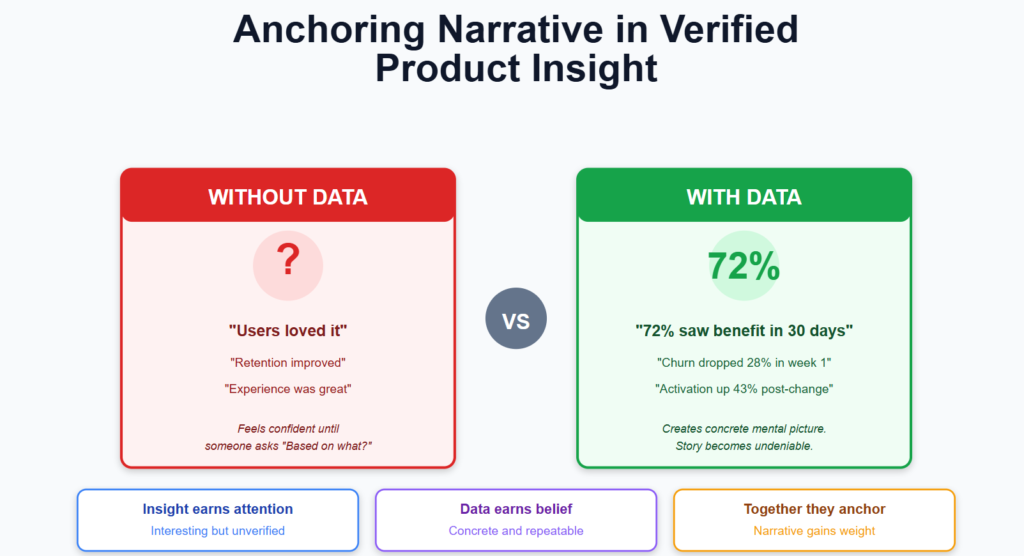
Saying retention “improved” invites skepticism.
Saying churn dropped by 28% once customers saw value in their first week creates a concrete mental picture.
Numbers don’t replace narrative.
They anchor it.
They tell the listener, this wasn’t a feeling, it was an outcome.
And if you have internal metrics, those always win. Generic examples are placeholders. Real data turns the story from plausible to undeniable.
Structuring Your Story With Data
Data has terrible timing.
It either shows up too early, before anyone cares.
Or it shows up too late, when everyone is already skeptical.
Which is unfortunate, because when data lands at the right moment, it does something remarkable. It turns a nice story into a believable one.
Before-and-after metrics work for exactly this reason. They give the story a sense of movement. There was a moment where things looked one way. Then something shifted. The numbers simply point to where that shift happened.
That’s also why visuals work when they’re used with restraint. A simple chart paired with a short narrative caption lets the reader see progress before they start analyzing it. Patterns emerge. Direction becomes obvious. No effort required.
The real magic, though, is in how numbers are framed.
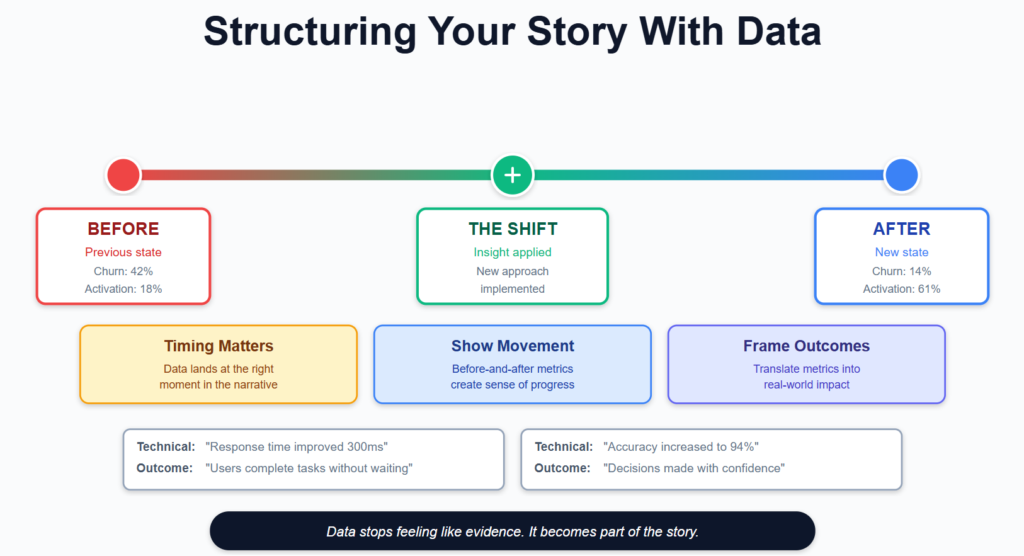
Metrics aren’t impressive on their own. What they unlock is. Speed matters when it removes friction. Accuracy matters when it changes decisions. Adoption matters when behavior changes without being forced.
Once technical metrics are translated into outcomes people already understand, the story becomes easier to follow. Time gets saved. Risk drops. Confidence rises. Revenue stabilizes.
At that point, data stops feeling like evidence you brought along just in case.
It feels like it was always part of the story.
And when that happens, the narrative doesn’t ask to be believed.
It earns it.
The Four Narrative Types That Sell
Not every story does the same job.
Some stories create trust.
Some create belief.
Some make comparison unnecessary.
Founders get into trouble when they try to force one story to do all of that at once. The better move is knowing which narrative you’re telling, and why.
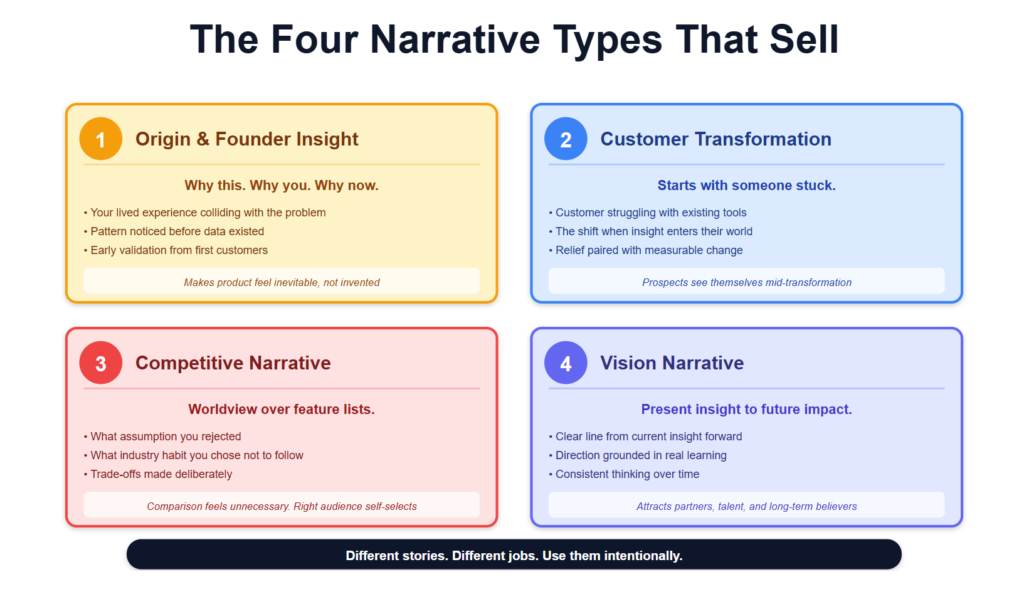
1. Origin and Founder Insight Stories
This is the story that answers a quiet question everyone is asking:
Why this product. Why you. Why now.
It’s not your résumé.
It’s not the heroic montage.
It’s the moment your lived experience collided with a problem you couldn’t ignore. The late nights. The workaround that kept breaking. The pattern you noticed before there was data to back it up.
What gives this story weight isn’t drama. It’s validation. Early usage. First customers. The small proof points that confirmed you weren’t imagining the problem.
When done right, this narrative makes the product feel inevitable rather than invented.
2. Customer-Driven Transformation Stories
These stories don’t start with you. They start with someone stuck.
A customer doing their best with the tools they had. A workaround that almost worked. A process that technically functioned but felt heavier every day.
Then the insight shows up in their world.
Something simplifies. A decision gets easier. A task stops draining energy. What matters here isn’t the feature. It’s the shift. Emotion paired with outcome. Relief paired with measurable change.
These stories sell because they let prospects see themselves mid-transformation, not at the finish line.
3. Competitive Narrative
This is where most founders default to feature comparisons.
That’s a missed opportunity.
A competitive narrative isn’t about listing differences. It’s about explaining why your approach exists at all. What assumption you rejected. What industry habit you chose not to follow. What trade-off you made deliberately.
By positioning insight against industry norms, you stop competing on checklists and start competing on worldview.
At that point, comparison feels unnecessary. The right audience self-selects.
4. Vision Narrative
This is the longest arc, and the easiest to get wrong.
A vision narrative draws a clear line from present insight to future impact, extending what you’ve already learned forward in a way others can follow.
When grounded in real insight, vision feels less like speculation and more like direction. It tells people where the product is headed and why that direction makes sense.
This is the story that attracts partners, talent, and long-term believers. Not because it promises everything, but because it shows consistent thinking over time.
Different stories. Different jobs.
The mistake isn’t choosing the wrong one.
It’s trying to tell all four at once.
Used intentionally, each narrative makes the product easier to understand, easier to trust, and easier to choose.
Where to Use Your Founder Narrative
A founder narrative doesn’t live in one place.
It travels.
When it works, it moves across conversations, documents, decks, and stages without losing its shape. The setting changes. The core stays intact.
Here’s where it does its best work.
Sales and GTM (Founder-Led Sales)
This is where narrative earns its keep.
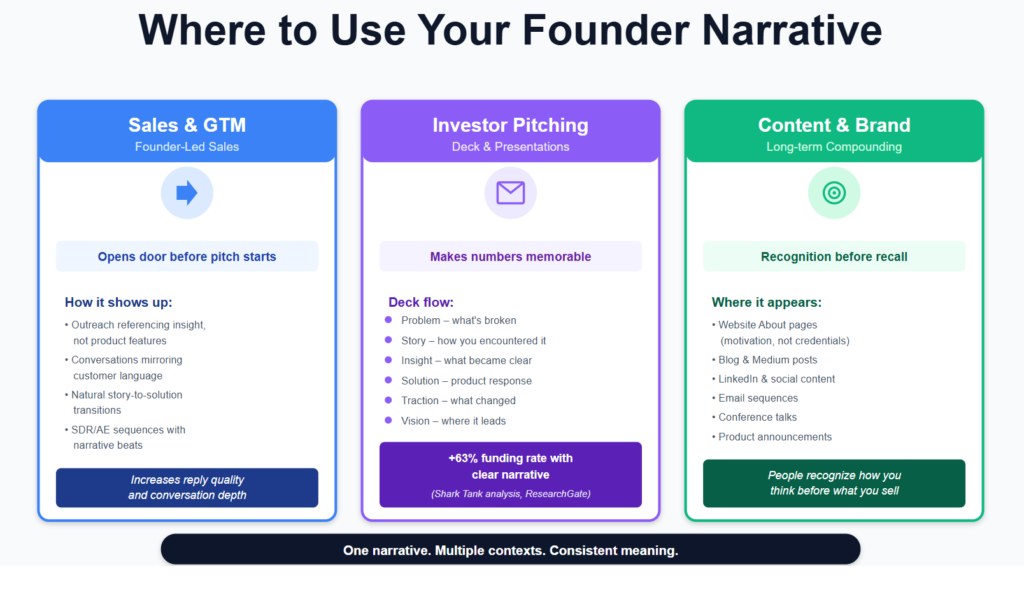
In founder-led sales, the story opens the door before the pitch ever starts. It gives context before qualification. It creates relevance before features enter the room.
Used well, narrative helps founders start conversations that feel human instead of transactional.
How it shows up in GTM outreach:
- Opening messages that reference the insight behind the product, not the product itself
- Conversations that mirror the customer’s language and daily friction
- Transitions from story to solution that feel natural, not rehearsed
In SDR and AE sequences, this often looks like a short narrative beat early on. A moment that explains why this problem exists and why the founder cared enough to solve it. StartupGTM research consistently shows founder-led context increases reply quality and conversation depth, even when deal cycles stay the same.
Narrative here doesn’t close the deal.
It earns the next sentence.
Pitching Investors
Investors hear numbers all day.
Narrative helps them remember yours.
In effective decks, the story appears early and sets the frame for everything that follows. A simple flow works because it mirrors how people make sense of information:
- Problem – what’s broken
- Story – how the founder encountered it
- Insight – what became clear
- Solution – how the product responds
- Traction – what changed
- Vision – where it leads
Research published on ResearchGate analyzing Shark Tank pitches shows that founders who integrated a clear narrative alongside fundamentals increased their chances of securing funding by roughly 63%. The numbers mattered. The story made them easier to believe.
Narrative doesn’t replace rigor.
It prepares the ground for it.
Content and Brand Building
This is where founder narrative compounds.
Once the story exists, it can be adapted without being diluted. Different formats. Same spine.
Common places it shows up:
- Website About pages that explain motivation, not credentials
- Blog and Medium posts that unpack insight over time
- LinkedIn and social content that frames lessons instead of announcements
- Email sequences that guide understanding, not just clicks
- Conference talks and pitches that feel cohesive across years
The benefit here is consistency. People start recognizing the way you think before they remember what you sell. The product feels familiar long before a buying decision shows up.
That’s the quiet power of a founder narrative.
Used in the right places, it shortens explanations, strengthens trust, and carries meaning further than features ever could.
And once it’s in motion, it keeps working long after the conversation ends.
Common Pitfalls and Narrative Mistakes
Most founder stories fail quietly.
They don’t collapse on stage or get laughed out of a room. They simply lose attention halfway through, then fade from memory. The patterns are predictable once you know where to look.
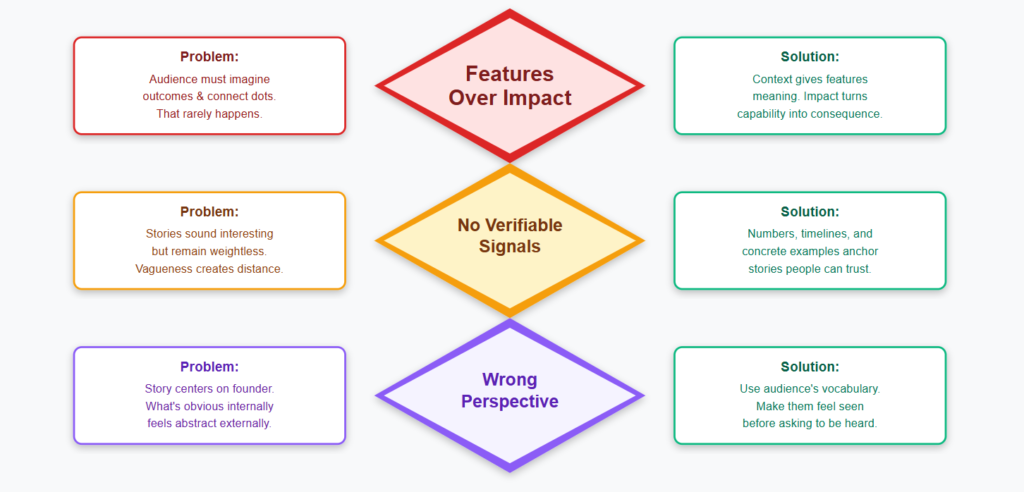
Over-focusing on “Features” Instead of Impact
Features explain what a product does.
Stories explain why that behavior matters.
When a narrative leans too heavily on specifications, it asks the audience to do extra work. They have to imagine outcomes, translate benefits, and connect dots on their own.
That rarely happens.
Context is what gives features meaning. Without it, even impressive technical details float without gravity. Impact is what turns capability into consequence.
Lack of Verifiable Signals
Stories gain momentum when they carry proof.
Without signals to anchor them, narratives sound interesting but remain weightless. Numbers, timelines, and concrete examples give a story something to lean on and something others can repeat.
Specifics create confidence.
Vagueness creates distance.
Attaching real outcomes to insight turns a story from something people enjoy into something they trust.
Ignoring Audience Perspective
A narrative works best when it reflects the listener’s world.
Founders slip when the story centers too closely on their own journey, language, or achievements. What feels obvious internally often feels abstract externally.
Strong narratives borrow the audience’s vocabulary, pressures, and priorities. They make the listener feel seen before asking to be understood.
Empathy shapes every part of that process. It guides what gets included, what gets simplified, and what gets left out.
When empathy leads, the story travels further.
When it doesn’t, the story stays with the founder.
Case Examples (Real World)
Case studies usually start with dates, founders, and market context.
Which is exactly why most people skip them.
Let’s do this differently.
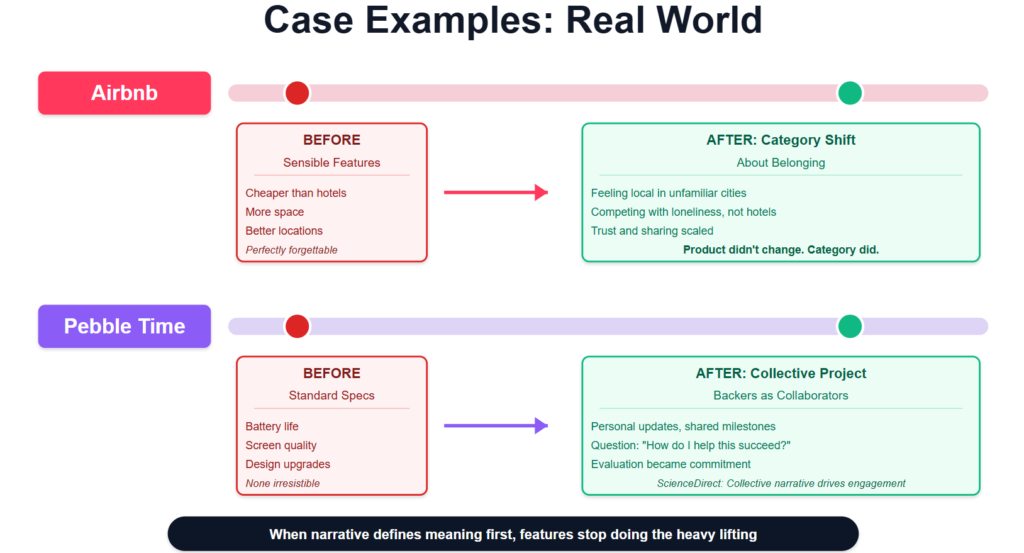
Example 1: Airbnb’s Belonging Narrative
Airbnb could’ve told a very sensible story.
Cheaper than hotels.
More space.
Better locations.
A perfectly reasonable pitch.
And a perfectly forgettable one.
Instead, the story took a strange turn.
It talked about belonging.
About staying somewhere that felt lived-in.
About feeling local in a city that wasn’t yours.
Suddenly, Airbnb wasn’t competing with hotels anymore.
It was competing with loneliness.
That shift did something powerful. Hosts stopped listing rooms and started hosting people. Guests stopped booking nights and started collecting experiences. Trust scaled. Sharing scaled. Network effects followed.
The product didn’t change.
The category did.
Example 2: Pebble Time Kickstarter Narrative
Pebble Time launched on Kickstarter with specs like every other gadget.
Battery life.
Screen quality.
Design upgrades.
All useful.
None irresistible.
What was irresistible was the story.
Backers weren’t treated like customers. They were treated like collaborators. Updates felt personal. Progress felt collective. Every milestone felt shared.
People didn’t just fund a watch.
They joined a project.
Research published on ScienceDirect shows this kind of collective narrative dramatically increases engagement and participation in crowdfunding campaigns. When people feel part of the story, evaluation turns into commitment.
Nobody asked, “Is this the best smartwatch?”
They asked, “How do I help this succeed?”
Both examples prove the same thing.
When narrative defines meaning first, features stop doing the heavy lifting.
People don’t need convincing.
They already know where they belong.
And that’s when products stop chasing attention
and start attracting it.
A Workshop: How to Draft Your Narrative
This is the part where people expect complexity.
Frameworks inside frameworks. Diagrams. Words like alignment and synthesis floating around doing very little work.
We’re skipping all of that.
You don’t need permission. You need a starting point.
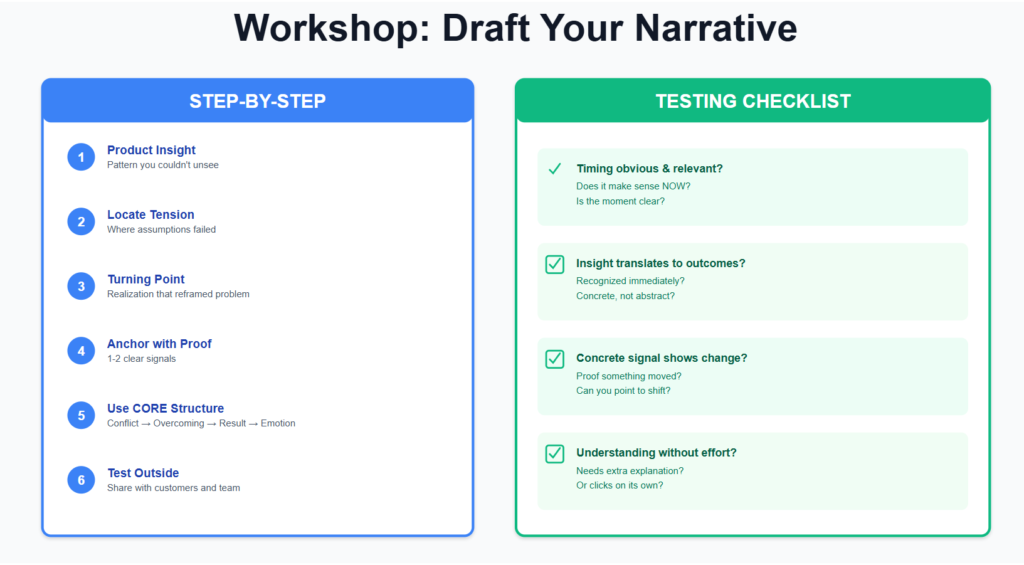
Step-by-Step
Start with the product insight.
Not the roadmap. Not the pitch. The moment something clicked. A pattern you couldn’t unsee once you noticed it.
Then locate the tension.
Where things broke. Where assumptions failed. Where users behaved differently than expected. That friction is your conflict.
Next comes the turning point.
The realization that reframed the problem. The shift that changed how you approached the product from that moment on.
Now anchor it with proof.
Choose the data points that show something moved. Adoption, retention, speed, behavior. One or two signals are enough when they’re clear.
Write the draft using the CORE structure.
Conflict. Overcoming. Result. Emotion.
Keep it human. Keep it grounded. Let the story breathe.
Finally, take it outside the building.
Share it with customers. With your team. Listen for where attention sharpens and where it fades. The story tells you what stays.
Narrative Testing Checklist
Before you ship the story, run it through a simple filter:
- Does it make the timing feel obvious and relevant right now?
- Does the insight translate into outcomes people recognize immediately?
- Is there a concrete signal that shows change actually happened?
- Does it create understanding without requiring extra explanation?
If the answer feels clear, you’re close.
If it feels fuzzy, the story isn’t done yet.
Narratives don’t come fully formed.
They earn their shape through use.
And once they do, they start doing work long after you stop explaining.
The Narrative Advantage
Here’s the funny thing.
Most founders already have the insight.
They just keep it locked inside product docs, dashboards, and their own heads.
So they keep explaining.
And explaining.
And explaining some more.
Narrative is what stops that loop.
It turns product insight into something people trust, remember, and repeat without you standing there to clarify it. The same research that shows stories are remembered up to 22 times more than standalone facts also explains why they convert better once real decisions are involved.
This isn’t branding fluff or clever positioning.
It’s a practical advantage rooted in how people process information, build confidence, and choose what to believe. When narrative leads, features land faster. Data feels credible sooner. Momentum replaces persuasion.
That’s why the best products don’t feel complicated, even when they are.
They feel obvious.
So here’s the move.
Take one insight.
The one that changed how you understood your product.
The one that made everything else click.
Turn it into a short narrative.
What broke. What shifted. What changed for others.
Start there.
Because once people understand the story,
the product stops needing an explanation.
Keep reading