 Denzil Otieno
Founders Don’t Need More Credentials — They Need a Story Users Trust
Credentials open doors, but users buy from founders whose story shows the cost of hesitation. Why trust-building stories start with the user, not the founder.

Jon Morrow didn’t break the blogging world by being impressive.
He broke it by being unmistakably real.
When he published his story about living with spinal muscular atrophy, readers didn’t just learn something about him. They recalibrated how they read everything he wrote after that. His ideas suddenly carried weight. His advice felt earned. His words stopped sounding optional.
That story did something credentials never do.
It showed the cost of hesitation.
It showed what effort looked like under real constraints.
And it made outcomes feel believable before they felt aspirational.
That is why Jon’s work spread the way it did.
Not because he was more qualified than everyone else, but because his story made change feel understandable. Readers could see the path. They could sense the stakes. Trust formed long before reputation caught up.
Founders still get this wrong.
They keep polishing credentials and stacking proof, while users are trying to answer a simpler question. What will actually change if I choose this?
Until your story answers that clearly, nothing else carries the decision.
This article shows why founders don’t need more credentials, and how the right story earns the trust users are already looking for.
Why Credentials Stop Working After the First Impression
Credentials do one job well.
They tell users you are legitimate.
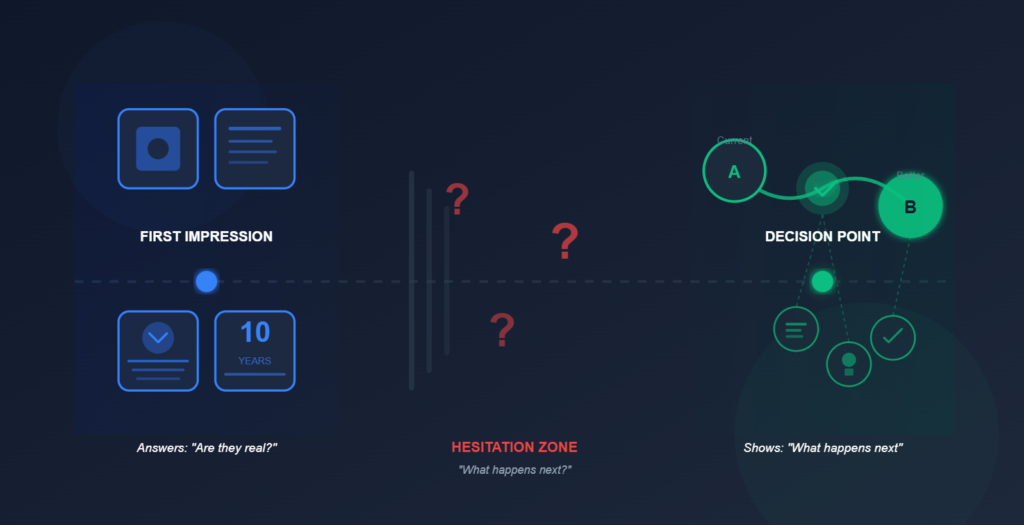
Degrees, years of experience, past companies, press mentions, logos. All of these reduce surface-level doubt. They answer the first question a user asks when they land on your page.
Are these people real?
Once that question is answered, credentials stop doing meaningful work.
What comes next is hesitation.
Users slow down even when the founder looks qualified. Even when the product looks solid. Even when the claims sound reasonable. Not because something feels wrong, but because something still feels unclear.
That hesitation doesn’t come from lack of proof.
It comes from a lack of understanding.
Credentials explain who you are. They do not explain what will happen after the user commits. They don’t show how the product fits into the user’s situation, how effort turns into outcome, or where risk actually sits.
This is where many founders misread the problem.
They keep adding credibility signals, assuming trust will eventually follow. But credibility and trust are not the same thing. Credibility gets you considered. Trust gets you chosen.
Trust forms when users can trace a clear line from their current state to a better one. When they can see what changes, what stays the same, and what the product does in between.
Until that line is visible, credentials sit in the background. They’re noticed, but they don’t move the decision.
That is why credentials work early and fade fast.
And why your story becomes necessary the moment first impressions are done.
What Users Are Really Trying to Decide
When someone lands on your page, they are not studying you.
They are not auditing your background, comparing credentials, or scoring your authority. That evaluation happens quickly, and then it’s done.
Users are deciding what happens to them if they move forward.
That decision runs on a different set of questions, and you can feel them playing out as the page loads.
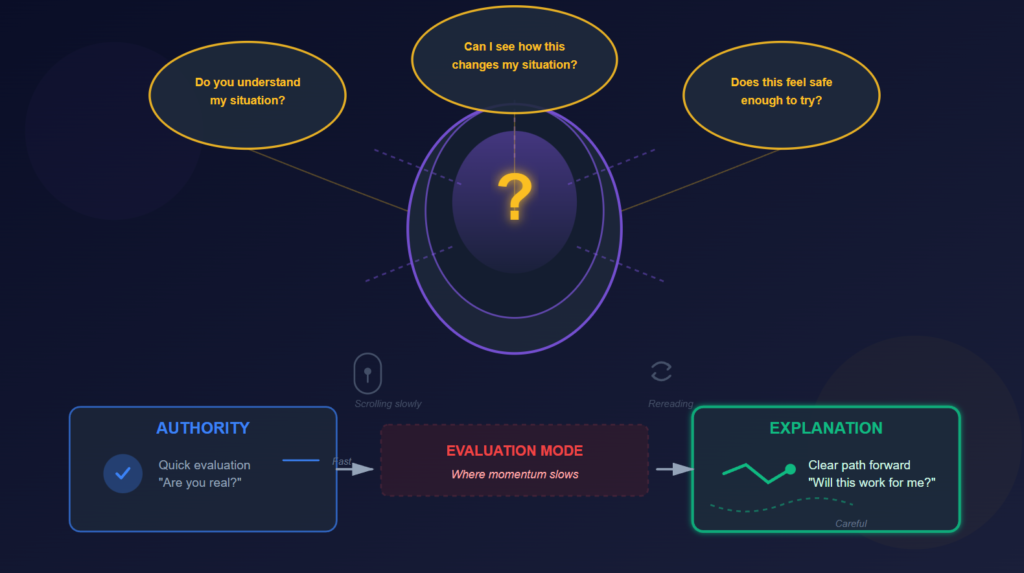
- Do you understand my situation as it actually is?
- Can I see how this product changes that situation?
- Does this feel safe enough to try without regret?
Those questions don’t show up as objections. They show up as hesitation.
You see it when users scroll slowly. When they reread sections. When they leave and come back later. The page looks fine, but the decision doesn’t complete.
That’s because trust is not formed through authority signalsalone.
Authority tells users you might be capable.
Explanation tells them what to expect.
And expectation is what reduces risk.
Trust forms when users can follow the logic of change. They need to understand how effort turns into outcome, where friction appears, and what support looks like along the way. When that path is visible, moving forward feels reasonable.
This is why impressive founders still struggle to convert attention into action.
Credentials answer “Are you real?”
Stories answer “Will this work for me?”
Until your content answers the second question clearly, users stay in evaluation mode. And evaluation is where momentum slows.
That’s the psychological center of the decision.
Why Founder Stories Fail When They Start With the Founder
Most founder stories fail for a simple reason.
They begin at the wrong point in the journey.
Bios, achievements, origin stories, and personal milestones place the founder at the center of the narrative. They explain who built the product, how long it took, and why the founder is qualified to be trusted.
But when a user arrives, they are not at that point yet.
They haven’t decided to care about you.
Starting with the founder creates distance because it asks for attention before understanding is earned. The reader is still trying to orient themselves in their own problem, while the story pulls them into someone else’s timeline.
That mismatch slows trust.
A founder-first story delays relevance. It forces users to translate your background into their situation. Most won’t do that work. They scroll, skim, and leave with the sense that the product might be good, but not yet clear.
This is why origin stories often perform well as brand pieces and poorly as conversion assets.
Trust doesn’t grow when users learn more about you.
It grows when they see themselves more clearly.
When the story starts with the founder, users wait.
When it starts with their reality, they lean in.
That is the difference between a story that informs and a story that builds trust.
What a Trust-Building Story Actually Does
If your story isn’t building trust, it’s usually because it’s doing the wrong job.
You’re trying to sound credible when you should be helping the reader orient themselves. You’re explaining value when you should be showing how change happens. A trust-building story fixes that.
It Starts With the User’s Reality
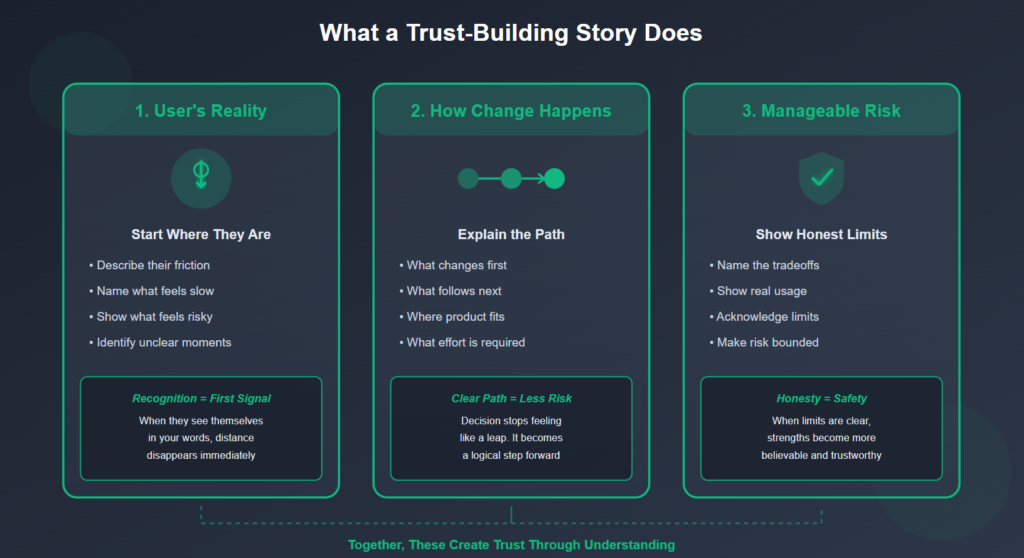
Your story needs to open where your user already is.
Not where you started. Not where your product shines. Where the friction actually shows up in their day. What feels slow. What feels risky. What feels unclear.
When you describe that state accurately, you remove distance. The reader doesn’t have to work to map your words to their situation. They recognize it immediately.
That recognition is the first signal of trust.
If you skip this step, everything else sounds theoretical, no matter how strong the product is.
It Explains the Mechanism of Change
You don’t earn trust by promising outcomes.
You earn it by explaining how those outcomes happen.
Your story should make it clear what changes first, what follows, and where your product fits in that sequence. What effort is required. What friction disappears. What still takes work.
This isn’t persuasion. It’s explanation.
When the path is clear, the decision stops feeling like a leap. It starts feeling like a step.
It Makes Risk Feel Manageable
Every founder wants to reduce risk for the user. Most try to do it by hiding it.
That backfires.
A trust-building story does the opposite. It shows limits. It names tradeoffs. It reflects real usage, not ideal usage. When you acknowledge where the product doesn’t help, the places it does help become more believable.
That honesty creates safety.
When risk feels bounded and understood, users don’t need to be convinced. They can decide.
Story Is Part of the Product, Not the Brand
If you treat your story as marketing, it will always feel optional.
If you treat your story as part of the product, it becomes necessary.
The first experience users have with your product is not the interface. It’s the explanation. Before they click anything, they’re already forming expectations about what effort looks like, what success looks like, and what failure might cost them.
That expectation-setting is the real job of your story.
When your story is clear, onboarding feels easier. Users arrive knowing what to focus on and what to ignore. Activation speeds up because the product behaves the way they were led to expect. Retention improves because the experience matches the promise that was made.
When the story is weak, the opposite happens.
Users sign up curious but uncertain. They explore without direction. Features feel disconnected. Friction feels surprising instead of expected. The product hasn’t changed, but the experience feels harder than it should.
That gap is not a usability problem. It’s a narrative problem.
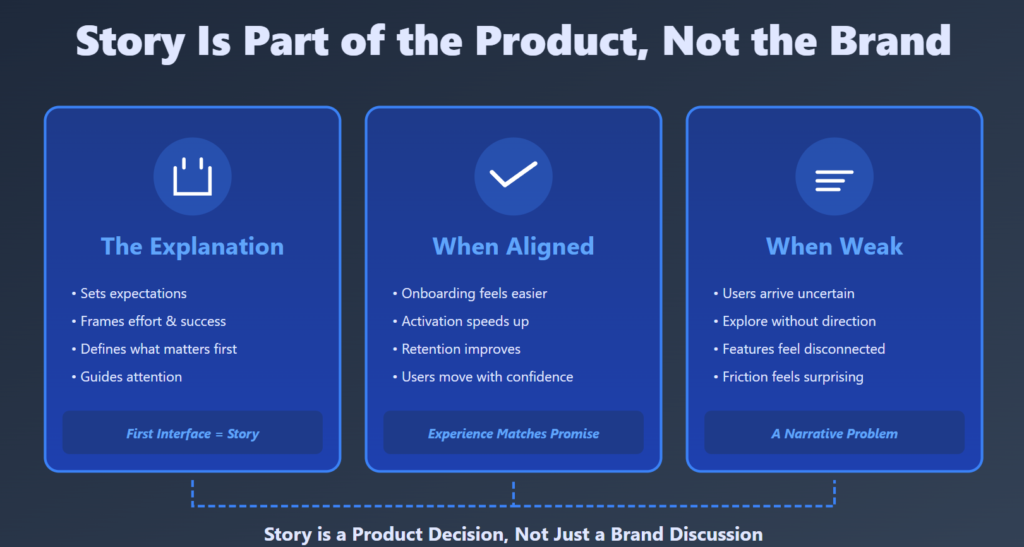
Your story acts like an invisible interface. It guides attention. It frames decisions. It tells users what matters first, what comes later, and what success actually looks like. Long before they learn your workflows, they learn your logic.
Founders often try to fix this with better copy or more tutorials.
The real fix is alignment.
When the story explains how the product works in the real world, users move with more confidence. They make fewer wrong turns. They recover faster when they get stuck. The product feels simpler, even when it isn’t.
That’s why your story belongs with product decisions, not just brand discussions.
If users interact with it before they interact with your software, it is part of the product whether you treat it that way or not.
How Founders Should Rethink Their Story
-
Stop leading with credentials: Credentials belong in the background. They answer legitimacy, not hesitation. Put them where users can find them, but don’t ask them to carry the story. They won’t.
-
Lead with understanding: Start by showing that you see the problem as it shows up in real life. Name the friction accurately. Reflect the constraints users are working under. When they recognize themselves, attention follows.
-
Show the path the product enables: Don’t jump to outcomes. Walk through what changes step by step. What happens first. What gets easier next. Where effort is required and where it drops. Clarity here does more than any promise.
-
Let the product confirm the story: Your story should set expectations your product can meet. When users experience what you described, trust compounds. When the experience matches the narrative, belief stops being fragile.
This shift isn’t about writing better copy.
It’s about deciding what your story is responsible for.
Now You Know — Credentials Open Doors, Stories Earn Trust
Credentials still matter.
They get you considered. They signal competence. They remove surface doubt. But they stop working quickly, and when they do, leaning on them harder only creates distance.
Hiding behind credentials is expensive.
It delays clarity. It pushes real understanding further down the page. It leaves users doing the work your story should have done for them. The result isn’t rejection. It’s hesitation. And hesitation is where momentum dies.
Trust isn’t claimed. It’s built.
It’s built when your story explains change clearly enough that users can follow it. When effort, risk, and outcome are visible. When the experience matches the expectation you set.
That level of trust doesn’t come from better copy. It comes from ownership.
Ownership of the story your product tells before a user ever touches it. Ownership of what you choose to explain and what you choose to leave vague. Ownership of trust as a system, not a signal.
Founders who understand this stop trying to look impressive.
They focus on being understood.
And that’s when decisions start to move.
Keep reading