 Denzil Otieno
Why SaaS Blogs Don’t Convert — And the Narrative That Makes Readers Buy
SaaS blogs don't convert because they educate without helping readers decide. The narrative structure, formats, and 24-hour fixes that turn readers into buyers.

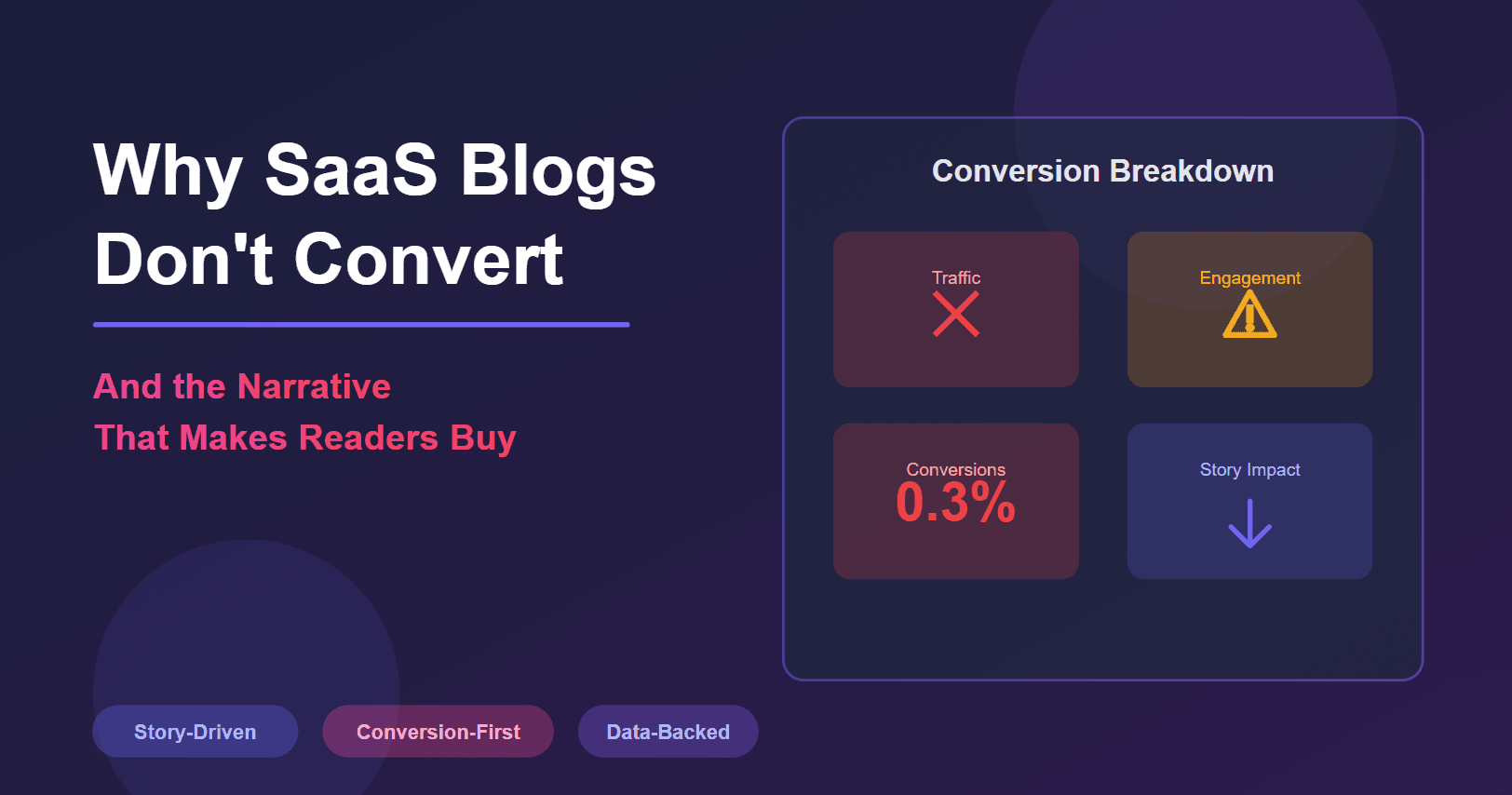
Most SaaS blogs are designed to educate.
They explain the problem, the market, and the best practices around it.
And then they stop.
What they rarely do is help a reader make a decision.
So the blog performs, but conversion stays flat. Traffic grows, but product usage does not follow. The content exists alongside the business instead of pulling it forward.
This isn’t a writing problem or an SEO problem. It’s a narrative problem.
Most SaaS blogs stop at explanation. They never take responsibility for guiding the reader toward a choice, or showing where the product fits once understanding is achieved.
This post explains why that happens and the narrative shift required for a blog to influence buying decisions, not just attract readers.
Starting With a Story Instead of a Definition
SaaS blogs open by defining the topic.
They explain what something is, outline the landscape, and establish background before moving on. The logic is simple: if readers understand the concept, the rest will follow.
But definition-first openings rarely help readers orient themselves.
By the time someone reaches a SaaS blog, they are not trying to learn terminology. They are trying to understand why their existing approach hasn’t led to a clear outcome. Definitions describe the space. They don’t clarify where the reader stands inside it.
This is where a product story plays a different role.
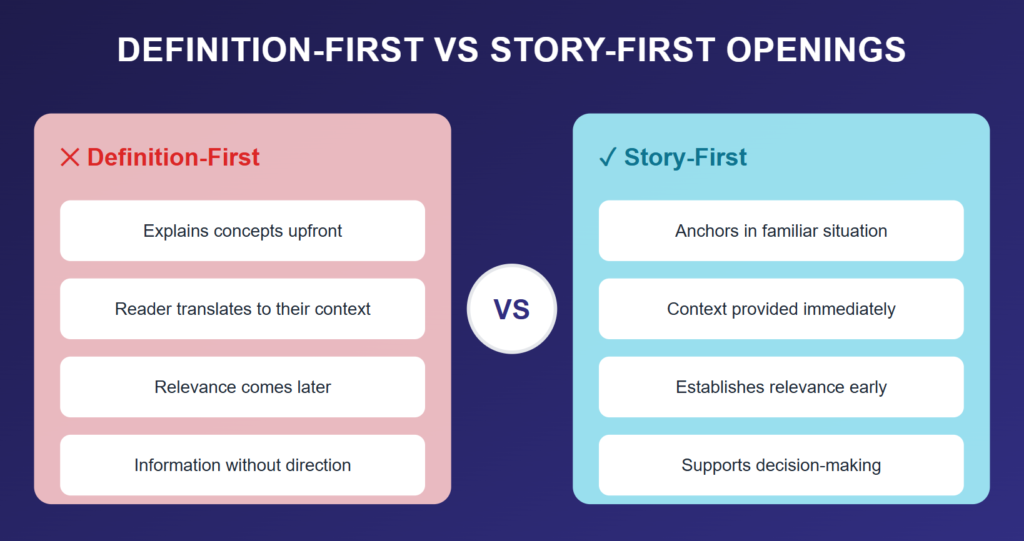
Not a story as creative writing, and not a story as persuasion. A story as context. A way of anchoring the discussion in a recognizable situation so the reader understands why the topic matters before it is explained.
Definitions deliver information. Stories establish relevance.
When a post begins with a definition, relevance is delayed. The reader has to translate the idea into their own situation and decide whether to keep going. When it begins with a story, that translation happens immediately.
This distinction matters because conversion does not come from understanding alone.
Blogs fail when they stop at information and never provide direction. Story-led openings create that direction by clarifying the reader’s position early, making everything that follows easier to process and act on.
That’s the functional difference between content that explains and content that supports decisions.
Why Most SaaS Blogs Fail to Make Readers Buy
The first failure is scope.
Many SaaS blogs are written for “everyone.” The language stays broad, the examples stay safe, and the advice applies to any company at any stage. That kind of writing avoids being wrong, but it also avoids being useful. When a reader can’t see themselves clearly in the post, the content never becomes part of a decision.
The second failure is structural.
Advice is often presented without a believable path to a product outcome. The post explains what to think about, what to consider, or what best practices exist, but it never shows how those ideas translate into an action the product actually enables. Insight is delivered, then abandoned.
A third issue is abstraction.
Many takeaways stay generic because they are not anchored to a real job to be done (JTBD). Without a concrete job, the advice floats. The reader may agree with it, but agreement is not the same as momentum. Nothing connects the idea to a specific use case where the product becomes relevant.
CTAs fail for a similar reason.
Some posts end with no CTA at all. Others jump straight to a demo or sales request without earning that step. In both cases, the CTA is disconnected from the reader’s level of understanding. It either arrives too late or too early, and in both scenarios it gets ignored.
These failures are not about writing quality.
They come from treating the blog as an educational asset instead of a decision-support asset. When content is not designed to guide a reader from problem clarity to product relevance, conversion never has a chance to happen.
How Narrative Turns Readers Into Buyers
Narrative works because it gives structure to how people already make decisions.
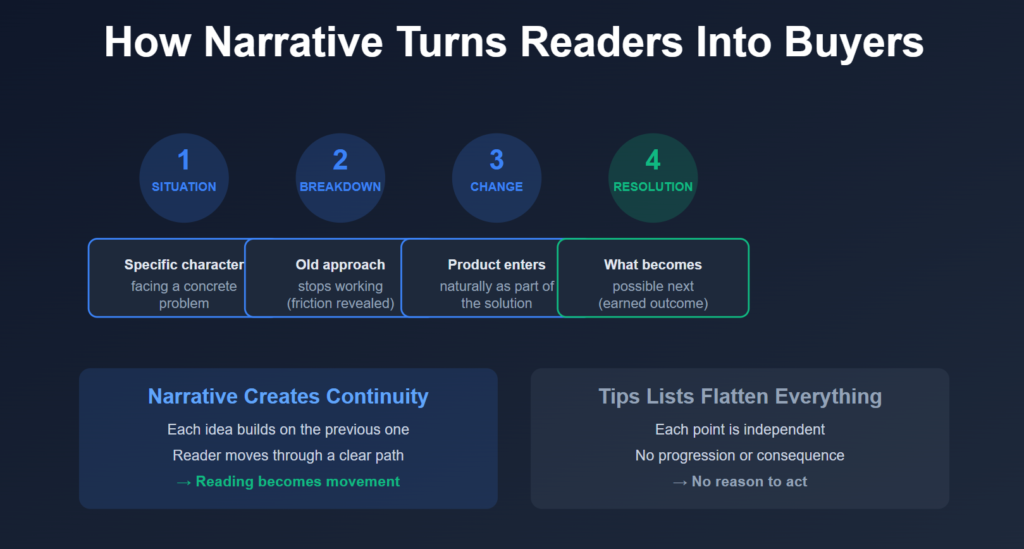
Instead of presenting isolated ideas, it creates a path. A clear sequence where a reader can recognize a situation, see what breaks down, understand what changes, and arrive at a resolution that feels earned.
Not persuasion. Orientation.
In practical terms, that path is simple: a specific character, a concrete problem, a moment where the old approach stops working, and a resolution that shows what becomes possible next. The product fits naturally into that sequence because it participates in the change, not because it is promoted.
This is why narrative helps buyers imagine themselves using a product.
Stories do not describe features in isolation. They show cause and effect. A reader can see what life looks like before the product, what friction exists, and how that friction is reduced once the product is introduced. That mental simulation is what makes the product feel relevant without being pushed.
This is also where narrative differs from “tips list” content.
Tips lists flatten everything. Each point is independent, interchangeable, and context-free. The reader may agree with every item and still have no clearer sense of what to do next. There is no progression, no consequence, and no reason for one step to follow another.
Narrative, by contrast, creates continuity.
Each idea builds on the previous one. Each section moves the reader closer to a decision by narrowing the problem and clarifying the role the product plays in resolving it. That continuity is what turns reading into movement, and movement into buying behavior.
Anatomy of a SaaS Blog That Converts
A converting SaaS blog is not a collection of good ideas. It is a sequence. Each part exists to qualify the reader, clarify their situation, and move them closer to a decision without forcing it.
Headlines And Leads That Qualify The Right Reader
The job of the headline is not to attract everyone. It is to exclude the wrong reader early.
Effective headlines center on a specific role, a clear outcome, and the obstacle preventing that outcome. This immediately signals who the post is for and what problem it addresses. When the role or outcome doesn’t apply, the reader moves on. That’s a feature, not a loss.
The lead then grounds that promise in reality.
Instead of opening with a definition, it opens in a real moment. A situation, a metric, or a constraint the reader recognizes. This establishes relevance before explanation begins and confirms that the post understands the problem from the inside.
Diagnose The “Before” State With Empathy And Clarity
Before a reader can move forward, their current state has to be named accurately.
That means using real language from customer pain points, not abstract phrasing or industry jargon. The goal is not emotional resonance for its own sake, but precision. The reader should recognize the problem immediately and see it reflected clearly on the page.
Strong blogs anchor this diagnosis in concrete examples. Specific behaviors, decisions, or tradeoffs that make the problem tangible. Abstraction creates distance. Specificity creates trust.
Present The Path Your Product Enables
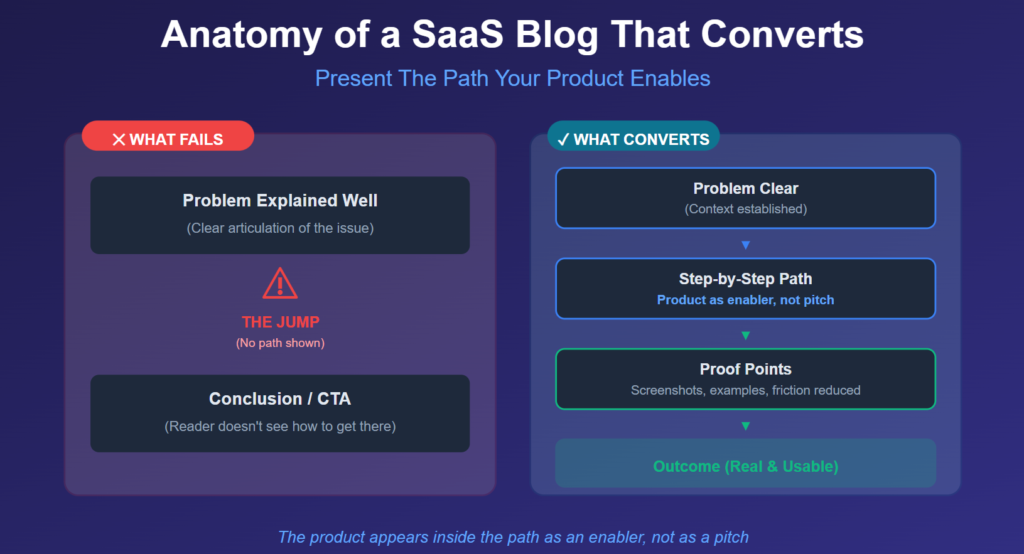
Once the problem is clear, the blog must show what changes.
This is where many posts fall apart. They explain the issue well, then jump straight to a conclusion. A converting blog does the opposite. It walks through the path from problem to outcome step by step, showing how each step reduces friction.
The product appears inside that path, not as a pitch, but as an enabler. Screenshots, short explanations, or brief examples act as immediate proof that the path is real and usable, not theoretical.
Show Proof That Reduces Purchase Anxiety
Understanding alone does not remove hesitation.
Readers need to see evidence that the path works for someone like them. This is where micro case studies matter. Not long success stories, but short examples tied to a single outcome or metric.
Comparisons also play a role here. Showing the difference between attempting the solution without the product and using it clarifies value without overstating it. The goal is not persuasion, but reassurance.
Ladder Of Next Steps That Respect Intent
Not every reader is ready to buy.
A converting blog offers graduated next steps that match the reader’s level of readiness. Early readers may only want a small commitment, such as a checklist or template. Others may want a deeper walkthrough or guided example.
Only readers who have followed the entire path should be invited into a trial or conversation. When next steps align with intent, they feel helpful instead of pushy. When they don’t, they get ignored.
This structure is what turns a blog into a decision-support asset.
Each section does a specific job. Together, they create momentum that feels natural, controlled, and credible.
Aligning Keywords And Buyer Intent
Keywords signal intent, not just topics.
A search query tells you where a reader is in their decision process. Some queries reflect early curiosity. Others signal comparison or readiness to act. When blogs treat all keywords the same, content and CTAs drift out of alignment.
This is why funnel stages matter.
Top-of-funnel (TOFU) keywords reflect problem awareness. Readers are trying to understand what’s happening and why. Middle-of-funnel keywords (MOFU) indicate solution awareness. The reader is evaluating approaches and narrowing options. Bottom-of-funnel (BOFU) keywords show product awareness. At this stage, the reader is looking for confirmation and next steps.
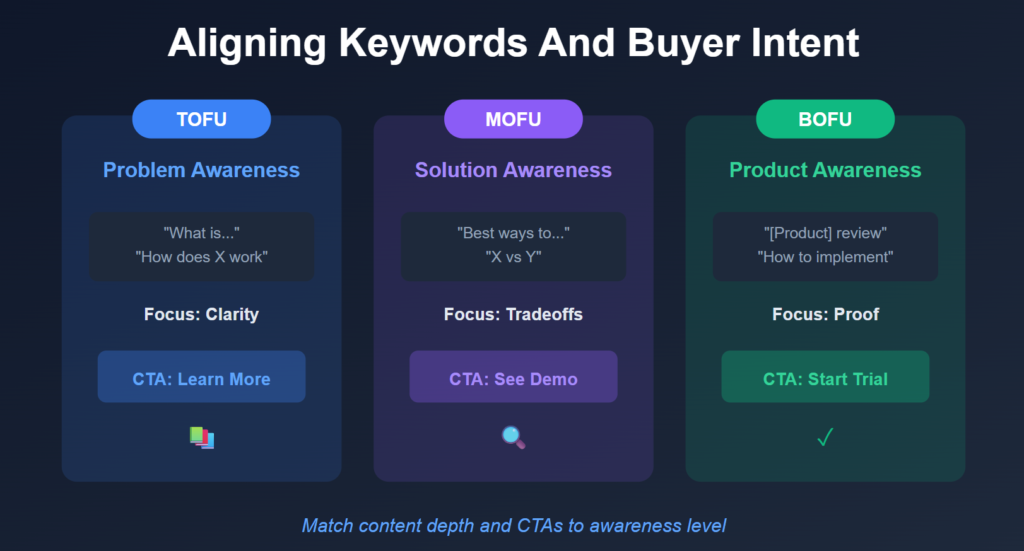
Effective SaaS blogs map keywords to these stages deliberately.
Content depth should increase as intent increases. Early-stage posts focus on clarity and orientation. Mid-stage posts show paths, tradeoffs, and use cases. Late-stage posts address risk, proof, and execution. Each stage has a different job, and forcing the same structure across all of them weakens conversion.
CTAs must follow the same logic.
An early-stage post should not push a trial. A late-stage post should not end with vague education. When CTAs match the reader’s level of awareness, they feel timely instead of intrusive.
This alignment is what allows SEO-driven traffic to contribute to revenue instead of staying isolated as an awareness channel.
Formats That Make Readers Act
Some content formats are easier to read. Others are easier to act on. Converting blogs favor the second.
Formats that drive action are designed around use, not consumption. They show how a problem is handled in practice and make the next step obvious without spelling it out.
Product-led walkthroughs are a strong example.
Instead of describing concepts, they walk through a task step by step and show where the product removes friction. Action steps are embedded directly into the explanation, so the reader can follow along or imagine doing the same inside their own account.
Comparison and migration guides serve a different purpose.
They meet readers who are already evaluating options and need help choosing. These formats work because they acknowledge tradeoffs, constraints, and switching costs openly. By framing the product inside a real decision context, the content becomes part of the evaluation process instead of sitting outside it.
Templates and interactive tools work because they deliver value immediately.
They let the reader experience a small part of the outcome before committing. That experience reduces uncertainty and shortens the distance between reading and trying. When used well, these formats turn interest into momentum without relying on persuasion.
Together, these formats shift the blog from explanation to participation. That shift is what makes action more likely.
How to Measure Whether Your Blog Is Working
Pageviews alone do not tell you whether a blog is doing its job.
A SaaS blog should be measured by how well it moves readers closer to using the product. That requires tracking progress, not just attention.
This is where a KPI ladder becomes useful.
Reading signals sit at the top. Time on page, scroll depth, and section engagement indicate whether the content is being consumed. These metrics show interest, but they are not outcomes.
Micro conversions come next. Newsletter sign-ups, template downloads, or guided walkthroughs signal that the reader found enough value to take a small step. This is often the first point where narrative either works or breaks.
Activation metrics matter more than volume.
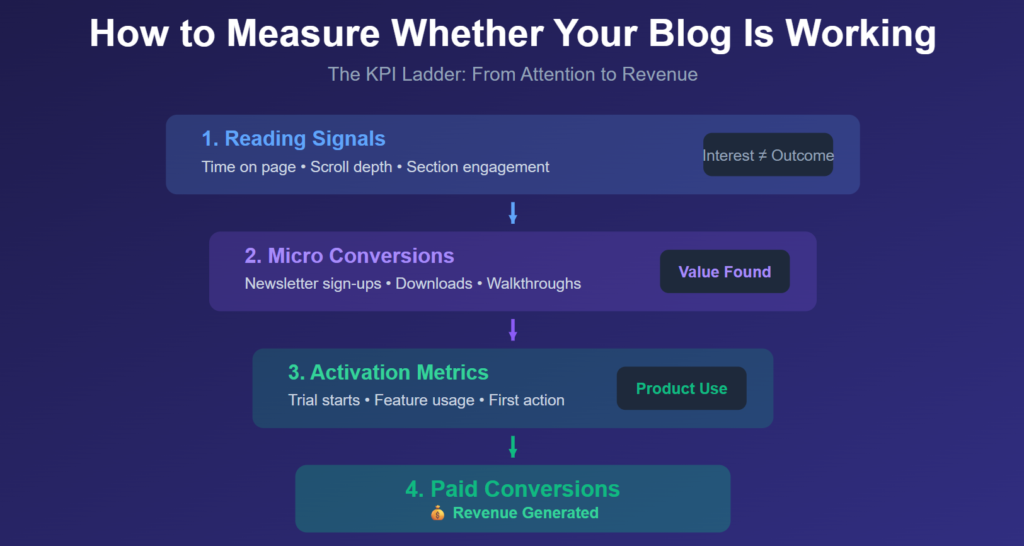
Trial starts, feature usage, or completion of a first meaningful action show whether the content helped a reader move from understanding to use. Paid conversions sit at the bottom of the ladder, but they only happen when the steps above them are aligned.
Engagement data also reveals where narrative weak points exist.
When readers consistently drop off at the same section, the issue is rarely length. It is usually clarity. The story loses direction, the relevance becomes fuzzy, or the path forward is no longer obvious. These signals tell you where the narrative needs reinforcement.
Measurement, done this way, turns the blog into a system you can improve instead of a channel you hope performs.
Quick Fixes You Can Apply In 24 Hours
-
Add one micro-conversion to every post: A checklist, template, or guided example that matches the post’s intent and gives the reader a small, useful win.
-
Replace vague CTAs with role-aligned actions: Each CTA should clearly state who it’s for and what outcome it helps achieve, not just invite a click.
-
Insert product proof where interest peaks: Place screenshots, short examples, or metrics immediately after the section that earns the most attention.
Plug-And-Play Templates For Your Next Post
-
Headline Template: Role + Metric + Obstacle: Frame the post around a specific reader, the outcome they care about, and what’s preventing it. This immediately qualifies attention and sets expectations.
-
Lead-Hook Template: Situation + Constraint + Direction: Open in a real, familiar situation. Name the constraint that makes it hard to move forward. Signal that the post will show how to navigate it.
-
CTA Ladder Template: Micro → Guided → Trial: Offer a small, low-commitment action first. Follow with a deeper, assisted step. Reserve trials or conversations for readers who have earned that point.
From Publishing Content to Driving Decisions
SaaS blogs fail when they stop at explanation.
Throughout this post, the pattern is consistent. Content performs when it helps readers understand a problem. It converts when it helps them decide what to do next. The difference is not volume, SEO, or writing quality. It’s whether the blog takes responsibility for carrying the decision forward.
Narrative is what creates that responsibility.
Not storytelling for effect, but structure that clarifies position, shows a path, and makes the product’s role obvious at the right moment. When content is built this way, reading naturally turns into movement.
The simplest next step is to test this shift on a single post.
Pick one article that already gets traffic. Replace the generic opening with a clearer orientation. Add a small, relevant next action. Insert proof where interest is highest. You don’t need to rewrite everything to see the difference.
If you want help doing that deliberately, this is the work I do.
I help SaaS teams turn existing blogs into decision-support assets that lead to activation, adoption, and revenue, without chasing more traffic or publishing more content.
Reach out. Let’s make your product’s value unmistakable and turn that clarity into growth you can measure.
Keep reading