 Denzil Otieno
How to Create an Effective SEO Strategy in 2026
An effective SEO strategy in 2026 starts with business outcomes, not keywords: core pillars, AI search visibility, common mistakes, and a practical checklist.

SEO did not change overnight.
It moved in phases. First, rankings mattered. Then intent reshaped how content was evaluated. Now, AI mediates how visibility is earned, deciding which explanations users see before they ever click.
That progression has quietly broken the old playbook.
Tactics that once delivered growth in isolation no longer compound on their own. Publishing more pages, chasing marginal keyword gains, or tweaking on-page elements without a system behind them produces diminishing returns.
What works now is coherence.
An effective SEO strategy in 2026 treats search as a system. One where discovery, understanding, trust, and conversion are connected. Not a checklist of tasks, but a framework that aligns content, product value, and business outcomes.
This article breaks down how to build that system.
Start With Business Outcomes Before You Touch Keywords
Most SEO strategies still start with keyword research. That approach worked when rankings reliably brought traffic and traffic reliably produced leads.
Today, that relationship is far less predictable.
In 2026, search will explain things before it sends people to a website. AI summaries, featured answers, and chat-style results will shape how users understand a topic before they ever click.
This changes what SEO needs to focus on.
When a strategy starts with keywords, it focuses on discovery. When it starts with business outcomes, it focuses on decision influence. Those two approaches lead to very different content.
Outcome-first SEO plans content around real business moments. It looks at where search can support revenue, lead quality, product adoption, or retention, and builds pages for those points in the journey. Keywords support the work, but they do not define it.
This is why traffic alone is no longer a strong primary SEO metric. A page can attract visitors and still fail to move anyone forward. What matters is whether search content helps a user take the next step.
An effective SEO strategy in 2026 treats search as a system that supports business growth, not just a channel for visits.
SEO Goals That Actually Matter in 2026
| Business Goal | SEO Metric to Track | Why It Matters |
|---|---|---|
| Revenue growth | Assisted conversions | Connects SEO to real revenue |
| Lead quality | Intent-based sessions | Filters out low-value traffic |
| Product adoption | Feature-page engagement | Links search to product usage |
| Brand authority | Mentions and citations | Influences rankings and AI visibility |
This framing changes how SEO decisions are made.
Content is judged by what it helps achieve, not how much traffic it brings. Each page has a clear role in the buying or usage journey. Optimization becomes planned, not reactive.
This is the point where SEO moves from day-to-day execution to a true business strategy
How Search Behavior Is Changing in 2026
Search no longer starts with fragments.
Users now ask full questions. They explain context. They expect the system to understand intent, not just match words. This shift from keyword queries to conversational search changes how content is discovered and evaluated.
At the same time, answers are showing up earlier.
AI summaries, voice responses, and chat-based results increasingly sit between the question and the website. Users get explanations before they see options. In many cases, they get enough clarity to decide without clicking at all.
This reshapes expectations.
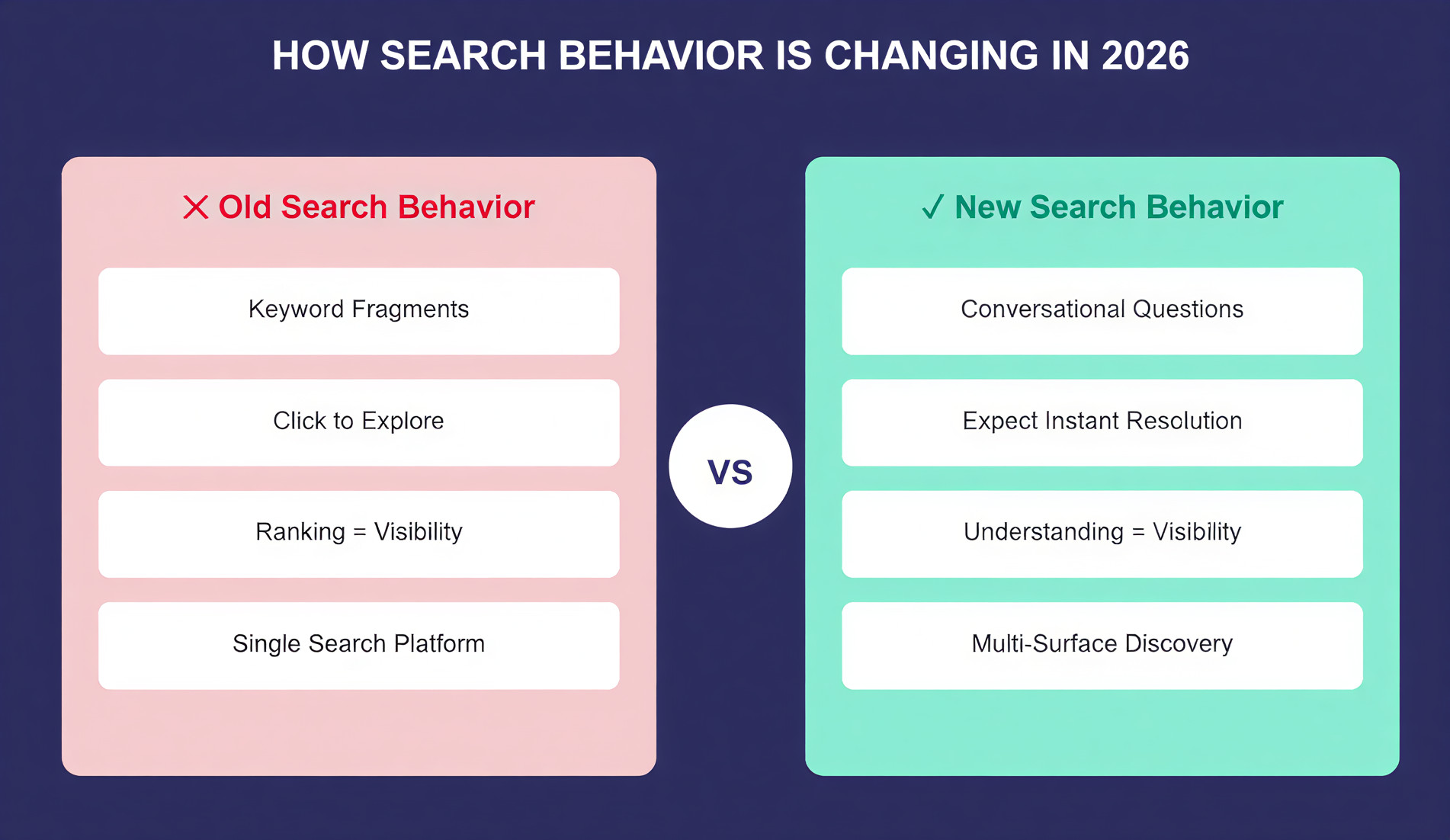
Search is no longer about finding places to explore. Users now expect resolution. They want the system to help them understand a problem, compare approaches, or choose a direction with minimal effort.
For marketers, this means visibility is no longer tied to where a page ranks alone. It is tied to where understanding is formed.
Where Discovery Happens Now
Discovery no longer lives in one place. It happens across multiple surfaces, often at the same time.
-
Google SERPs and AI Overviews: Traditional results now sit alongside AI-generated explanations that shape context before clicks.
-
ChatGPT, Gemini, Perplexity, and Copilot: These tools act as starting points for research, comparison, and learning, not just follow-up tools.
-
Voice assistants and mobile prompts: Spoken and short-form queries favor direct answers over long exploration paths.
-
Social and community search surfaces: Users increasingly search inside platforms where answers feel practical and experience-based.
Together, these changes explain why search strategy in 2026 must focus on clarity and usefulness. Content is no longer competing only for attention. It is competing to be understood and reused.
The Core Pillars of an Effective SEO Strategy in 2026
If you strip SEO down to what actually works, you are left with a few fundamentals that do not change with tools or algorithms.
These pillars are not tactics. They are decisions. Get them right, and everything else compounds. Get them wrong, and no amount of optimization will fix the gap.
The first pillar sits upstream of content, keywords, and tools.
1. Audience and Intent-Driven Research
In 2026, search does not reward coverage. It rewards alignment.
Users no longer search with loose keywords. They search with a problem in mind and an outcome they want. If your content does not match that intent clearly, it gets skipped or ignored, no matter how well it is optimized.
This is why intent clusters matter more than keyword lists.
Keyword lists tell you what people type. Intent clusters tell you what people are trying to solve. They group queries by underlying purpose, not by wording. One problem often shows up in many different searches, asked in different ways, across different stages of understanding.
Your job is not to chase each variation. Your job is to address the problem completely.
That starts with mapping intent to awareness.
Some users are trying to name a problem. Others are comparing options. Others are close to choosing. Mapping problems to stages of awareness helps you decide what kind of content to create and what role it should play.
Early-stage content explains.
Mid-stage content clarifies and compares.
Late-stage content supports action.
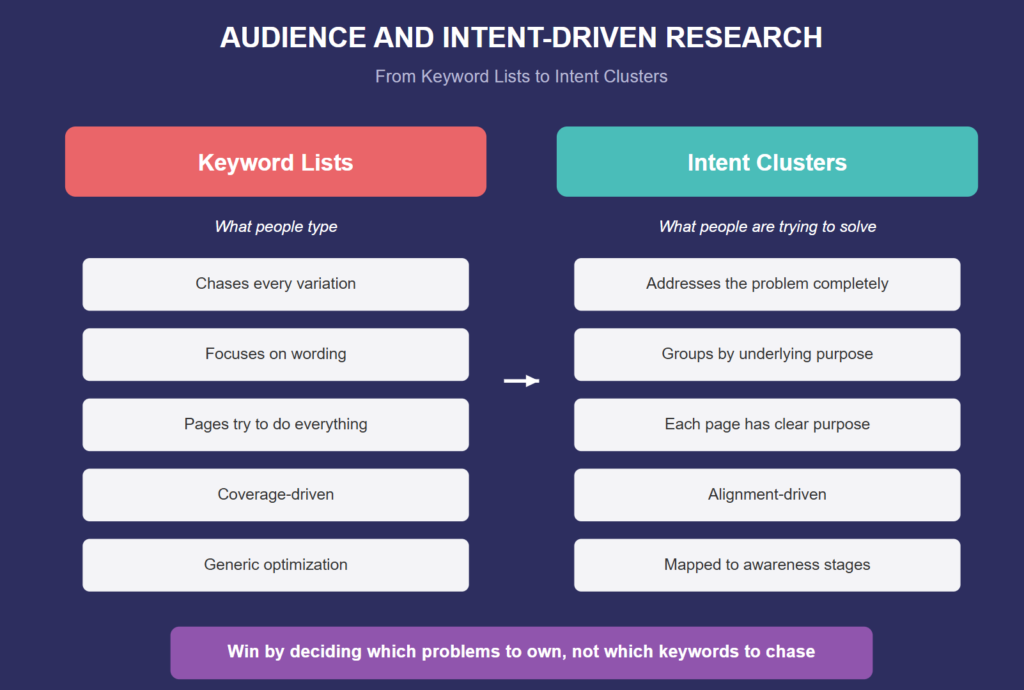
When you research this way, content planning becomes sharper. You stop writing pages that try to do everything at once. Each page has a clear purpose tied to a specific user state.
This is also where AI-driven search becomes easier to win.
Generative systems prefer content that resolves a clear intent. When your content aligns tightly with a specific problem and stage, it becomes easier to understand, easier to extract from, and easier to reuse in answers.
Audience and intent-driven research is not about finding more keywords.
It is about deciding which problems you want to own, and which moments you want search to work for you.
2. Technical SEO as the Discovery Layer
Intent means nothing if your content cannot be reliably discovered.
In 2026, technical SEO is not about chasing edge-case optimizations. It is about removing friction between your content and the systems that need to understand it. Search engines and AI models both rely on clean signals to find, interpret, and trust what you publish.
This starts with crawlability and indexing.
Your site structure should make it obvious what matters. Important pages must be easy to reach, logically linked, and consistently indexed. When architecture is messy, discovery becomes inconsistent. Pages exist, but they are not treated as reliable sources.
Good technical SEO creates a stable foundation where content can be found without guesswork.
Architecture plays a bigger role than most teams admit.
Clear hierarchies help systems understand how topics relate. Supporting pages reinforce core ones. Nothing important is buried. This structure makes it easier for both search engines and AI systems to recognize topical focus and authority.
Then there is structured data and entity clarity.
AI systems do not just read text. They interpret meaning. Structured data helps them understand what a page represents, who it is about, and how different pieces of information connect.
When entities are clear, content becomes easier to classify and reuse. Definitions are recognized as definitions. FAQs are treated as answers. Products, features, and brands are understood in context.
Technical SEO does not create demand. It removes resistance.
It ensures that when your content is relevant, it can be discovered, interpreted, and trusted without friction.
3. Content Built for Answers, Not Rankings
Content no longer wins by covering topics broadly. It wins by answering specific questions clearly.
Search systems now evaluate how well a page resolves intent before they consider where it should rank. This is why direct answers need to come before depth. The core idea should be obvious early, both to the reader and to the systems interpreting the page.
Once that answer is clear, depth does the real work. Long explanations add context, address edge cases, and build trust. They support the answer rather than compete with it.
Structure matters just as much as clarity.
Single, isolated posts struggle to signal authority on their own. Topic clusters create context by connecting related questions, explanations, and use cases across multiple pages. When content is organized this way, search systems can see how ideas relate and where expertise lives.
Clusters are not about publishing more content. They are about making intent coverage visible. Each page handles one job. Together, they explain a problem space completely.
Different content types play different roles inside this structure.
| Content Type | Purpose | SEO Impact |
|---|---|---|
| Direct answer blocks | Resolve core intent quickly | AI reuse |
| Long-form explainers | Provide depth and context | Trust signals |
| Case studies | Show real experience and outcomes | EEAT reinforcement |
When content is planned this way, pages stop competing with each other. Each one exists to support a specific moment in the user’s journey while strengthening the overall topic.
That is how content earns visibility now.
Not by trying to rank for everything, but by being clear enough to be reused.
4. Authority, Trust, and Off-Site Signals
At this point, content quality alone is not enough.
You can publish clear, well-structured pages and still be ignored if nothing outside your site supports them. Search engines and AI systems both rely on external signals to decide whether your content is safe to trust.
This is where brand mentions, PR, and expert content matter.
When your brand is referenced across reputable sites, publications, and communities, it creates a trail of validation. These mentions tell systems that your ideas are not isolated. They are part of a wider conversation.
Authority influences more than rankings.
Search engines use off-site signals to judge credibility. AI systems use the same signals when deciding what to cite or reuse in answers. Content that lacks external support carries more risk during synthesis, no matter how well it is written.
This is why authority compounds.
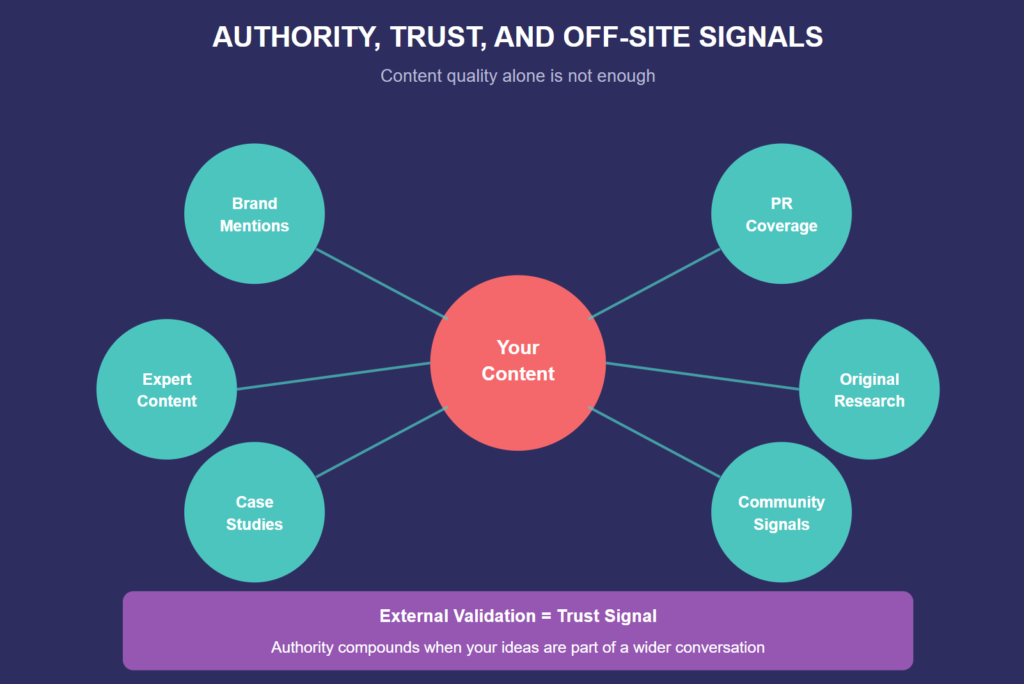
Expert contributions, original research, case studies, and thought leadership give other sites a reason to reference you. Each mention strengthens the signal that your content represents real experience, not just interpretation.
From a strategic standpoint, this changes how SEO work is prioritized.
Link building is no longer just about passing equity. PR is no longer just about exposure. Off-site signals now directly influence whether your content participates in answers at all.
If you want your ideas to shape how problems are explained, you need to earn trust beyond your own pages.
That is what turns visibility into influence.
5. AEO and AI-Ready Optimization
Once authority is established, the next question becomes practical: how your content is actually used.
This is where Answer Engine Optimization (AEO) comes in.
Answer Engine Optimization (AEO) is the practice of structuring content so it can be directly used by AI systems to generate answers, not just indexed or ranked by search engines. It works alongside SEO, not instead of it.
If SEO helps your content get discovered, AEO helps your content get chosen.
For you, this means writing with reuse in mind. Generative systems do not browse pages. They extract explanations. They look for sections that can stand alone, hold meaning, and survive compression without losing clarity.
Preparing content for generative systems requires a few deliberate shifts:
-
Resolve the main question early: Make the primary answer clear near the top. AI systems prioritize content that removes uncertainty quickly.
-
Structure sections around one idea at a time: Each heading should signal a specific problem being solved. Each section should work even when read on its own.
-
Write the way users ask questions: Conversational language mirrors how prompts are formed, making content easier for AI to reuse.
-
Support answers with context, not filler: Depth should clarify, not distract. Examples and explanations help AI systems trust the answer.
-
Use structured data to reinforce meaning: Schema helps classify content, but only when it matches what the page actually explains.
When AEO is part of your SEO strategy, content stops competing only for position.
It starts competing for inclusion.
And that is how your ideas stay visible when answers are formed, not just when pages are ranked.
6. Local, Multimodal, and Emerging Search Surfaces
Search does not live in one place anymore, and you cannot optimize for it as if it does.
Users discover products, services, and information across different surfaces depending on context. Sometimes they are comparing options. Sometimes they are nearby. Sometimes they are speaking, scanning, or tapping instead of typing.
This is why local SEO still matters, even as AI search grows.
Local signals help search systems understand relevance in the real world. Location, proximity, reviews, and consistency across listings all contribute to trust. When your business is tied to a place, local optimization ensures you appear when intent is high and decisions are close.
Beyond local, behavior itself has changed.
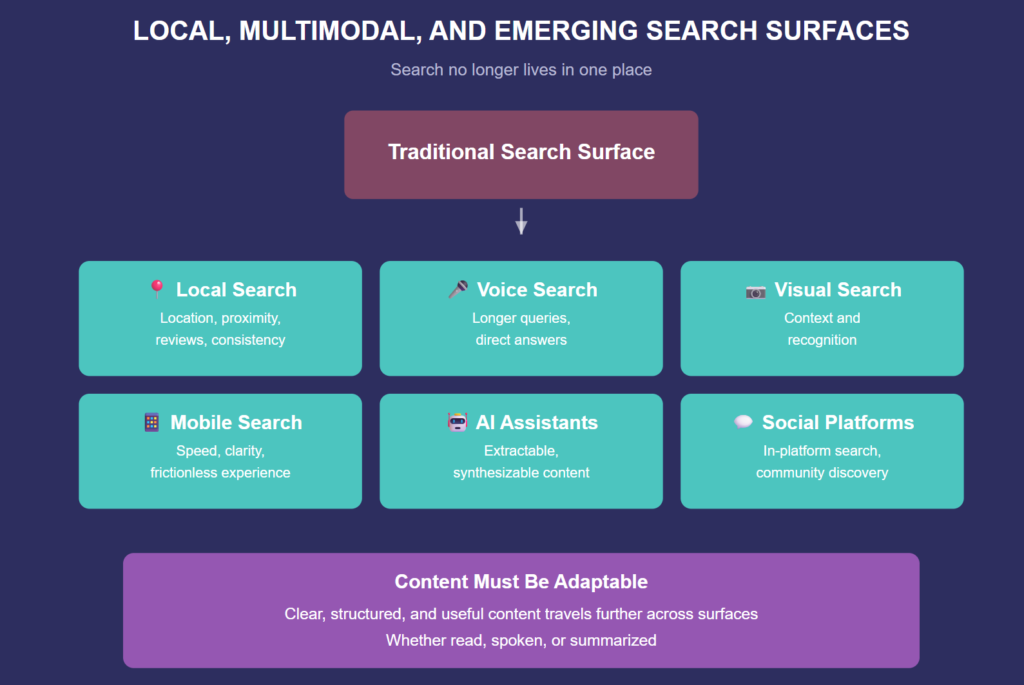
Voice, visual, and mobile-first search shape how questions are asked and how answers are delivered. Spoken queries are longer and more direct. Visual searches rely on context and recognition. Mobile interactions favor speed and clarity.
For you, this means content needs to be adaptable.
Pages should load quickly, explain ideas clearly, and work without friction on smaller screens. Answers should be easy to extract and understand, whether they are read, spoken, or summarized by an assistant.
Emerging search surfaces reward the same principle.
Content that is clear, structured, and useful travels further. It holds up whether it appears in a local result, a voice response, or a visual interface.
If you plan for these surfaces early, your SEO strategy stays resilient as search continues to expand
7. Measurement, Iteration, and SEO as a System
If you treat SEO as a one-time plan, it will break.
Search behavior shifts too fast for annual strategies to hold. Algorithms change. AI systems update how they select sources. User expectations evolve. This is why quarterly planning beats annual guessing.
Quarterly cycles force you to stay close to reality. You review what is working, what is being reused, and what is being ignored. You adjust structure, content, and focus before small issues turn into lost visibility.
Measurement needs the same reset.
Traffic still matters, but it no longer tells the full story. You need to measure influence, not just visits. That means paying attention to how often your content appears in AI summaries, how frequently your brand is referenced, and whether your pages support movement through the funnel.
For you, this changes how success is judged.
A page can perform well without ranking first. A piece of content can drive impact without generating large volumes of clicks. What matters is whether search helps users understand, trust, and act.
When you measure SEO this way, iteration becomes intentional.
You refine what contributes. You remove what does not. Over time, SEO stops feeling like a collection of tasks and starts operating as a system that compounds value.
Common SEO Mistakes to Avoid in 2026
-
Chasing rankings without conversion intent: If a page ranks but does not support a decision, it is not doing its job. Rankings without intent alignment create visibility without impact.
-
Treating SEO as a task list: When SEO becomes a checklist of fixes and optimizations, strategy disappears. SEO works when actions connect to outcomes, not when tasks exist in isolation.
-
Ignoring technical debt: Slow pages, broken structures, and poor indexing quietly limit everything else you do. Technical issues reduce trust and make discovery unreliable for both search engines and AI systems.
-
Publishing without distribution: Content that lives only on your site struggles to earn authority. Mentions, references, and external visibility are what turn good content into trusted content.
Where Product-Led Storytelling Fits Into SEO
Most SEO content explains what something is.
Product-led storytelling explains why it matters and how it works in the real world.
That difference shows up immediately in how users engage with your pages. Story-driven content builds trust faster because it removes guesswork. Instead of abstract promises, you show how a product solves a problem, step by step, in a way the reader can recognize.
This is why product-led narratives improve session quality.
When users understand the product through context and experience, they stay longer, read deeper, and move forward with intent. They are not just consuming information. They are evaluating fit. Search systems notice that behavior.
More importantly, AI systems do too.
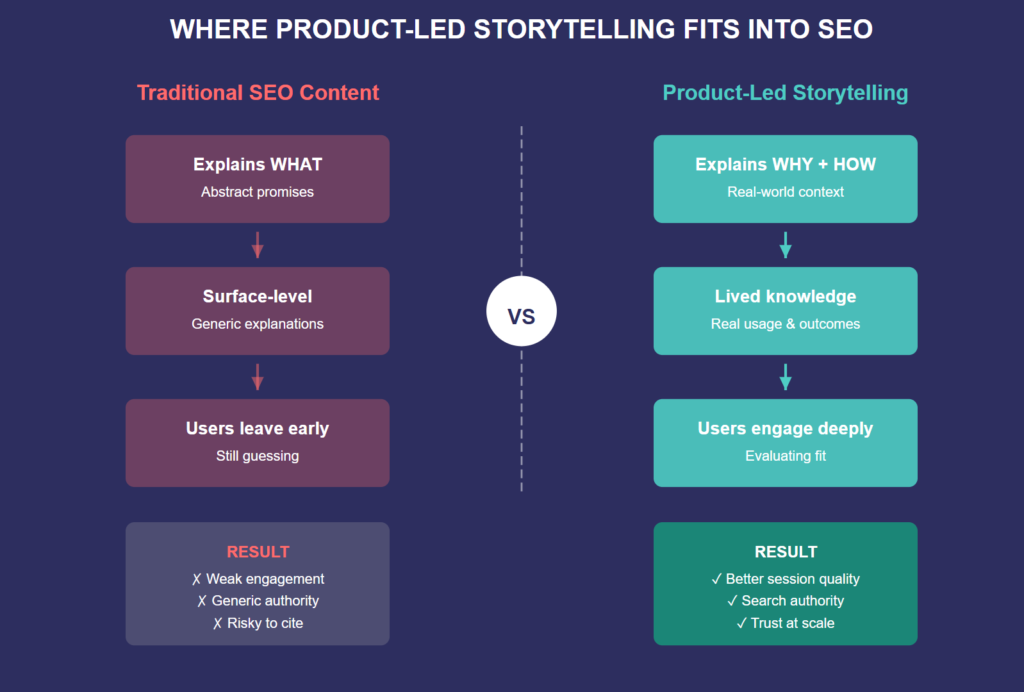
Product experience is one of the strongest forms of search authority. When your content reflects real usage, real decisions, and real outcomes, it becomes safer to reuse. It reads as lived knowledge, not surface-level explanation.
This is how storytelling turns into an SEO advantage.
Not by adding emotion, but by adding clarity.
When your product is embedded into the story, search content stops being generic. It becomes specific. It explains not just the category, but your position within it. Over time, this is how brands earn trust at scale.
Product-Led Stories as SEO Assets
Product-led storytelling is not a single format. It shows up across several high-impact content types.
-
Case studies: These demonstrate outcomes, decisions, and results. They signal experience and reinforce trust for both users and AI systems.
-
Feature narratives: Instead of listing features, you show how they solve specific problems. This helps users understand value without needing a sales conversation.
-
Use-case breakdowns: These map real scenarios to product behavior. They attract high-intent search traffic and support decision-stage visibility.
When these assets are built into your SEO strategy, content stops chasing keywords.
It starts owning understanding.
And that is where product-led storytelling becomes a durable search advantage, not just a brand choice.
A Practical SEO Strategy Checklist for 2026
Use this as a working reference, not a one-time read.
-
Define the outcome first: Decide what SEO is responsible for before you plan content. Revenue support, lead quality, product adoption, retention, or brand authority. If the outcome is unclear, the strategy will be too.
-
Map intent clusters, not just keywords: Group searches by the problem being solved and the stage of awareness. Build content to resolve intent fully, not to capture isolated terms.
-
Fix technical foundations: Ensure clean crawl paths, reliable indexing, logical site structure, and fast load times. Technical clarity makes everything else possible.
-
Structure content for answers: Lead with clear explanations. Use focused sections. Make each page easy to understand, extract from, and reuse in AI-generated responses.
-
Build authority signals beyond your site: Earn mentions, references, and citations through PR, expert content, partnerships, and real distribution. Authority outside your site reinforces trust inside it.
-
Measure quarterly and adapt: Review performance every quarter. Track contribution, influence, and reuse, not just traffic. Adjust based on what actually moves users forward.
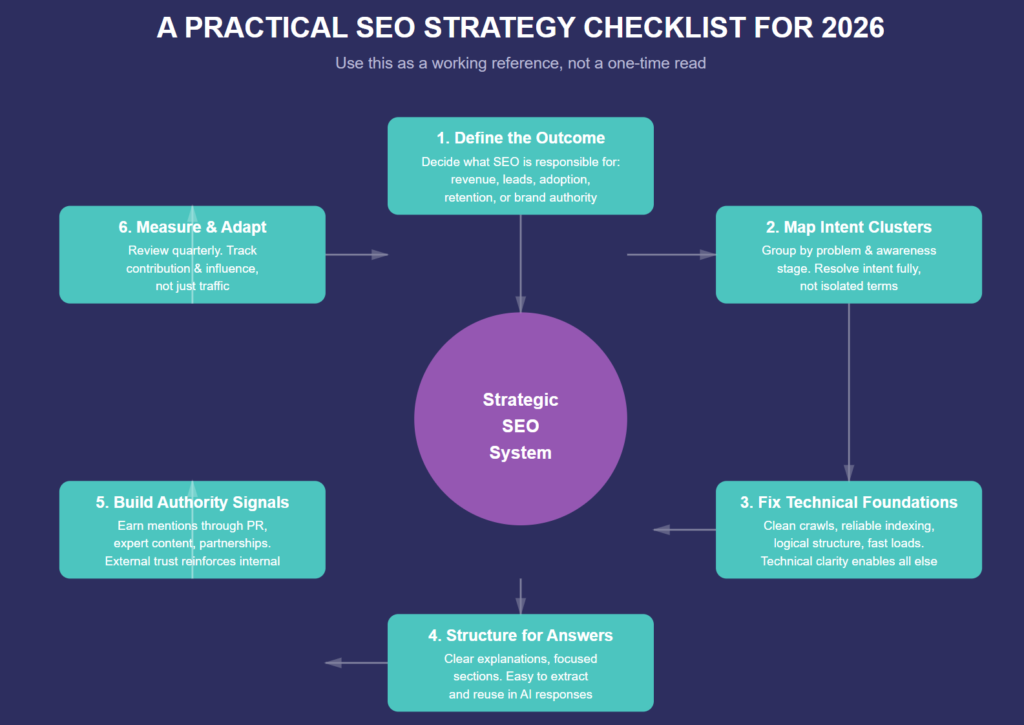
If your SEO work consistently checks these boxes, you are no longer reacting to search changes.
You are building a system that holds up as search evolves.
SEO in 2026 Is a Growth Engine, Not a Channel
If you still treat SEO as a channel, you will always fall behind.
Channels are managed. Growth engines are designed.
In 2026, SEO compounds when it is built to support how people understand problems, evaluate options, and make decisions. Rankings may fluctuate. Traffic may rise or fall. But clarity, intent alignment, and authority compound over time.
That is the leverage.
When your content explains clearly, search works before a click happens. When it matches real intent, it attracts users who are ready to move. When it reflects real experience and earns trust beyond your site, it stays visible even as systems change.
This is why SEO now sits closer to strategy than execution.
It influences how your product is understood.
It shapes how your category is framed.
It determines whether your ideas are reused when answers are formed.
Owning SEO in 2026 means stepping away from tactics as the starting point. It means deciding what role search plays in growth, then building the system to support that role consistently.
When you do that, SEO stops being something you “do.”
It becomes something your business benefits from, quarter after quarter.
That is the difference between chasing visibility and building momentum.
And that is how SEO earns its place as a growth engine.
Keep reading