 Denzil Otieno
How to Win the Age of AI Search with Generative Engine Optimization SEO (GEO)
Generative Engine Optimization (GEO) is how content gets selected and cited by AI search. A step-by-step framework: answer blocks, structure, and topic authority.

SEO used to be a ranking problem.
You researched keywords, optimized pages, and built links. If you reached page one, the system worked. Traffic followed rankings, and rankings followed optimization.
That model held for years.
Then search stopped behaving like a directory and started behaving like a decision engine.
Generative systems now read, synthesize, and answer questions directly. They pull from multiple sources, compress context, and present a single response before users ever see a list of links. In many cases, there is no click to win.
This is where traditional SEO begins to fall short.
You can still rank highly and remain invisible inside AI-generated answers. You can publish strong content and never be referenced by the systems users now trust for explanations, comparisons, and decisions.
Generative Engine Optimization (GEO) exists to address that shift.
GEO focuses on making content understandable, extractable, and trustworthy to AI systems, not just indexable by search engines. It determines whether your insight becomes part of the answer or disappears behind it.
This article breaks down what GEO is, how it differs from SEO, and how marketers can adapt their content strategy for an answer-first search landscape.
What is Generative Engine Optimization (GEO)?
Generative Engine Optimization starts where traditional SEO begins to lose its grip.
For years, optimization meant helping a page rank. You structured content so search engines could index it, score it, and place it higher than competing pages. Visibility came from position. Traffic came from clicks.
GEO shifts that center of gravity.
Generative Engine Optimization (GEO) is the practice of optimizing content so AI systems can understand it, trust it, and reuse it when generating answers. It is not about appearing in a list of results. It is about becoming part of the response a user reads.
In other words, GEO optimizes for AI-generated answers, not just rankings.
This distinction matters because modern search tools no longer act like directories.
When someone asks a question in ChatGPT, Gemini, Perplexity, Google AI Overviews, or Microsoft Copilot, the system does not send them browsing. It reads across sources, identifies consistent explanations, and synthesizes a single answer. The content that survives this process is not the most optimized page. It is the clearest, most complete, and most reliable explanation.
GEO exists to make content usable in that moment.
This is where SEO and GEO separate.
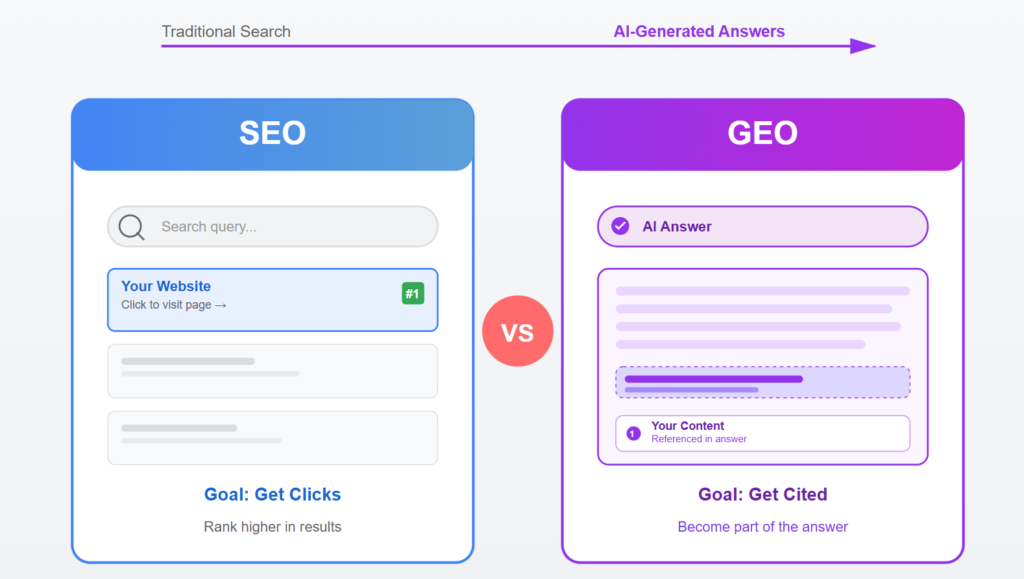
SEO gets a user to your link. GEO gets your thinking into the answer itself.
SEO measures success in rankings, impressions, and sessions. GEO measures success in references, summaries, and citations, even when the user never clicks through. The page becomes secondary. The idea becomes primary.
That does not make SEO obsolete. It reframes it.
SEO helps AI systems discover your content. GEO determines whether that content is chosen, trusted, and reused when the answer is formed.
As search continues to move from exploration to explanation, GEO becomes the layer that decides whose voice is heard when questions are answered.
SEO vs Generative Engine Optimization (GEO)
The difference between SEO and GEO is not in the tools used, but in what success looks like.
SEO optimizes pages to rank. GEO optimizes content to be reused. One competes for position. The other competes for inclusion. This is why the same page can perform well in search results and still disappear inside AI-generated answers.
That difference reshapes how keywords function.
In traditional SEO, keywords often mirror search syntax. Short phrases. Modified terms. Variations designed to match how users type. In GEO, language must match conversational intent, because generative systems respond to how people ask questions, not how they structure queries.
Content is evaluated for how well it answers, not how well it matches a string.
Structure follows the same logic.
Ranking rewards density. Extraction rewards clarity. GEO favors clear sections, defined concepts, and self-contained explanations, because AI systems pull answers from specific passages, not entire pages. When meaning is easy to isolate, it is easier to reuse.
Authority remains foundational, but its role becomes more visible.
EEAT acts as a baseline for AI trust. Expertise, experience, author credibility, and external validation help generative systems decide which sources are safe to cite when synthesizing responses. Authority no longer just boosts rank. It enables participation.
Seen together, SEO and GEO are not competing strategies.
SEO helps your content get discovered. GEO determines whether that content is chosen when answers are formed. One earns visibility through placement. The other earns it through trust and clarity.
This is why GEO does not replace SEO. It sits on top of it.
| Aspect | Traditional SEO | Generative Engine Optimization (GEO) |
|---|---|---|
| Primary goal | Rank pages higher in search results | Become part of AI-generated answers |
| Main success metric | Rankings, traffic, clicks | Citations, references, answer inclusion |
| Unit of visibility | Webpage or URL | Passage, explanation, or idea |
| User interaction | User clicks a link to explore | User reads a synthesized response |
| Optimization focus | Keywords, backlinks, on-page signals | Clarity, structure, authority, context |
| Content structure | Page-level optimization | Modular, extractable content blocks |
| Discovery method | Search engine crawlers | AI retrieval and synthesis systems |
| Role of authority | Improves ranking | Determines trust and reuse in answers |
| Traffic dependency | Essential for value | Optional or indirect |
| Outcome | Visibility through position | Visibility through participation |
Why Marketers Should Care (Context Over Clicks)
The biggest impact of AI search does not happen at the end of the funnel.
It happens at the beginning.
Generative systems increasingly shape the first moment a user encounters a question, a category, or a solution. In many cases, that interaction happens entirely inside an AI interface. No SERP. No scrolling. No comparison between ten results.
The user hears an explanation, not a list.
This matters because early understanding influences every decision that follows. When an AI system explains a problem, frames a category, or recommends an approach, it quietly sets the baseline for what feels credible and familiar.
If your content is not part of that explanation, your brand may never enter the conversation.
This is where GEO changes the value equation.
Traditional SEO optimizes for the moment after curiosity has already formed. GEO operates before that, at the point where understanding is being shaped.
The benefits reflect that shift.
-
Pre-click brand authority: When an AI system references your explanation, your thinking reaches the user before they choose where to go. Authority is established without a visit. Your brand becomes associated with clarity, not just visibility.
-
Contextual trust: Generative engines favor sources that explain concepts cleanly and consistently. When your content is used to frame an answer, trust is transferred by association. The user does not just see your name. They inherit your perspective.
-
Share of attention in synthesized results: AI answers rarely rely on a single source. They blend multiple viewpoints into one response. GEO increases your share of that blended attention, ensuring your insights influence the final narrative instead of being excluded from it.
This reframes how performance should be evaluated.
Traditional SEO measures success by rank and traffic. GEO measures success by citation footprint and influence inside AI-generated responses.
A page can rank well and still contribute nothing to how a category is explained. GEO focuses on whether your ideas shape the answer users remember, not just the link they might click.
As search continues to move toward answer-first experiences, marketers who optimize only for clicks risk becoming invisible at the moment meaning is formed.
GEO ensures your content is present where understanding begins.
How Generative Engines Work (A Marketer’s Map)
Generative engines do not search the web the way traditional search engines do.
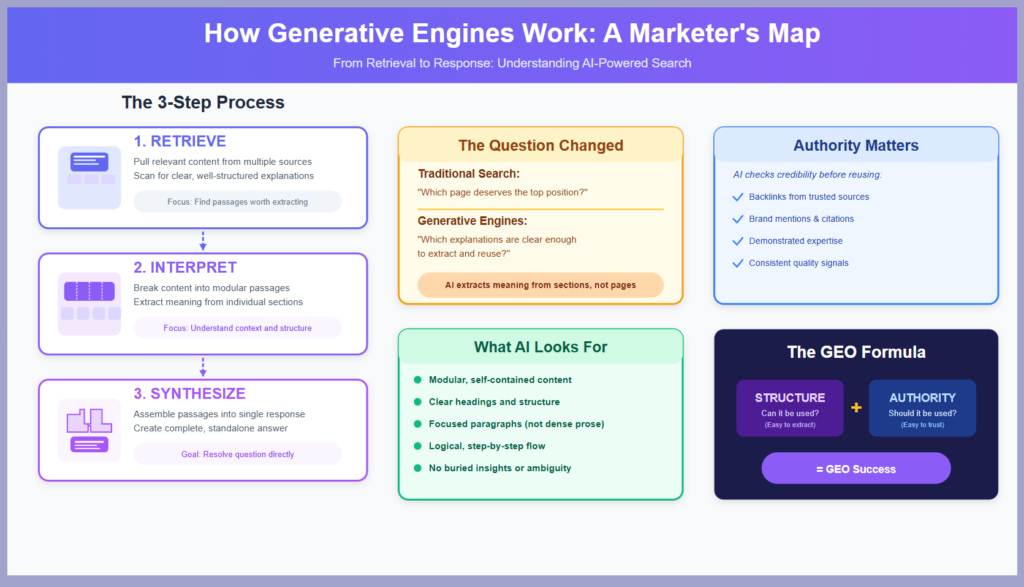
They do not scan pages, score them, and line them up by relevance. They retrieve, interpret, and assemble information to produce an answer that sounds complete on its own.
LLM-based search systems pull relevant content, break it into passages, and synthesize those passages into a single response. The goal is not to send the user somewhere else. It is to resolve the question directly.
This is why content selection works differently.
Instead of asking which page deserves the top position, generative engines ask which explanations are clear enough to reuse. They look for passages that define concepts cleanly, outline steps logically, or explain cause and effect without ambiguity.
AI systems extract meaning from sections, not from entire pages.
This is where structure becomes a competitive advantage.
Content that is modular, well-labeled, and logically segmented is easier for AI systems to understand and repurpose. Clear headings, focused paragraphs, and self-contained explanations increase the likelihood that a passage is selected and included in an answer.
In contrast, dense pages that rely on flowery transitions or buried insights are harder to extract from, even if they rank well.
Authority still plays a role, but it functions differently than in traditional SEO.
Generative engines rely on authority signals to assess credibility before reusing content. Backlinks, brand mentions, demonstrated expertise, and consistent citations help AI systems determine which sources are safe to trust when forming an answer.
This means GEO is not about choosing between structure and authority. It requires both.
Structure determines whether your content can be used. Authority determines whether it should be.
When marketers understand this retrieval-and-synthesis model, GEO stops feeling abstract. It becomes a practical exercise in making ideas easy to find, easy to trust, and easy to reuse.
A GEO Action Framework: Step-by-Step
GEO does not require abandoning what already works. It requires building on it with intention.
Each step below reflects how generative engines actually discover, evaluate, and reuse content. Follow them in sequence. Skipping steps weakens the ones that follow.
Step 1: Master the Basics of SEO First
GEO depends on discoverability.
If AI systems cannot reliably find your content, they cannot cite it. Crawling, indexing, internal linking, and technical hygiene still matter because generative engines rely on search infrastructure to surface source material.
SEO makes your content visible. GEO makes it usable.
Before optimizing for AI answers, ensure your foundation is sound. Pages should be accessible, well-linked, and clearly focused. GEO does not bypass SEO. It assumes it is already working.
Step 2: Reorient Content Around Questions
AI systems respond to questions, not keyword strings.
This means your content must be built around the questions users actually ask, using natural language that mirrors how problems are described in conversation. The goal is not to match search syntax. It is to resolve uncertainty.
Think in questions and answers, not keywords and variations.
When a section clearly answers a specific question, it becomes easier for AI systems to extract and reuse that explanation.
Step 3: Structure for AI Extraction
Generative engines do not read pages the way humans do.
They scan for structure. They isolate sections. They reuse passages that stand on their own. This is why modular content structure matters.
Clear headings, focused paragraphs, concise bullets, and defined summaries increase the likelihood that a passage is selected. Each section should explain one idea completely, without relying on surrounding context.
If a paragraph cannot be lifted and still make sense, it is harder for AI to use
Step 4: Build Topic Authority (Clusters Not Islands)
AI systems evaluate content in context.
A single page rarely establishes enough coverage to signal authority. Topical clusters help AI connect related ideas across multiple pages, reinforcing expertise and consistency.
When your content addresses a topic from multiple angles and links those explanations together, it becomes easier for generative engines to trust your perspective and reuse it across different questions.
Authority is not claimed. It is demonstrated through coverage.
Step 5: Earn External Mentions and Citations
Generative engines pay attention to real-world validation.
Mentions, citations, backlinks, and references across reputable sources help AI systems assess credibility. These signals reduce risk when selecting sources to include in an answer.
Citations matter because AI systems optimize for trust.
This makes distribution, partnerships, and thought leadership part of GEO, not separate from it. Content that is referenced elsewhere is more likely to be reused when answers are formed.
Step 6: Optimize for Multiple Engines
Not all AI systems behave the same way.
ChatGPT, Gemini, Perplexity, Google AI Overviews, and Copilot rely on different retrieval methods and source preferences. Some emphasize freshness. Others prioritize authority or breadth.
GEO requires optimizing for multiple AI search interfaces, not a single algorithm.
This means monitoring where your content appears, how it is referenced, and which formats perform best across engines.
Step 7: Track Visibility and Update Continuously
GEO is not a one-time optimization.
AI systems evolve. Source preferences shift. Content that was once referenced can be replaced. This makes monitoring visibility essential.
Track AI citations, references, and answer inclusion over time. Update content to improve clarity, coverage, and relevance. GEO rewards consistency and maintenance, not static publishing.
When your content improves, your chances of being reused improve with it.
GEO Tactics that Deliver Results
Once you understand how generative engines retrieve and assemble answers, execution becomes more precise.
These tactics focus on making your content easier to select, easier to trust, and easier to reuse inside AI-generated responses.
1. Use Direct Answer Blocks to Resolve the Core Question Early
Generative engines look for resolution before they look for depth.
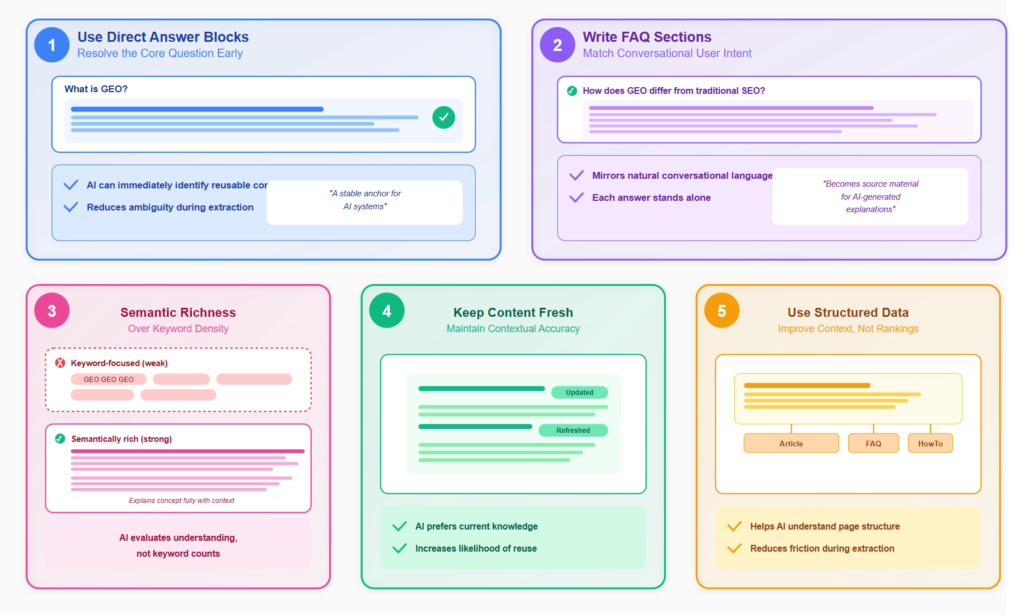
When a page opens with a clear, concise answer to the primary question, AI systems can immediately identify what the content is about and whether it is reusable. This is not a summary for humans. It is a signal for machines.
Direct answer blocks reduce ambiguity during AI extraction.
A short paragraph that defines a concept, explains a process, or states a conclusion gives generative systems a stable anchor. Once that anchor exists, the rest of the content provides supporting context rather than competing explanations.
2. Write FAQ Sections That Match Conversational User Intent
AI systems learn from how questions are phrased.
FAQs work best when questions mirror natural, conversational language, not keyword-stuffed variants. This aligns directly with how users prompt ChatGPT, Gemini, and Perplexity.
FAQ sections help AI map questions to answers without reinterpretation.
Each question should address a single intent. Each answer should stand on its own. When written this way, FAQ sections often become the source material for AI-generated explanations.
3. Prioritize Semantic Richness Over Keyword Density
Generative engines do not count keywords. They evaluate understanding.
Content performs better in GEO when it fully explains a concept, including related ideas, causes, implications, and boundaries. This depth allows AI systems to grasp meaning rather than infer it.
Semantic richness helps AI assess topical understanding and reliability.
Instead of repeating terms, focus on explaining the idea clearly enough that it could be taught, summarized, or reused without distortion.
4. Keep Evergreen Content Fresh and Contextually Accurate
AI systems prefer content that reflects current knowledge.
Even evergreen topics benefit from updates that clarify definitions, expand coverage, or reflect changes in industry language. Freshness does not mean rewriting everything. It means removing outdated assumptions.
Content freshness increases the likelihood of continued AI reuse.
When explanations stay current, they remain safe for generative systems to include in answers.
5. Use Structured Data to Improve Context, Not Rankings
Structured data supports interpretation, not visibility.
Schema helps AI systems understand what type of information a page contains and how sections relate to one another. This is especially useful for definitions, FAQs, and instructional content.
Structured data improves contextual clarity during AI retrieval.
It does not replace good writing. It reduces friction when systems decide how to classify and reuse your content.
Common GEO Mistakes Marketers Make
Most GEO failures are not strategic. They are behavioral. Teams apply familiar SEO habits to a system that no longer evaluates content the same way.
These are the mistakes that quietly keep content out of AI-generated answers.
-
Treating GEO as a replacement for SEO: GEO depends on discoverability. If AI systems cannot reliably find your content through search infrastructure, they cannot cite it. GEO builds on SEO. It does not bypass it.
-
Optimizing pages instead of explanations: AI systems extract meaning from passages, not layouts. When insights are buried inside long narrative flow, they become harder to reuse. Clear, self-contained explanations travel further.
-
Writing for keywords instead of questions: Generative engines respond to conversational intent. Content shaped around keyword syntax rather than real questions often feels incomplete or forced when reused in answers.
-
Assuming length equals authority: Depth comes from clarity, not word count. Overly long sections that delay conclusions introduce ambiguity, which reduces the likelihood of citation.
-
Ignoring external mentions and citations: AI systems evaluate trust using real-world validation. Content that is never referenced elsewhere carries more risk during answer synthesis.
-
Failing to monitor AI visibility over time: GEO is not static. Source preferences change. Content that is not reviewed, updated, and reinforced loses its place inside AI-generated responses.
The Future of Search is Answer-First
Search is no longer organized around exploration.
It is organized around resolution.
As generative interfaces become default entry points, users increasingly expect answers, not options. They ask full questions. They expect clear explanations. They trust systems that reduce complexity before presenting choice.
This is why GEO is becoming table stakes, not an advantage.
When AI systems shape how categories are explained and how problems are framed, visibility depends on participation inside those explanations. Brands that are absent at this stage do not get a second chance later in the funnel.
Recent research reinforces this direction.
Studies show that generative models demonstrate a bias toward third-party authority when selecting sources to cite. Independent publications, established brands, and externally validated content are more likely to be reused than self-referential or weakly supported sources.
This signals where search is heading.
Authority, clarity, and context are no longer just ranking factors. They are prerequisites for inclusion. GEO formalizes this reality and gives marketers a way to respond deliberately instead of reactively.
Closing Perspective: From Being Found to Being Used
You are no longer optimizing for discovery alone.
Whether you choose to acknowledge it or not, AI systems are already deciding which explanations users hear first. They are shaping how problems are understood before a click ever happens. That means your content is either part of that understanding, or it is invisible at the moment it matters most.
Being found is no longer the finish line. Being used is.
This is the shift GEO responds to.
You can continue to optimize pages for rankings and hope traffic follows. Or you can design your content so it survives synthesis, earns trust, and becomes part of the answers users rely on.
That choice shows up in how you write.
In how you structure explanations.
In how seriously you treat clarity, authority, and context.
GEO is not about chasing a new algorithm. It is about aligning with how information is now delivered.
If you want your ideas to shape decisions, your content must do more than rank. It must explain. It must hold up when removed from the page. It must be clear enough to be reused without you being present.
That is the work in front of you.
Not to publish more.
Not to optimize harder.
But to make your thinking unmistakable when answers are formed.
That is what visibility looks like now.
Frequently Asked Questions About Generative Engine Optimization (GEO)
What is Generative Engine Optimization (GEO)?
Generative Engine Optimization (GEO) is the practice of optimizing content so it can be understood, trusted, and reused by AI systems when they generate answers. Unlike traditional SEO, GEO focuses on being cited inside AI-generated responses rather than ranking for clicks.
How is GEO different from SEO?
SEO optimizes pages to rank in search results. GEO optimizes explanations to be included in AI answers. SEO is measured by traffic and rankings. GEO is measured by citations, references, and visibility inside generative search interfaces.
Does GEO replace traditional SEO?
No. GEO builds on SEO. Search engines still help AI systems discover content. SEO ensures visibility. GEO determines whether that content is selected and reused when answers are formed.
Which AI search engines use GEO principles?
GEO applies to ChatGPT, Google AI Overviews, Gemini, Perplexity, and Microsoft Copilot, among others. Any system that synthesizes answers from multiple sources relies on the same core signals: clarity, structure, and authority.
How do I know if my content is appearing in AI-generated answers?
You can monitor AI citations, references, and brand mentions across generative platforms, track prompt-based visibility, and observe whether your explanations are paraphrased or reused in responses. GEO performance is measured by influence, not just traffic.
What type of content performs best for GEO?
Content that performs best for GEO is clearly structured, question-driven, semantically rich, and externally validated. Pages with direct answers, strong topical coverage, and consistent citations are more likely to be reused by AI systems.
Keep reading