 Denzil Otieno
Conversion Copy Isn’t Persuasion, It’s Clarity
Conversion copy's job is not to persuade harder but to make the decision obvious. Most conversion failures are clarity failures after interest already exists.


Conversion copy has been overengineered.
Everywhere you look, it’s urgency, persuasion frameworks, psychological triggers, and increasingly aggressive promises. The assumption underneath all of it is simple: if people don’t convert, they need more convincing.
That assumption is wrong.
Most conversion failures happen after interest is already established. The buyer is not asking whether they want the product. They are trying to understand what committing actually means. When that understanding is fuzzy, action slows. When it’s incomplete, action stops.
This article argues that conversion copy has been misdiagnosed. Its job is not to persuade harder. Its job is to make the decision obvious enough to finish.
The Persuasion Myth That Weakens Conversion Copy
Most conversion copy problems trace back to a single assumption about how buyers behave at the point of decision.
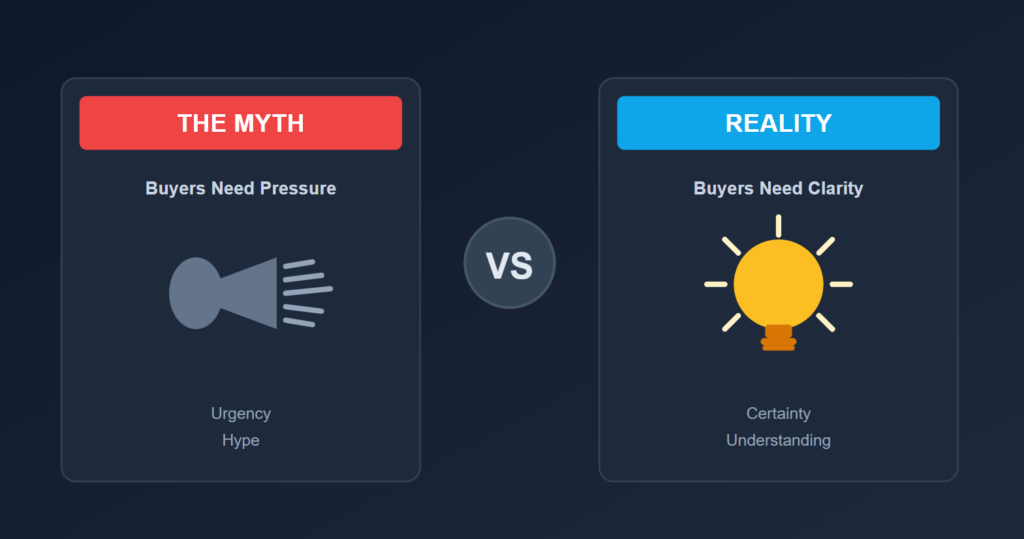
Persuasion Assumes Resistance
A large share of conversion advice treats the reader as skeptical by default. Pages are written to overcome doubt, apply urgency, and push the buyer toward action as if resistance is the primary obstacle.
At the conversion stage, that framing distorts the job of the page. Pressure shifts the buyer’s attention away from the decision and toward the message itself. Instead of evaluating whether the choice makes sense, they start evaluating the intent behind the copy.
This increases cognitive load at the worst possible moment. The buyer is no longer resolving a decision. They are managing tension introduced by the page. What looks like persuasion often becomes the reason progress slows.
High-Intent Buyers Are Uncertain, Not Unmotivated
Conversion copy inherits desire. It does not create it. By the time a buyer reaches a pricing page, demo form, or checkout, interest has already been established through earlier exposure.
What delays action at this stage is uncertainty. Buyers hesitate when outcomes feel underspecified, tradeoffs feel hidden, or implications of commitment remain unclear. That hesitation persists even when the product is relevant and the problem is real.
Treating this as a motivation problem leads teams to push harder instead of clarifying more. The page gets louder while the decision stays unresolved. Conversion improves when uncertainty is reduced, not when pressure is increased.
What Conversion Copy Is Actually Responsible For
Once you remove persuasion from the job description, the role of conversion copy becomes far more specific.
Reducing Decision Friction
Conversion copy exists to simplify evaluation. At the point of commitment, the buyer is comparing risk, effort, and outcome in real time. Anything that complicates that comparison slows progress.
Interpretation is one of the most common sources of friction. When buyers have to infer meaning, translate promises, or connect dots the page leaves implicit, effort increases. That effort shows up as hesitation, second-guessing, or abandonment.
Effective conversion copy minimizes the work required to understand the decision. It presents information in a way that supports evaluation rather than competing with it.
Making The Product Legible
Buyers convert when the consequences of choosing are clear. They want to understand what changes after the click, how the product fits into their workflow, and what committing actually unlocks.
Legibility comes from specificity, not enthusiasm. Clear copy makes the product easy to reason about by showing how it behaves, where it fits, and what it does not attempt to do.
Excitement without clarity creates hesitation. When the page sounds confident but leaves outcomes undefined, buyers pause to protect themselves from making the wrong call.
Why Persuasive Techniques Backfire At The Conversion Stage
Persuasive tactics change how buyers process information at the exact moment clarity matters most.
Emotional Tactics Compete With Reason
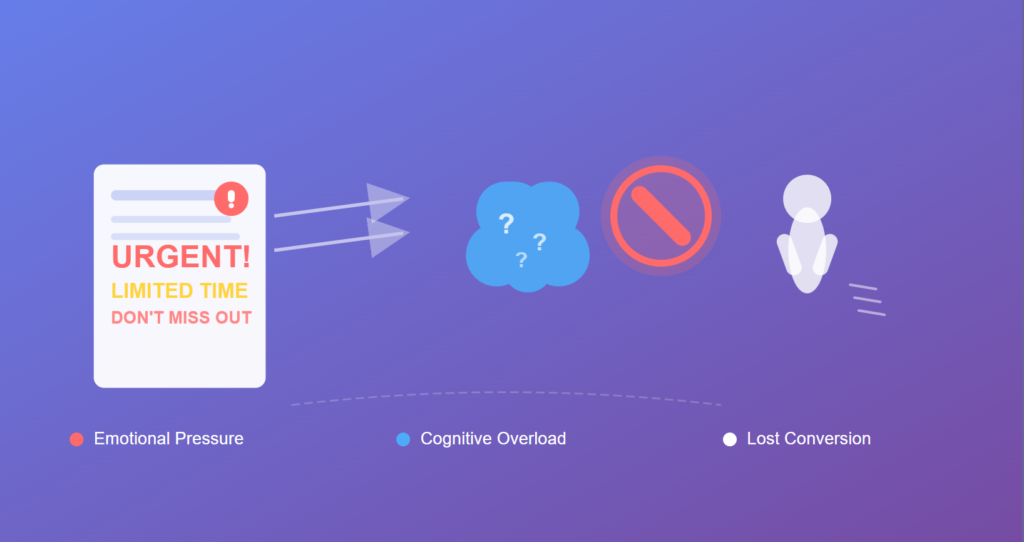
Urgency, hype, and emotional framing pull attention toward the language itself. Instead of evaluating the decision, buyers start evaluating the message, questioning intent, and scanning for exaggeration.
This shift is subtle but costly. The page becomes something to interpret rather than something to act on. Mental effort is spent managing pressure rather than resolving the choice. The more force the copy applies, the more cognitive resources are diverted away from decision-making.
At the conversion stage, attention is finite. When persuasion competes with reason, reason loses ground
Clever Language Introduces Ambiguity
Clever copy asks the reader to decode meaning. Metaphors, slogans, and wordplay create distance between what is said and what is meant.
That distance increases cognitive load. Buyers have to translate language into implications, outcomes, or next steps. Each act of translation adds friction to the decision.
At the moment of commitment, ambiguity functions as risk. When meaning is unclear, hesitation becomes the rational response.
Clarity Is Structural, Not Stylistic
Clarity is not created by tone, friendliness, or simplification. It is a consequence of how information is arranged.
Clear Copy Is Organized Around Decisions
Effective conversion copy is structured around the questions buyers must resolve before committing. Each section exists to answer one decision-critical concern, not to decorate the page or reinforce a mood.
Order matters. Buyers evaluate risk in a predictable sequence. When sections follow that sequence, the page feels easy to move through. When they do not, readers are forced to jump, re-read, or fill gaps on their own. Friction appears even when the writing itself is clean.
Structure does most of the work clarity is often credited for.
Clear Copy Surfaces Hidden Questions
Hesitation usually comes from questions the page does not openly address. Pricing mechanics, usage constraints, and outcome boundaries tend to sit below the surface of the decision, shaping risk perception without being explicitly named.
Clear copy brings those questions into view. It defines how pricing actually works, where the product fits, and where it does not. By making limits visible, the page removes the need for defensive interpretation.
When hidden questions are surfaced, the decision becomes easier to complete.
What Clarity Looks Like In High-Performing Conversion Copy
Clarity shows up in choices the page makes about what to say and what to leave out.
Specificity Over Broad Benefit Claims
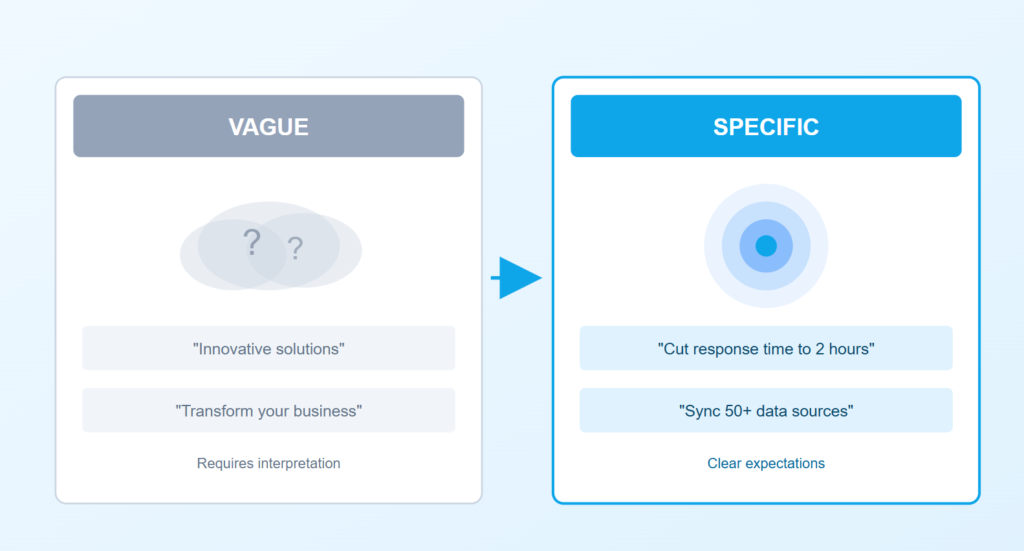
High-performing conversion copy favors concrete outcomes over abstract promises. Buyers make decisions more easily when they can picture what the product actually delivers rather than interpret what a benefit might mean.
Specificity reduces risk by anchoring expectations. When outcomes are named clearly and limits are acknowledged, trust increases. Constraints signal control and intent, which makes the decision feel safer rather than smaller.
Vague benefit language leaves room for interpretation. Interpretation invites doubt.
Plain Language Without Oversimplification
Clear copy relies on precision, not friendliness. When language is exact, fewer words are required to communicate meaning. Precision naturally shortens copy by removing the need for explanation or reinforcement.
Direct language respects the reader’s intelligence. It allows buyers to evaluate the decision without being guided, softened, or reassured. When language stays out of the way, clarity does its work quietly.
Where Persuasion Belongs In The Funnel
Persuasion plays an important role, just not at the point where the decision is executed.
Persuasion Happens Before The Conversion Moment
Persuasion belongs earlier in the journey, where beliefs are still forming. Thought leadership shapes how buyers understand their problem. Education reframes what success looks like and what options are worth considering.
By the time a buyer reaches a conversion page, that work should already be done. The page inherits a set of assumptions and priorities shaped upstream. Its responsibility is to work within those assumptions, not reopen them.
Mixing Funnel Stages Dilutes Conversion
Conversion pages fail when they try to persuade and convert at the same time. Introducing new beliefs at the moment of commitment forces the buyer to slow down and reassess rather than proceed. This is the same failure pattern behind most landing pages that don't convert: the page is doing a job that belonged to an earlier stage.
Effective conversion copy operationalizes existing beliefs. It translates prior agreement into action by showing how the decision plays out in practice. When funnel stages stay separate, conversion becomes simpler and more reliable.
How To Audit Conversion Copy For Clarity
This section moves from diagnosis to application. The goal is to make clarity testable.
The “What Happens Next” Test
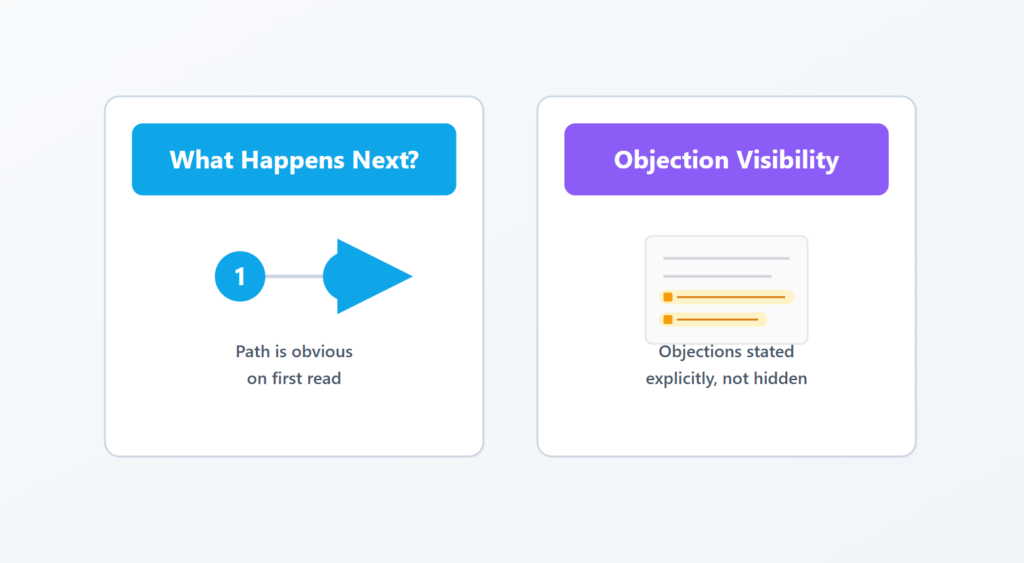
After reading the page once, you should be able to explain the next step without scanning back up. If the sequence of actions is unclear, clarity is missing.
This test exposes hidden friction. When readers need to reorient themselves, the page has left too much work unresolved. Clear conversion copy makes the next step obvious on first pass.
The Objection Visibility Test
Scan the page for the objections buyers are most likely to hold. If they are only implied or softened, they are not doing their job.
Unstated objections feel evasive. Explicitly naming limits, constraints, or tradeoffs reduces perceived risk. When objections are visible, the decision feels safer to complete.
Clarity Is The Conversion Mechanism
Conversion copy works when it removes reasons to hesitate. Hesitation is not emotional resistance. It is a rational response to incomplete information.
When understanding is complete, action follows without pressure. Buyers move forward because the decision explains itself. Outcomes are clear. Limits are visible. The next step feels contained and reversible.
Clear decisions feel self-directed. The buyer does not feel pushed or managed. They feel oriented. That sense of control is what allows commitment to happen.
High-performing conversion pages do not convince. They make the correct choice obvious by eliminating ambiguity. When clarity is treated as the primary mechanism, conversion becomes a byproduct of understanding rather than an act of persuasion.
Keep reading