 Denzil Otieno
When Your Product Is Good but the Story Is Weak
Good products stall when users can't repeat what they do, and easier-to-explain rivals win the decision. How to diagnose and rebuild a weak product story.

There’s a special kind of frustration reserved for products that are genuinely good and somehow still hard to talk about.
The kind where the demo goes well, the features are solid, and everyone on the team agrees the product “makes sense,” right up until someone outside the company asks what it actually does. At that point, the explanation stretches longer than expected, the confidence dips slightly, and the moment loses its edge.
Nothing is wrong with the product. It works. It solves real problems. It even looks impressive on paper. But when it needs to move from one person to another, something slips.
That something is the story.
When the story is weak, good products don’t lose outright. They linger. They earn polite interest, a few nods, and a mental note that says, “This looks solid.” Then something easier to explain appears and wins the decision.
What should feel like a confident choice turns into homework. The product stays impressive, but it never becomes obvious. And impressive rarely beats obvious.
The response usually aims at polish. Teams swap words, adjust pages, and add more explanation in hopes that clarity will appear. Effort increases, but hesitation sticks around. The decision keeps slipping, even though nothing is actually wrong with the product.
The product isn’t the problem.
The explanation carries too much weight.
The issue isn’t effort or quality. The product never received a story strong enough to stand on its own.
And when the story can’t carry the product, the product ends up carrying explanations instead.
That’s what this piece is about.
What a “Product Story” Actually Is (And What It Isn’t)
Before anything else, the word story needs to be rescued from how it’s usually used.
Not Brand Slogans or Marketing Narratives
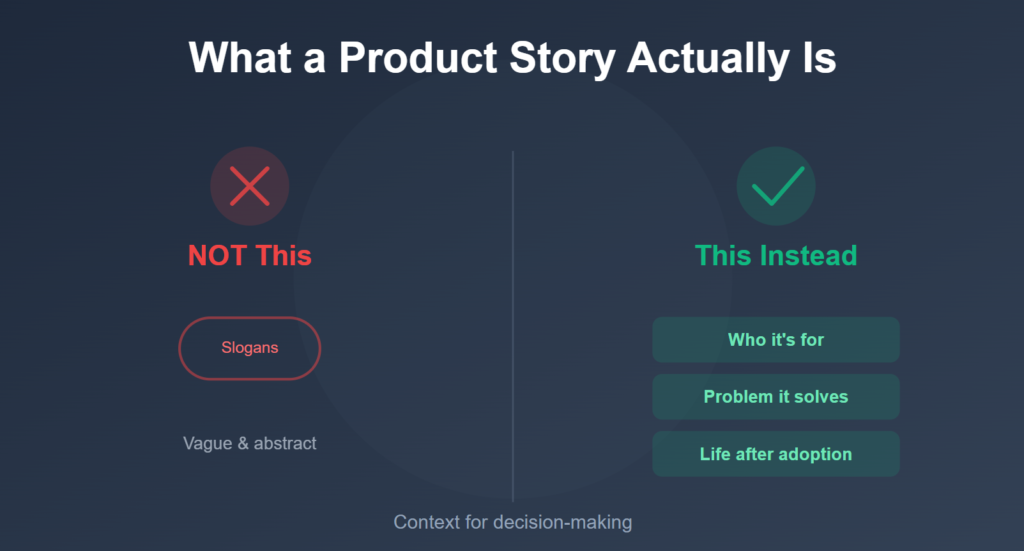
When teams hear “product story,” they often think of surface artifacts. A tagline. A mission statement. A polished homepage headline that sounds confident but vague.
Those elements can support a story, but they are not the story itself.
They fail for a simple reason. They don’t help people decide.
A slogan might sound appealing, but it doesn’t tell a buyer whether this product fits their situation. A mission statement may explain what the company believes, but not what changes for the user. A homepage headline can capture attention without giving direction.
In decision-heavy environments, especially in B2B, that kind of abstraction creates friction. Buyers aren’t looking to be impressed. They’re looking to reduce risk. Anything that doesn’t help them place the product clearly in their world slows the decision down.
That’s why many products sound good on the surface, yet struggle to convert once scrutiny begins.
A Product Story as Decision Context
A real product story does a different job.
It creates context for decision-making. It gives the buyer a framework they can use to evaluate fit, justify choice, and explain the decision to others.
At its core, a product story answers three questions clearly and consistently.
Who this is for.
What problem it exists to change.
What life looks like after adoption.
When those answers are clear, the product stops being abstract. It becomes situational. The buyer can recognize themselves in the story and see the path forward without needing excessive explanation.
This is why stories are so effective in buying decisions.
They act as cognitive shortcuts. Instead of forcing buyers to analyze every feature in isolation, a story helps them categorize the product quickly. It answers, often subconsciously, “Is this meant for someone like me?” and “Does this move me closer to the outcome I care about?”
When that context is missing, buyers compensate by comparing features, reading reviews, and delaying commitment. Not because they enjoy the process, but because the product hasn’t given them a clear enough narrative to stand on.
A product story doesn’t replace evidence or functionality. It organizes them.
It’s the structure that allows everything else to make sense.
The Three Weak Positioning Stories That Kill Sales
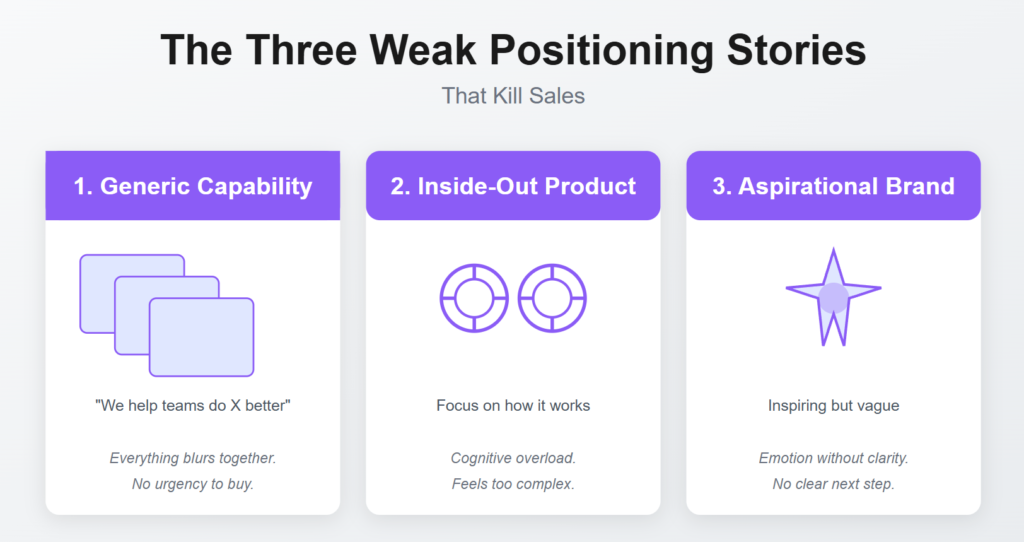
When products struggle to sell, it’s rarely because they lack a story. It’s because they’re telling the wrong one. Over time, three weak positioning patterns show up again and again, quietly undermining conversion and growth.
1. The Generic Capability Story
This is the most common story in crowded markets.
“We help teams do X better.”
“We make Y faster.”
“We simplify Z.”
On the surface, these statements sound reasonable. In practice, they disappear.
The problem is feature parity. By the early 2020s, most SaaS categories had matured to the point where 10 to 50 direct competitors offered similar feature sets. When capabilities overlap, capability-based positioning stops differentiating.
From the buyer’s perspective, everything starts to blur. Products sound interchangeable because the story never moves beyond what they do. There’s no clear reason to choose one now instead of another later.
The result is predictable.
Buyers delay decisions. They keep evaluating. They ask for more demos. Not because they’re unconvinced the product works, but because nothing feels distinct enough to commit to. In a crowded market, generic positioning erases urgency.
2. The Inside-Out Product Story
This story is built from the inside of the company outward.
It emphasizes architecture, workflows, processes, and internal logic. It explains how the system works before it explains why the system exists. The story makes perfect sense to the team that built it.
It rarely makes sense to the buyer.
This approach fails because buyers don’t buy how products work; they buy what changes because of them. Internal clarity doesn’t translate to external relevance. When the story mirrors the builder’s mental model instead of the buyer’s reality, the burden of interpretation shifts to the user.
That burden has consequences.
Research in UX and decision science consistently shows that cognitive overloadincreases abandonment and indecision. When users have to translate technical explanations into personal meaning, they slow down. They hesitate. They disengage.
The product may be powerful, but the story makes it feel heavy.
3. The Aspirational Brand Story With No Direction
This story leans on emotion without instruction.
It uses inspiring language about transformation, innovation, or impact, but avoids specificity. The message sounds ambitious, even exciting, yet fails to clarify what the user should do next or how the product fits into their immediate context.
This breaks conversion in a subtle way.
Users feel something, but they don’t gain orientation. They’re moved, but not guided. Without clear next steps or defined outcomes, emotion doesn’t turn into action. It fades.
This pattern became especially common in post-funding startup rebrands between 2020 and 2024, where companies invested heavily in vision and identity without tightening positioning. The result was often a brand that looked confident while the product story remained vague.
In all three cases, failure isn’t a lack of effort or ambition.
It’s a mismatch between what the story emphasizes and how buyers actually make decisions. When positioning doesn’t help users place the product clearly in their world, sales don’t stop because the product is bad.
They stop because the story gives buyers nothing solid to stand on.
Why Story Gaps Show Up as Sales and Adoption Problems
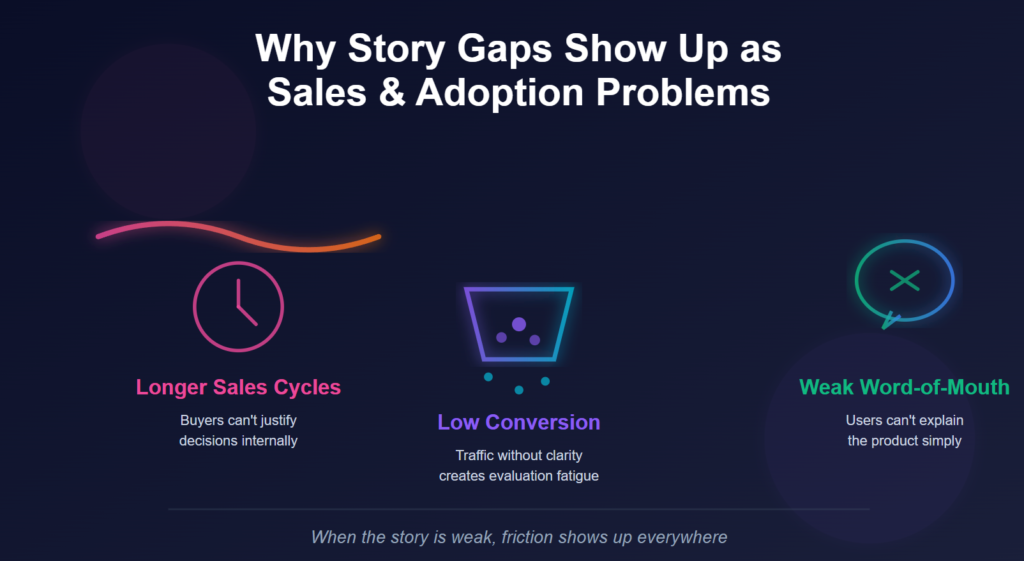
When a product’s story is unclear, the impact doesn’t stay confined to messaging. It shows up downstream, in measurable ways, across sales, conversion, and growth. What looks like separate problems often traces back to the same source.
Longer Sales Cycles
Sales cycles rarely stretch because buyers need more information. They stretch because buyers need more confidence.
When a product lacks a clear “why us” narrative, prospects struggle to justify the decision internally. They may understand the features. They may even like the demo. But when it’s time to explain the choice to a manager, a finance team, or a broader group, the reasoning falls apart.
Without a strong story, consensus becomes slow and fragile.
This has become more pronounced in recent years. As buying committees expanded and scrutiny increased after 2020, average B2B SaaS sales cycleslengthened, especially in competitive categories. Buyers didn’t become more skeptical of products. They became more accountable for their decisions.
A clear story shortens that process because it gives buyers language they can reuse. When that language is missing, decisions stall.
Low Conversion Despite Traffic
Another common symptom is strong traffic paired with weak conversion.
On the surface, this looks like a performance or UX issue. In reality, it’s often a story issue. Traffic without clarity creates evaluation fatigue. Users arrive interested, explore briefly, and then disengage, not because they’re confused, but because they’re uncertain.
They don’t know how to judge fit.
This is why story gaps often explain patterns like high demo requests with low close rates, or free trials that see activity but never convert. Users engage enough to explore, but not enough to commit. The product never becomes clearly preferable to the alternatives they’re considering.
Without a story to anchor the experience, every interaction feels provision
Weak Word-of-Mouth
The final signal appears after adoption, or fails to appear at all.
If users can’t explain a product simply, they don’t recommend it. Not because they’re unhappy, but because they don’t have a clear way to describe what the product actually does for someone else.
This is why story clarity is a prerequisite for organic growth.
Word-of-mouth doesn’t spread features. It spreads understanding. Users share products when they can summarize the value confidently and situate it in a specific use case. When that story isn’t clear, even satisfied users stay quiet.
Across sales, conversion, and referrals, the pattern is consistent.
When the story is weak, friction shows up everywhere.
When the story is clear, momentum compounds.
Why Story Beats Features in Modern Markets
The advantage story provides today isn’t philosophical. It’s structural.
Markets Are Mature, Not Empty
Most product categories are no longer forming. They’re crowded, educated, and comparative.
In mature markets, buyers aren’t discovering categories for the first time. They’re choosing between alternatives that already look credible. This changes how decisions are made. Evaluation happens faster, and comparison is less analytical than teams expect.
Buyers scan. They shortlist. They react.
In these conditions, buyers compare alternatives quickly and emotionally, even when the purchase itself is rational and high-stakes. They’re not asking which product has the most capability. They’re asking which one feels like it fits their situation with the least friction.
This is why feature-heavy differentiation weakens over time. As markets mature, features converge. What remains distinct is interpretation.
Story as a Differentiation Multiplier
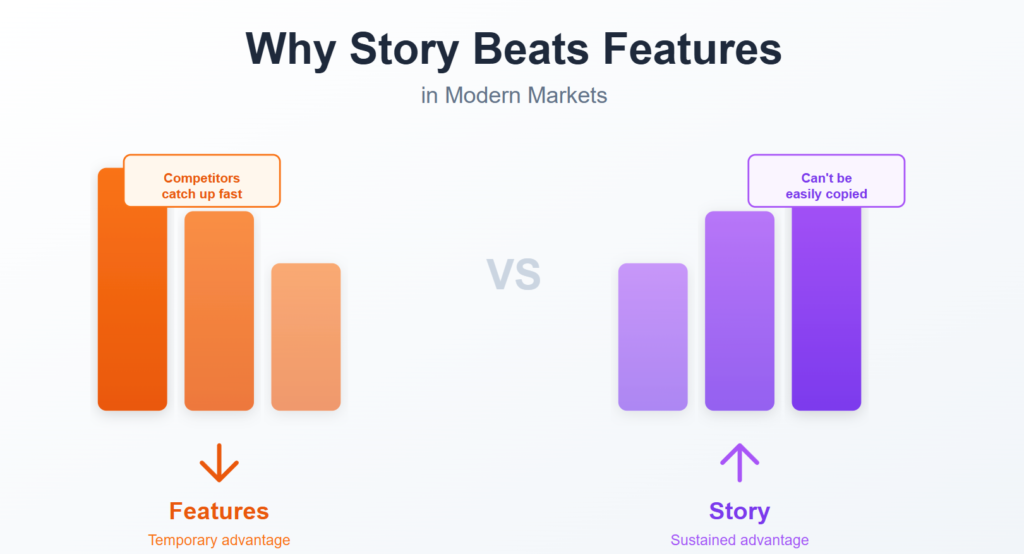
Features differentiate temporarily.
A new capability might create a short window of advantage, but that window closes as competitors catch up. In most SaaS markets, parity arrives faster than teams plan for. What looked unique six months ago becomes expected twelve months later.
Stories behave differently.
When a product story is anchored to a specific user transformation, it creates a frame competitors can’t easily copy. The product isn’t just defined by what it does, but by the change it represents and the audience it serves.
This is how enduring category leaders hold their position.
They don’t win by outbuilding everyone forever. They win by clearly defining their lane early and reinforcing it consistently. Their story becomes the reference point buyers use to make sense of the category itself.
In that context, features become proof, not persuasion. They support the story instead of trying to replace it.
That’s why in modern markets, story isn’t a soft layer on top of the product. It’s the mechanism that turns capability into preference and preference into sustained advantage.
When features level out, story is what keeps products distinct.
What a Strong Product Story Must Do
A strong product story isn’t clever. It’s precise. It does a few things exceptionally well, and almost nothing else.
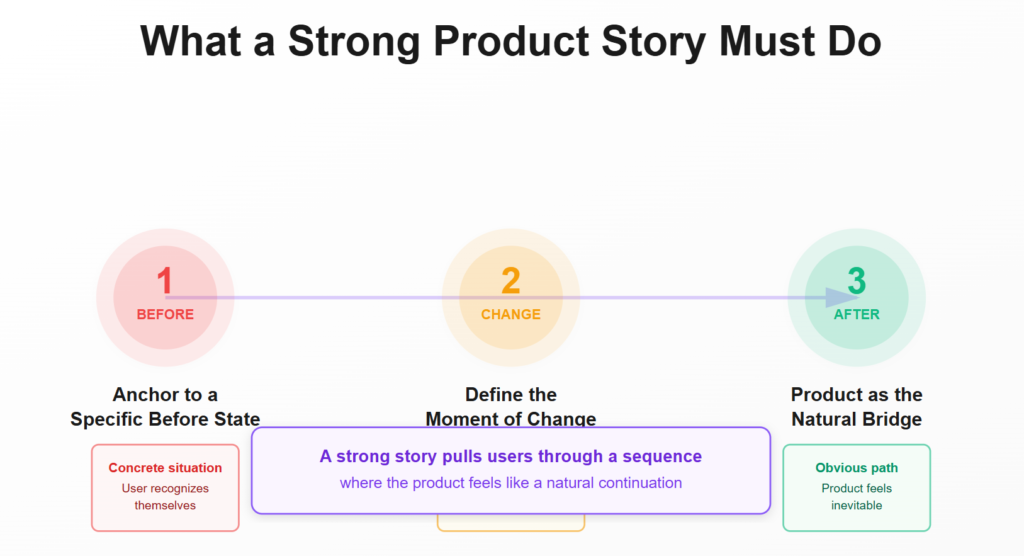
1. Anchor to a Specific Before State
Every effective story starts before the product appears.
That “before” state needs to be concrete. Not a vague pain point like “inefficiency” or “lack of visibility,” but a recognizable situation the user already inhabits. The kind they can nod along to without translating.
Specificity matters because it signals understanding.
When a product accurately names the user’s current struggle, trust forms quickly. The user doesn’t feel marketed to. They feel recognized.
Vague language does the opposite. It forces users to project their own meaning onto the story, which introduces doubt before the product has even entered the frame.
A strong story earns attention by being precise about where the user is starting from.
2. Define the Moment of Change
Next, the story must clearly name what changes.
Not eventually. Not aspirationally. But concretely.
This is the moment where effort turns into outcome. Where the user can say, “This is different from how things worked before.” Without that moment, the product feels like a collection of improvements rather than a shift.
This is where positioning becomes real.
If the story can’t articulate the exact transition the product enables, buyers struggle to understand why this solution exists at all. They may appreciate the features, but they won’t feel the urgency to adopt them.
A clear moment of change turns interest into intent.
3. Make the Product the Natural Bridge
Finally, the product must appear as the obvious path between before and after.
Not hyped. Not forced. Just fitting.
When the story is aligned, users don’t feel persuaded. They feel oriented. The product makes sense in the context of the change they’re trying to make. The reaction isn’t “this sounds impressive,” but “this fits what I need right now.”
That reaction is the goal.
A strong product story doesn’t push the product forward. It pulls the user through a sequence that makes the product feel inevitable. When that happens, adoption stops feeling like a decision and starts feeling like a continuation of the story the user is already living.
How Story Alignment Impacts the Entire Funnel
A clear product story doesn’t live in one place. When it’s aligned, it quietly reshapes every stage of the funnel, from first touch to long-term use. But when it’s not, friction appears everywhere.
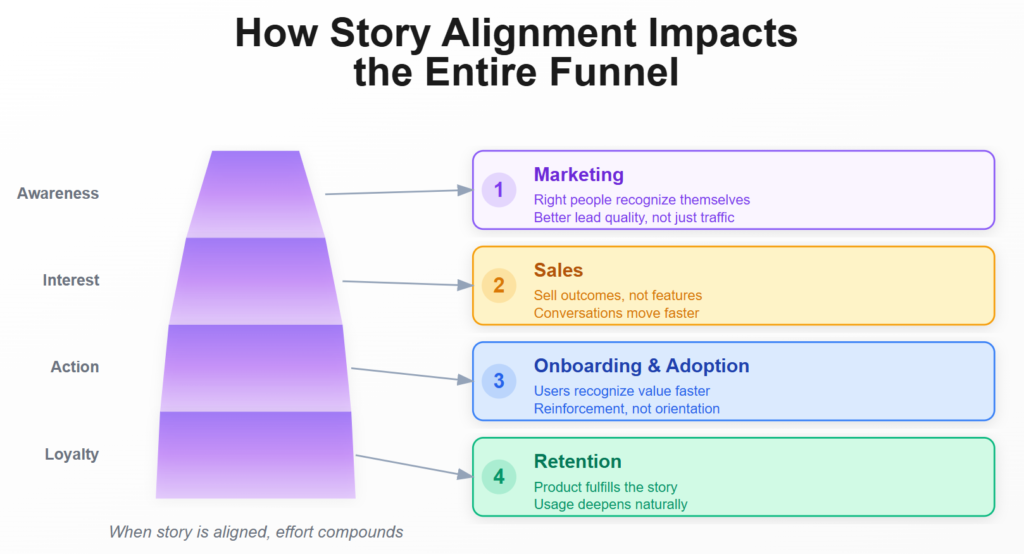
Marketing
Clear stories reduce acquisition waste because they help the right people recognize themselves early.
When messaging is specific, users self-select more accurately. Those who aren’t a fit move on quickly. Those who arrive with context and intent. The result is better lead quality, not just more traffic.
Instead of pulling everyone in and sorting later, story alignment does the filtering upfront.
Sales
Sales become easier when the story is doing its job.
Reps aren’t forced to walk prospects through every feature to prove value. They sell outcomes. They reinforce the same narrative the buyer already encountered earlier in the journey.
When the story is consistent, explanation time shrinks. Conversations move faster because both sides are speaking the same language. The product doesn’t need to be defended. It needs to be confirmed.
Onboarding and Adoption
This is where the effects compound.
Users who arrive with a clear story recognize value faster. They don’t spend the early days asking, “What is this for?” because that question has already been answered.
Onboarding becomes reinforcement, not orientation. Instead of teaching users what exists, the product shows them progress toward the change they expected. That alignment accelerates adoption and reduces early drop-off.
Retention
Retention is where the story either holds or collapses.
Users stay when the product continues to fulfill the story they bought into. When the experience matches the expectation, usage deepens naturally.
When stories are misaligned, churn arrives early. Not always with complaints, but with quiet disengagement. The product didn’t fail functionally. It failed narratively.
Across the funnel, the pattern is consistent.
When the story is aligned, effort compounds.
When it isn’t, friction multiplies.
Diagnosing Whether Your Product Lacks a Story
You can usually tell a product lacks a clear story by paying attention to the same issues showing up again and again.
-
Prospects ask, “How is this different?”: This question signals that your positioning isn’t landing. The product hasn’t been placed clearly enough in their mind to feel distinct from alternatives.
-
Sales relies heavily on demos to explain value: When demos are doing the job of the story, it means clarity is arriving too late. Demos should confirm value, not introduce it.
-
Marketing creates content without a clear throughline: Blog posts, pages, and emails exist, but they don’t reinforce the same idea of who the product is for and why it exists. Each piece works alone, but they don’t build momentum together.
-
Interest appears early, but decisions stall: Prospects explore, ask questions, and sometimes even try the product, yet hesitate to commit. This often points to uncertainty, not dissatisfaction.
There’s also a simple internal check.
Ask five people in your company to explain the product: If the explanations sound meaningfully different, the story isn’t clear enough yet. When the story is strong, explanations converge. When it isn’t, everyone fills in the gaps differently.
Rebuilding a Product Story That Actually Sells
Rebuilding a product story doesn’t start with a whiteboard or a positioning workshop. It starts by listening more closely to how people already talk about the problem.
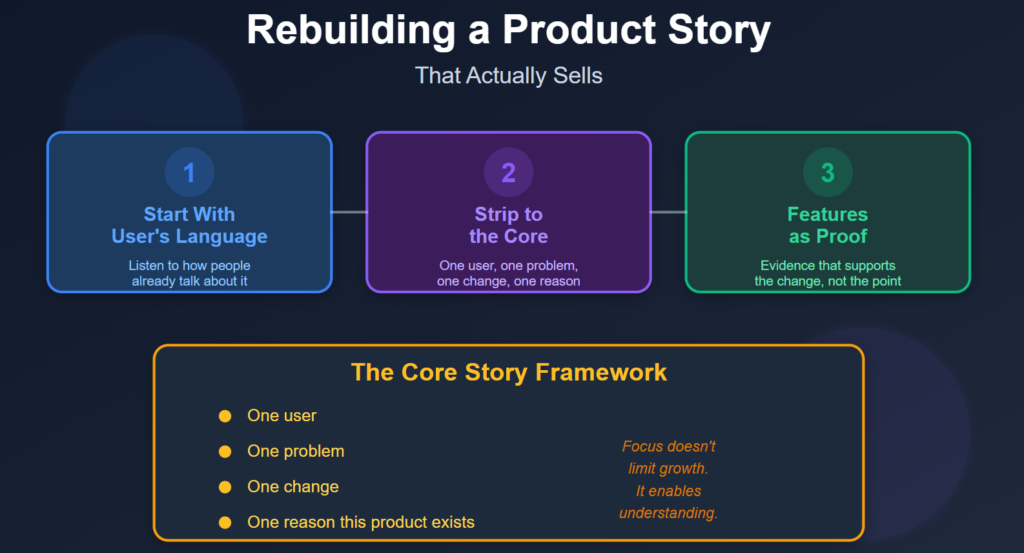
Start With the User’s Language
The fastest way to lose clarity is to invent language in isolation.
Real insight already exists in the words users use every day. Sales calls reveal how prospects describe their situation before they adopt. Support tickets show where expectations break down. Reviews capture what users remember and value after using the product.
This language matters because it’s tested.
User language reflects how people think, not how teams wish they would think. It’s concrete, situational, and grounded in experience. When positioning is built from that language, it feels familiar instead of manufactured.
That’s why user language consistently outperforms invented positioning. It reduces translation effort and makes the story easier to grasp and repeat.
Strip the Story to Its Core
Clarity doesn’t come from adding more context. It comes from removing everything that isn’t essential.
At its core, a strong product story can be reduced to four elements:
- One user.
- One problem.
- One change.
- One reason this product exists.
If the story needs multiple users, multiple problems, or multiple reasons to exist, it becomes harder to explain and easier to forget. Focus doesn’t limit growth. It enables understanding.
A simple story isn’t simplistic. It’s deliberate.
Re-introduce Features as Proof, Not the Point
Features belong in the story, but they don’t lead it.
Once the core narrative is clear, features become evidence. They support the change the product claims to deliver. They show how the story holds up in practice.
When features are treated as the point, the story fragments. When they’re treated as proof, the story gains credibility.
The goal isn’t to hide capability. It’s to place it where it strengthens meaning instead of competing with it.
Story Is the Sales Asset Most Teams Underestimate
Products rarely fail because they lack capability. Most teams have already built something that works.
What fails is placement.
When buyers can’t clearly place a product in their world, they hesitate. They delay. They compare. In crowded markets, that hesitation is enough to lose the sale, no matter how strong the feature set is.
This matters more now than it did in earlier markets. Buyers are informed, options are abundant, and differentiation based on capability alone erodes quickly. Long before a sales conversation begins, people are already forming conclusions about fit, risk, and relevance.
Story is what shapes those conclusions.
Not as persuasion, but as structure. It gives buyers a way to understand what the product is for, why it exists, and how it fits into the change they’re trying to make. Without that structure, even good products struggle to move forward.
Teams that treat story as a sales asset don’t rely on explaining harder or adding more. They make the product easier to recognize and easier to choose.
In modern markets, that clarity isn’t a nice-to-have.
It’s what allows products to sell at all.
I Can Be Your Product’s Storyteller, Can I?
If this article felt familiar, it’s because you’ve already seen the pattern play out.
You’ve watched strong products struggle to convert. You’ve sat through long sales cycles where prospects seemed interested but never fully committed. You’ve seen features land, traffic grow, and yet clarity remains elusive.
That’s not a product failure. It’s a story gap.
This is the work I do.
I help founders and product teams turn what their product does into a story users can understand early, trust quickly, and repeat without effort. Not brand fluff. Not surface-level copy. But product-led stories that anchor positioning, guide decisions, and make adoption feel obvious.
If you want to sharpen your thinking first, join the Product-Led Stories newsletter. I break down how real products earn clarity across positioning, onboarding, sales, and retention, with practical insight you can apply immediately.
And if you’re ready to fix this directly, you can work with me to design and write the story your product needs to sell itself more clearly.
Reach out through the contact page, send a quick message on Telegram, or email me directly. Let’s make your product’s value unmistakable and turn that clarity into growth you can measure.
Keep reading