 Denzil Otieno
User Transformation Is a Messaging Problem, Not a Feature Problem
When users don't experience the change they signed up for, the fix is rarely more features. Transformation is a messaging problem: name what changes first.

A user signs up with a clear intention.
They want something to change. Less manual work. Clearer numbers. Fewer decisions to carry around. The product promises that shift, so they step in expecting progress.
What they experience first doesn’t feel like progress.
It feels like orientation.
Screens to scan. Options to choose from. Features to explore. Setup steps to complete. Everything technically correct, yet strangely distant from the reason they came. The product explains what it can do, but not what will change for them first.
So the user slows down.
Not because the product is confusing. Not because it’s broken. But because the link between action and outcome hasn’t formed yet. They can see the machinery, but not the movement. Effort is visible. Transformation is not.
This is where adoption quietly collapses.
Modern products are more capable than ever. They ship faster, automate more, and integrate deeper than they did just a few years ago. But capability alone doesn’t create change. Understanding does.
When users don’t understand value early, they don’t wait to figure it out later. Research shows that up to 90% of users churn if they fail to grasp a product’s value in the early stages of onboarding. The exit happens long before features have time to earn their place.
This is the moment most teams misread.
They look at the drop-off and assume something is missing in the product. Another feature. Another improvement. Another release.
But the user didn’t experience a feature gap.
They experienced a meaning gap.
And that’s why user transformation is rarely a feature problem.
It’s a messaging problem.
Why the “Feature Fix” Fallacy Persists
After a user leaves, the response inside the company is almost automatic.
The drop-off shows up in a dashboard. A funnel step dips. Activation stalls. The instinctive question becomes, What’s missing? And the safest answer is always the same: a feature.
Features are tangible. They’re measurable. They fit neatly into roadmaps and sprint plans. Shipping something feels like progress, even when the original problem was never about capability in the first place.
There’s also a quieter reason this pattern repeats.
Building is comfortable. It keeps teams inside familiar territory. You can scope it, estimate it, and ship it. Communication is harder. It forces uncomfortable questions about whether the product is being understood at all, and whether the story users are forming matches the one the team believes they’re telling.
So when adoption stalls, teams default to product logic.
From inside the product, the reasoning makes sense. If users had access to more power, more automation, more options, they’d get value. The assumption is that usage follows exposure.
But users don’t operate on product logic. They operate on meaning.
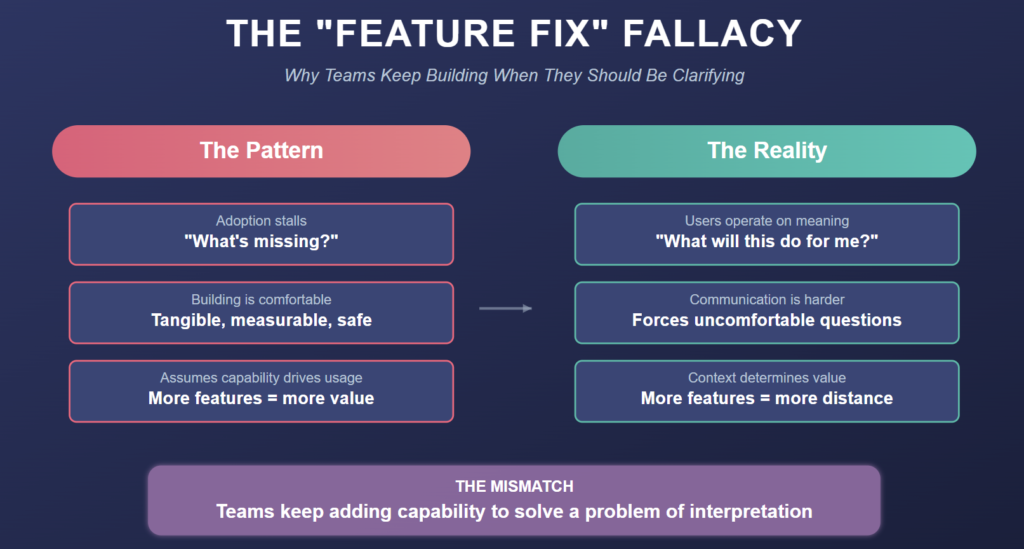
They don’t ask what a product can do in total. They ask what it will do for them, right now, in the context they’re already in. Until that answer is clear, more features don’t increase confidence. They increase distance.
That’s the fallacy at the center of so many product decisions.
Teams keep adding capability to solve a problem of interpretation. And as long as that mismatch remains, the product can keep improving while user transformation stays stalled.
The Hard Truth: Features Don’t Deliver Value, Understanding Does
This is where the diagnosis sharpens.
Up to this point, we’ve seen how users experience the product and why teams default to feature fixes. What matters next is understanding what actually produces value in the user’s mind, and how quickly that window closes.
Users Don’t Buy Features; They Buy Outcomes
Value doesn’t come from what a product can do in total.
It comes from what a user believes it will change for them.
Decision science shows that people make choices based on perceived value and clarity of outcome, not on raw capability. If the outcome feels uncertain, the decision slows. If the connection between effort and result isn’t clear, motivation collapses.
This is why feature exposure rarely creates momentum on its own. Users don’t explore products to admire functionality. They explore to confirm that a specific problem in their life is about to feel lighter.
When that confirmation doesn’t arrive, usage becomes tentative. Clicking continues, but commitment doesn’t form.
And that hesitation has a cost.
Data consistently shows that users who fail to engage meaningfully in the first few days are overwhelmingly likely to churn, with risk approaching 90% when early value isn’t established. Not because they discovered the product was weak, but because they never discovered why it mattered to them.
The Critical First Week
During the first week, users are trying to understand what the product will change in their work and whether it’s worth committing to.
During those early days, users are running a quiet evaluation: Is this moving me toward something better than where I started? If the answer isn’t felt quickly, the product is mentally deprioritized.
This is where onboarding messaging becomes decisive.
In-app guidance, emails, prompts, and walkthroughs don’t just teach mechanics. They shape perception. They define what progress looks like, what success means, and which actions are worth taking now.
When that framing is absent or unclear, users may continue interacting, but they don’t internalize value. The product remains something they’re trying, not something they’re adopting.
By the time the first week ends without a clear sense of outcome, the product has already lost its window. Not because it failed functionally, but because it failed to anchor meaning early enough.
What “Messaging” Actually Means in Product Context
When people hear “messaging,” they tend to think of positioning statements, landing pages, or marketing copy.
That’s not what’s at play here.
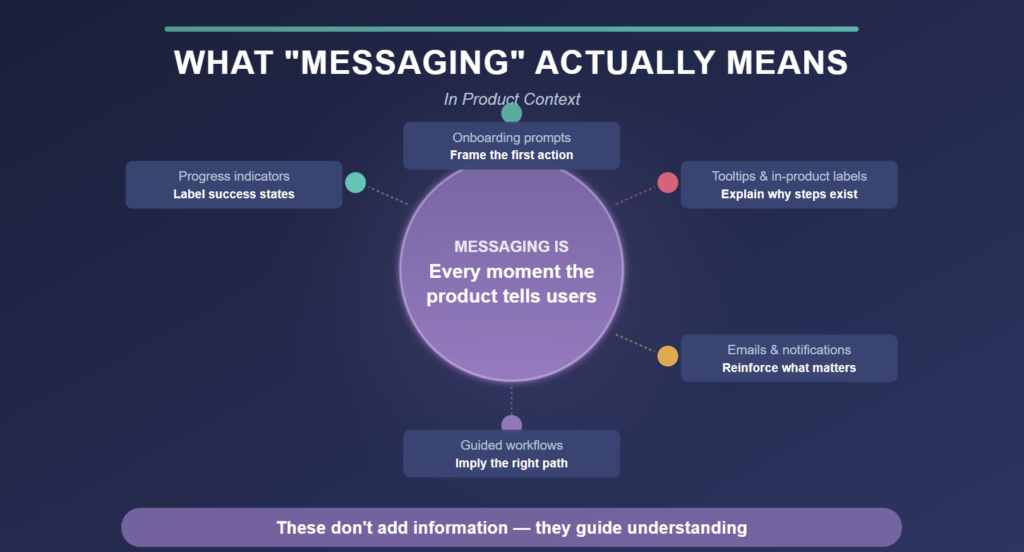
In a product context, messaging is every moment where the product tells the user how to interpret what’s happening. It’s the layer that explains why this action matters now and what outcome it’s moving them toward.
That interpretation is shaped continuously, not in one place.
- Onboarding prompts that frame the first action
- Tooltips that explain why a step exists
- In-product language that labels success or progress
- Emails and notifications that reinforce what matters
- Guided workflows that imply a “right” path forward
None of these exist to add information. They exist to guide understanding.
Before a user acts with confidence, they need a mental model of what the product is doing for them. Messaging is what builds that model. It reduces ambiguity, focuses attention, and makes effort feel purposeful instead of exploratory.
This is why messaging shows up so clearly in behavior change research.
Models like the one popularized by BJ Foggemphasize that behavior happens when motivation and triggers align. In a product, features supply the capability, but messaging supplies the trigger. It tells the user when to act, where to act, and why this action is worth taking now.
Without that layer, users aren’t blocked. They’re unconvinced.
And unconvinced users don’t transform.
Evidence That Messaging Drives Adoption
At this point, the claim isn’t theoretical. The effects of messaging show up clearly once you look at how users behave after they enter a product.
Messaging & Onboarding Correlations
When onboarding messaging is intentional, the downstream effects are measurable.
SaaS products that invest in clearer, more contextual onboarding language consistently see a reduction in support load, with some reporting around a 35% drop in support tickets. That reduction doesn’t come from fewer features or simpler products. It comes from users understanding what to do, why they’re doing it, and what outcome to expect.
The same pattern shows up in activation behavior.
Clear, situational language helps users discover features faster because they aren’t searching blindly. They’re being guided toward relevance. Friction drops not because complexity disappears, but because uncertainty does. Users spend less time guessing and more time moving forward with intent.
In other words, messaging doesn’t just make products feel easier. It makes them behave easier.
Broader Digital Transformation Evidence
This pattern isn’t limited to SaaS onboarding.
Research into failed digital transformation initiatives shows a similar root cause. Many projects labeled as “technology failures” actually collapse due to communication and content breakdowns, not because the systems themselves are inadequate.
Analyses published by Content Science Review point to content and messaging misalignment as a recurring factor in adoption failure, even in organizations with strong technical infrastructure. The tools work. The transformation doesn’t land.
The reason is consistent with what we see in product adoption.
When users aren’t given a clear narrative for how new systems change their work, they resist, disengage, or revert to old habits. Not out of stubbornness, but because meaning was never established strongly enough to support behavior change.
Across products and organizations, the evidence points in the same direction.
Adoption doesn’t break where capability is missing.
It breaks where understanding never fully forms.
The Messaging Problems That Hurt Transformation Most
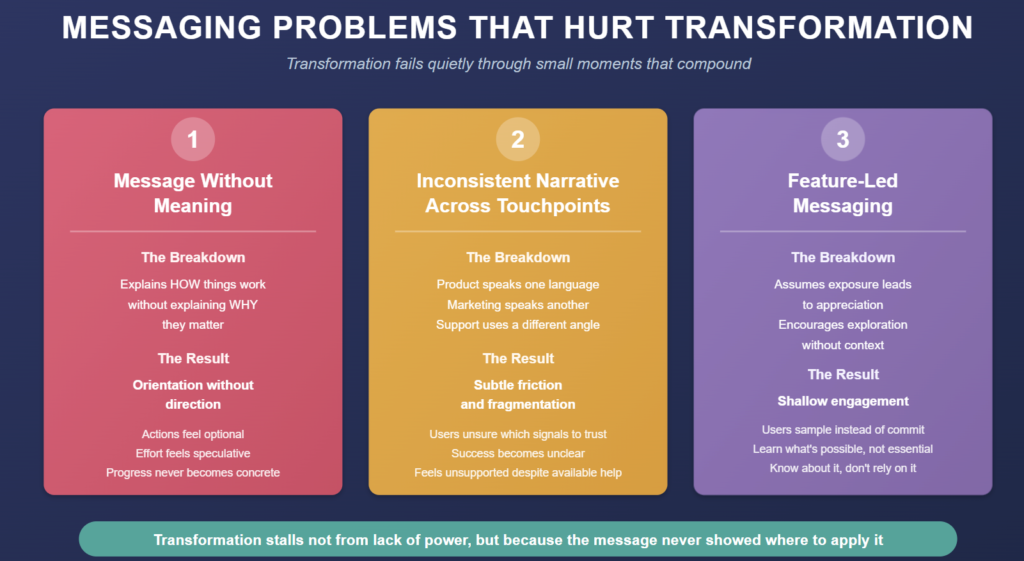
When transformation fails, it rarely fails loudly. It erodes quietly through small moments of misunderstanding that compound over time. Most of those moments fall into a few predictable patterns.
1. Message Without Meaning
This is the most common breakdown.
Products explain how things work without explaining why they matter. Users are given technical descriptions, feature names, and procedural steps, but no clear sense of what changes once those steps are completed.
The result is orientation without direction.
Users may understand what a feature does, but not how it improves their situation. Without an outcome attached, actions feel optional. Effort feels speculative. Progress never becomes concrete.
2. Inconsistent Narrative Across Touchpoints
Even when individual messages are clear, the story often fractures across the product experience.
The product speaks one language. Marketing speaks another. Support answers questions from a different angle. Customer success frames value in yet another way. Each function is well-intentioned, but the user is left to reconcile the differences.
That inconsistency creates subtle friction.
Users aren’t sure which signals to trust or what “success” actually looks like. Instead of feeling guided, they feel unsupported, even when help is technically available. The product stops feeling cohesive and starts feeling fragmented.
3. Feature-Led Messaging
Feature-led messaging assumes that exposure leads to appreciation.
Users are encouraged to explore, click, and try things out, with the expectation that value will eventually reveal itself. But exploration without context rarely produces confidence. It produces hesitation.
When capabilities are highlighted without tying them to transformation, users engage shallowly. They sample instead of commit. They learn what’s possible, but not what’s essential.
Over time, the product becomes something users know about, not something they rely on.
And when that happens, transformation stalls not because the product lacks power, but because the message never showed where that power was meant to be applied.
How Messaging Shapes Behavior, Not Just Information
Messaging doesn’t just explain a product.
It directs user behavior.
Every message a user encounters influences what they pay attention to, what they ignore, and what they decide is worth their effort. This is why product messaging shapes behavior, not just comprehension.
When messaging is clear, users don’t have to guess where to start or what matters most. They move with intention. When it’s vague or overly technical, users hesitate, even if the product is powerful.
This happens because users aren’t evaluating products analytically in real time. They’re forming mental models of value. Messaging is what builds those models.
Good messaging reduces cognitive load in onboarding. It narrows focus. It tells users which actions are meaningful now and which ones can wait. Instead of scanning everything, users follow a path that feels purposeful.
This is where behavior change becomes possible.
Research into behavior-driven product adoption shows that users act when three elements align: motivation, ability, and a clear trigger. Features provide ability. Motivation comes from the user’s existing problem. Messaging supplies the trigger. It tells the user this action matters now and this is what it moves you toward.
Without that trigger, users aren’t blocked.
They’re undecided.
And undecided users don’t form habits. They don’t build routines around the product. They don’t integrate it into their workflow. The product remains something they visit occasionally instead of something they rely on daily.
This is why messaging is a core adoption lever, not a cosmetic layer.
When messaging consistently reinforces progress, users feel momentum. When it names outcomes clearly, effort feels justified. Over time, those small signals shape product-led behavior change, turning initial curiosity into sustained use.
That confidence is built, message by message.
Reframing Product Metrics Through a Messaging Lens
If messaging shapes understanding, then it also shapes what should be measured.
Most product teams track feature usage metrics because they’re easy to capture and easy to defend. Clicks, activations, and adoption rates feel objective. But on their own, they don’t explain why users commit or quietly disengage.
A messaging lens changes the question.
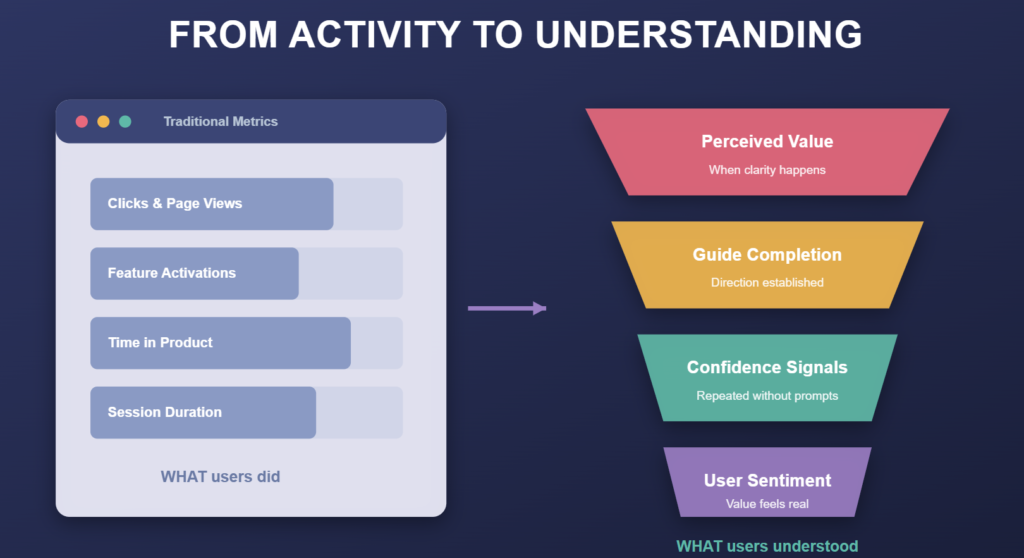
Instead of asking whether a feature was used, it asks whether value was perceived. Whether the user reached a moment where the product made sense in the context of their work. That shift matters because perception always precedes commitment.
This is where different signals become more useful.
-
Time to first perceived value: How long it takes before a user clearly understands what the product is doing for them. Not just what they clicked, but what changed.
-
Guide completion rates: Whether users finish guided experiences that are meant to establish direction and meaning, not just teach mechanics.
-
Early engagement signals: Behaviors that indicate confidence, such as returning to a core workflow, repeating an action, or progressing without prompts.
-
Qualitative sentiment at key milestones: Language users use in feedback, support conversations, or surveys that reveals whether value feels real or still abstract.
These metrics don’t replace traditional product analytics. They explain them.
When engagement drops, they help distinguish between a capability problem and a comprehension problem. They show whether users are stuck because something is missing, or because something was never made clear.
In a product-led environment, what users understand is often a stronger predictor of retention than what they’ve technically accessed.
And that makes messaging not just something you write, but something you can measure.
Practical Playbook: Messaging That Drives Transformation
Once you see messaging as the driver of understanding, the work becomes more concrete. This isn’t about clever copy. It’s about deliberately shaping how users make sense of the product as they move through it.
1. Start with the User Question
Every user enters with an unspoken question, whether they articulate it or not: What is this going to change for me?
Effective messaging begins there. Not with what the product does, but with the change the user is trying to make in their work or life. When messaging is aligned to that desired outcome, everything that follows feels relevant instead of instructional.
This is how outcome-driven product messaging earns attention early. Users don’t need to be persuaded. They need to recognize themselves in what they’re seeing.
2. Build Value Narratives into Onboarding
Onboarding is not a tutorial. It’s a narrative.
Each step should answer a simple question: What did this just move forward for me? When milestones are tied explicitly to real results, users stop feeling like they’re setting things up and start feeling like they’re progressing.
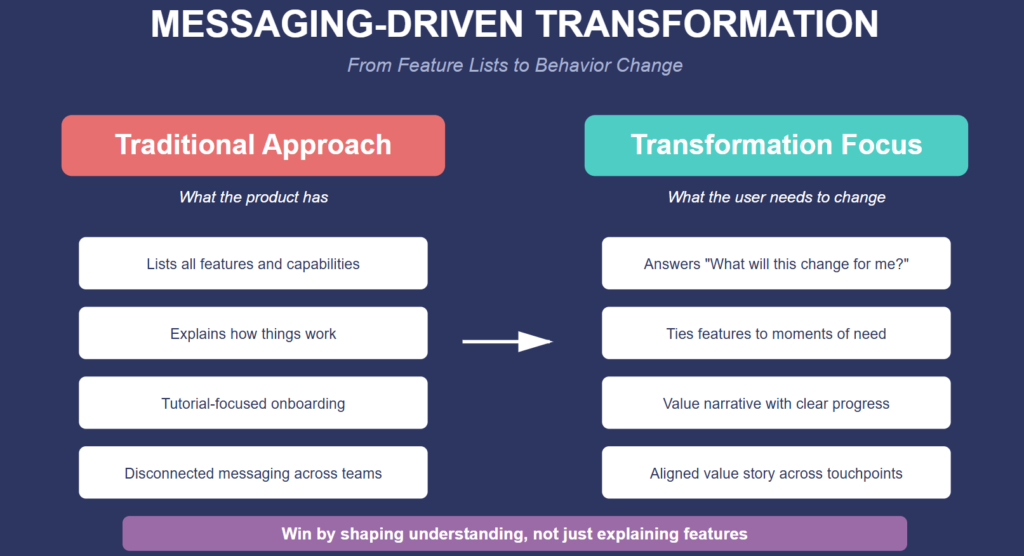
Early signals matter most here. The first few actions should clearly demonstrate value, not just prepare for it later. Messaging should reinforce those moments so users can name what’s working and why.
This is how onboarding messaging establishes perceived value, before habits have a chance to fade.
3. Tie Feature Learning to Behavior Change
Features don’t matter in isolation. They matter in moments.
Instead of introducing features broadly, effective messaging explains why a feature matters right now, in the context the user is already in. A prompt that connects action to outcome does more than educate. It encourages behavior.
This is where many products go wrong. They overwhelm users with options, assuming exploration will lead to insight. In practice, feature dumps dilute focus. Contextual prompts create momentum.
When learning is tied to behavior change, users don’t just understand the feature. They adopt it.
4. Align Cross-Functional Messaging
Transformation breaks when the story fragments.
If product messaging, support responses, marketing language, and customer success guidance all frame value differently, users are left to reconcile the gaps. That cognitive work drains confidence.
Alignment doesn’t mean sameness. It means consistency in the value story being told. Every touchpoint should reinforce the same understanding of what progress looks like and why the product exists in the user’s world.
When teams speak the same language, users feel guided instead of corrected. And that coherence is what allows understanding to compound over time.
Case Examples (High-Level Narratives, No Brand Names)
In one SaaS product serving operational teams, retention stalled despite steady feature releases. The product was powerful, but new users rarely made it past the early workflows. Usage data showed activity, but not commitment.
Instead of adding more functionality, the team changed how the product spoke.
They reworked onboarding to frame each early action around a visible outcome. Prompts stopped explaining configuration steps and started explaining what would become easier once those steps were complete. In-product language shifted from feature descriptions to progress markers. Even confirmation messages were rewritten to reinforce what had just changed for the user.
Nothing about the core product changed.
What changed was how quickly users could recognize value. Within weeks, early engagement deepened. Fewer users stalled after setup. Support questions shifted from “what is this for?” to “how can I do more with it?” Retention followed, not because the product gained new power, but because users finally understood how to use the power it already had.
The contrast becomes clearer when you look at the opposite approach.
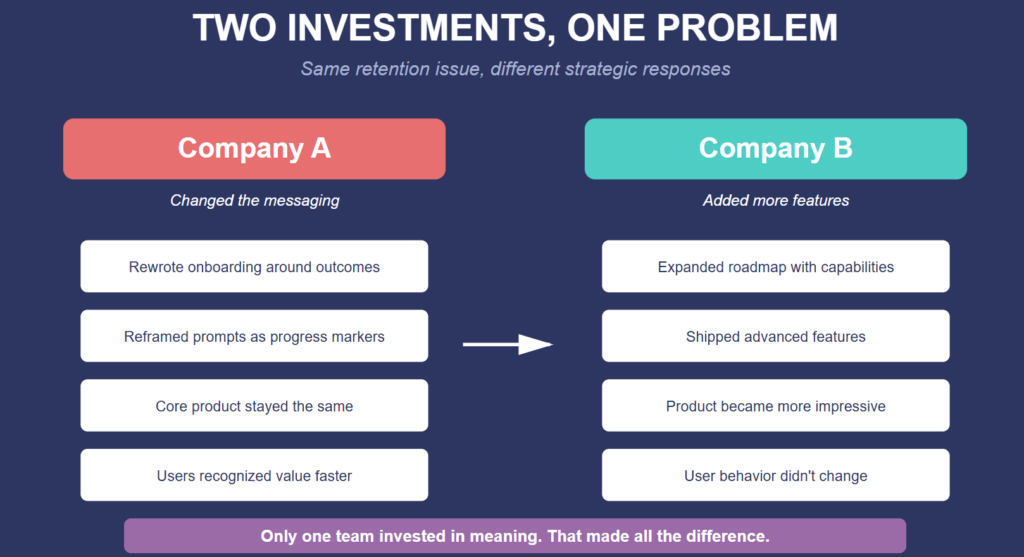
In another product, declining adoption triggered a familiar response. The roadmap expanded. New features were shipped. Advanced capabilities were added to address edge cases and competitive gaps. Each release made the product more impressive on paper.
User behavior didn’t change.
Activation stayed flat. Drop-off points remained the same. New features were discovered late, if at all. The core issue was never capability. Users still couldn’t see how the product fit into their day-to-day work early enough to matter.
Both teams invested heavily.
Only one invested in meaning.
And that difference is what separates products that grow through understanding from products that accumulate features without transformation.
Why Messaging Is the Transformation Lever You Can’t Ignore
By now, the pattern should be clear.
Features unlock ability.
Messaging unlocks understanding.
Ability alone doesn’t change behavior. Understanding does. Users don’t transform because a product is powerful. They transform when they can clearly see what that power is meant to change for them, early enough to trust it.
That’s why so many products stall despite strong engineering. The work was done. The capability exists. But the meaning never fully formed in the user’s mind. And without that meaning, effort feels optional, progress feels uncertain, and commitment never takes root.
Transformation only happens when users internalize change.
When they can articulate, in their own words, what the product is doing for them. When actions feel purposeful instead of exploratory. When progress is recognizable, not theoretical. That process isn’t driven by more features or faster shipping. It’s driven by communication that frames value at the right moments, in the right context.
The early window matters most.
When users don’t grasp value quickly, they don’t linger in confusion. They leave. Not because they’ve evaluated the product and rejected it, but because the product never earned a clear role in their work. The decision happens quietly, long before the roadmap has a chance to help.
That’s the leverage most teams overlook.
Messaging isn’t a layer you add after the product is finished. It’s the mechanism that allows the product to do its job. When it’s clear, transformation accelerates. When it’s vague, even the best features struggle to matter.
If user transformation feels elusive, the question usually isn’t what should we build next?
It’s what are users failing to understand right now?
That’s where the real work begins.
Let’s Get Users Adopting Your Products, Shall We?
If this resonated, it’s because you’re already seeing the gap.
You’re building capable products, but you know capability alone isn’t what turns users into believers. Clarity does. Timing does. The story users form in their first few moments does.
That’s exactly what I work on.
Join the Product-Led Stories newsletter if you want practical, grounded breakdowns of how messaging shapes adoption, onboarding, retention, and real user behavior. No recycled frameworks. Just clear thinking you can apply to your product immediately.
And if you don’t want to figure this out alone, you can hire me to help you design and write the stories that make your product’s value unmistakable. Stories users understand early, trust quickly, and act on consistently.
Reach out through the contact page, send a quick message on Telegram, or email me directly. Let’s make your product’s value unmistakable and turn that clarity into growth you can measure.
Keep reading