 Denzil Otieno
Product-Led Growth Strategy: A Practical Framework to Reduce Friction and Drive Sustainable Growth
A product-led growth strategy makes the product the main driver of acquisition and revenue. The full framework: free models, growth loops, PQLs, and metrics.

A product-led growth (PLG) strategy is a go-to-market approach where the product itself, not a sales team, is the primary driver of customer acquisition, activation, retention, and expansion.
Users sign up self-serve, reach the product's core value on their own, and upgrade when the product has proven its worth. Sales and customer success still exist, but they work from product usage signals instead of cold outreach.
Key takeaways:
- Friction is the central constraint in PLG. Every unnecessary step between signup and first value costs you a measurable percentage of users.
- Choose your free model (trial, freemium, or reverse trial) based on how fast users reach value, then design the upgrade path around usage limits.
- Growth loops (referrals, invites, network effects) turn existing users into your cheapest acquisition channel.
- Sales and customer success should run on product-qualified leads (PQLs): users whose in-product behavior already shows buying intent.
- Activation rate, time to value, expansion revenue, and cohort retention are the metrics that tell you whether the strategy is compounding.
What Is a Product-Led Growth Strategy?
A product-led growth strategy organizes your entire go-to-market motion around one principle: the product experience is the most persuasive sales asset you own. Pricing, onboarding, marketing, sales, and customer success all get built around it.
Instead of gating the product behind demos and contracts, you let prospects use it. Then you engineer the journey so the value shows up before the invoice does.
The term was coined in 2016 by Blake Bartlett at OpenView Venture Partners to describe what companies like Slack, Dropbox, and Atlassian were already doing: growing dominant businesses where the product itself handled acquisition and conversion work that traditionally belonged to sales teams.
Being product-led doesn't mean having no sales team. It means the product generates and qualifies the demand, and humans step in where they add the most leverage: expansion deals, enterprise procurement, and accounts whose usage signals say they're ready to buy.
Why PLG Replaced the Sales-First Default
For years, the default go-to-market strategy for SaaS companies was straightforward: hire sales reps, run demos, and close deals. The product came after the conversation, not before it. That model worked when buyers had limited ways to evaluate software on their own, but that's no longer the world we're operating in.
Today's buyers want to experience the product before they ever talk to a salesperson. They expect to sign up, explore, and find value on their own terms, and if your product can't deliver that, they'll find one that does.
This shift has made product-led growth strategy less of a competitive advantage and more of a baseline requirement for any SaaS company serious about scaling efficiently.
The companies winning at customer acquisition right now aren't necessarily the ones with the biggest sales teams or the largest ad budgets. They're the ones whose products are designed to sell themselves through fast onboarding, clear value delivery, and experiences so intuitive that users become advocates before a single sales call happens.
At the center of all of this is friction. Every unnecessary step in your user journey, every confusing onboarding flow, and every moment where a user has to stop and ask "what do I do next?" is a leak in your growth engine.
The companies that grow sustainably are the ones that treat friction reduction as a core product discipline, not an afterthought.
This guide breaks down exactly how to build and execute a product-led growth strategy that drives sustainable results, from designing your first self-serve experience to aligning your sales and customer success teams around product signals, and building the analytics infrastructure to measure all of it.
Product-Led vs. Sales-Led: What Actually Changes
| Dimension | Sales-led growth | Product-led growth |
|---|---|---|
| First touchpoint | Demo call with a rep | Self-serve signup |
| Who does the convincing | Sales team | The product experience |
| Time to value | Weeks (after contract) | Minutes to days (before payment) |
| Primary lead type | Marketing-qualified leads (MQLs) | Product-qualified leads (PQLs) |
| Acquisition cost curve | Rises with headcount | Falls as growth loops compound |
| Expansion driver | Account manager outreach | Usage limits and in-product upgrades |
PLG isn't the only alternative to sales-led growth, and it helps to know where the lines sit. Marketing-led growth generates demand through content, ads, and brand, then hands leads to sales. The product enters late in that motion.
Customer-led growth centers on feedback loops and community-driven expansion from your existing base. Product-led growth is distinct because the product does the persuading itself: acquisition, conversion, and expansion all happen inside the product experience.
In practice most scaled SaaS companies run a hybrid, but one motion leads. Which one leads determines where you invest first. OpenView's PLG benchmarks consistently show product-led companies growing faster and trading at higher revenue multiples than their sales-led peers once they pass early scale.
The Benefits of a Product-Led Growth Strategy
The case for PLG is ultimately an efficiency case. When the product does the selling, every stage of the funnel gets cheaper and faster:
- Lower customer acquisition costs: self-serve signup and growth loops replace headcount-heavy outbound motions, so CAC falls as the model matures instead of rising with every new sales hire.
- Shorter sales cycles: users arrive at the buying decision already convinced by the product, so conversations start at "help me roll this out," not "let me convince you."
- A wider top of funnel: a free tier or trial captures buyers who would never book a demo, including the end users who later champion the purchase internally.
- Better-qualified pipeline: product-qualified leads convert at a far higher rate than marketing-qualified leads because intent is demonstrated, not inferred from a downloaded PDF.
- Compounding expansion revenue: usage-based upgrade paths mean revenue grows with customer success in the product, which is what pushes top PLG companies to 130%+ net dollar retention.
- Faster feedback loops: thousands of free users generate the usage data that tells you what to build next, a research advantage sales-gated products never get.
1. Start With Friction Reduction
Most product-led growth strategies collapse at the point where users first interact with the product. Users sign up with genuine interest, hit a wall of complexity or unnecessary steps, and leave before they ever experience what made them sign up in the first place.
Friction is the single biggest barrier between your customer acquisition efforts and actual product adoption. Reducing it is the foundational work that determines whether your PLG strategy converts interest into activated, retained users.
Reducing Friction Across the User Journey
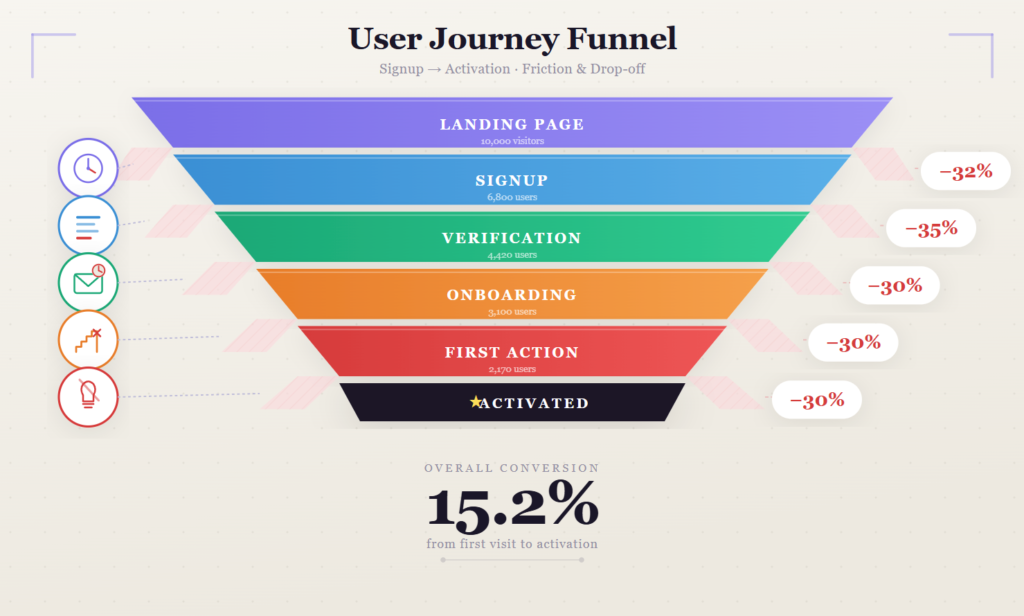
The first step to reducing friction is knowing exactly where it lives in your product. Most teams assume they know where users struggle, but assumptions built without data will have you optimizing the wrong things while the real drop-off points go untouched.
Start by mapping every step a new user takes from signup through to their first meaningful action in the product. Tools like session recording, funnel analytics, and heatmaps will show you where users slow down, where they rage-click, and where they abandon the flow entirely.
Using a platform like Windsor.ai makes it significantly easier to pull this data together across your marketing and product touchpoints without manual exports or fragmented reporting.
Once you've identified where friction lives, the next priority is removing unnecessary steps from your self-service onboarding flow. Every field you ask users to fill out and every decision you force them to make before they've seen value is a step that will cost you a percentage of users.
Time to value is the metric that should govern every onboarding decision you make. It measures how long it takes a new user to experience the core benefit your product promises, and shortening it should be treated as a primary growth lever. The benchmark to aim for: visible product value in the first 10 minutes.
If your product promises better team collaboration, the onboarding flow should get a user collaborating with a teammate within minutes, not after a 10-step setup process.
Prioritizing self-service functionality means designing your product so users can find answers, complete tasks, and reach value without needing to contact support or wait for a sales call. This includes in-app tooltips, contextual help docs, progress indicators, and empty states that guide users toward the next action.
The compounding effect of reducing friction across the user journey is significant. Lower drop-off during onboarding means more activated users, and stronger customer experience signals give your team the data needed to keep iterating toward a tighter, faster path to value.
2. Prioritize Self-Serve Product Access
The fastest way to accelerate product adoption is to let users experience your product before asking them to commit financially. When users can explore your product on their own terms, they arrive at the purchase decision already convinced, which shortens the sales cycle and reduces the cost of converting them.
Self-serve access only works if the value is obvious once users are inside. That's a messaging problem as much as a product one: value users can't see is value that doesn't exist as far as conversion is concerned.
Giving users self-serve access also filters for the right kind of customer. People who sign up, explore, and find value independently are far more likely to stick around than those who were talked into a purchase by a sales rep before they understood what they were buying.
Introduce a Free Tier or Trial Model
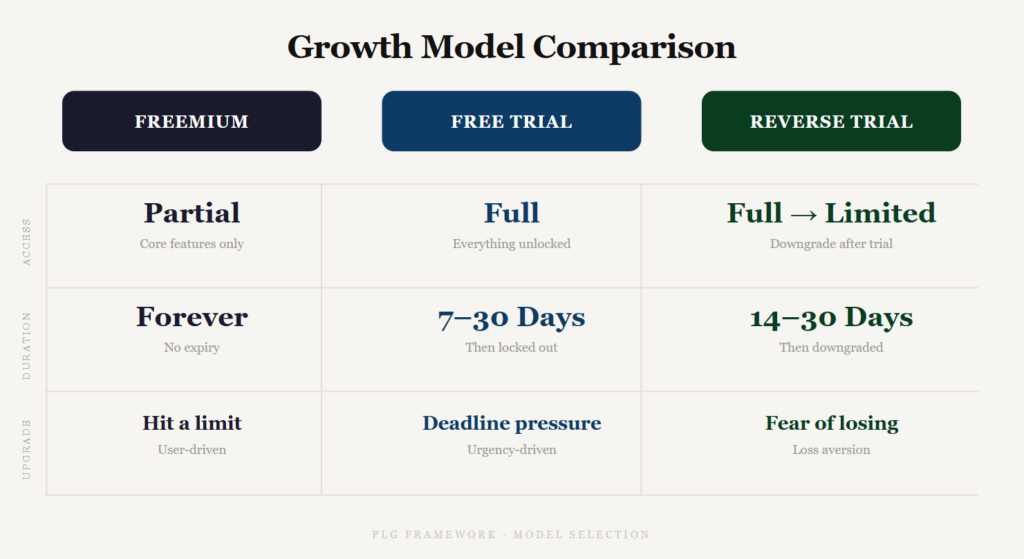
The first decision you need to make is whether a freemium model or a free trial better fits your product and your growth goals. A free trial gives users full or near-full access to your product for a fixed period, typically 7 to 14 days. A freemium model gives users permanent access to a limited version of the product, with paid tiers unlocking more functionality.
| Model | Access | Best for | Upgrade trigger |
|---|---|---|---|
| Free trial | Full product, 7–14 days | Products whose core value is felt quickly | Trial expiry, while value is fresh |
| Freemium | Limited tier, forever | Products with network effects or long evaluation cycles | Usage/feature limits hit over time |
| Reverse trial | Full product first, then free tier | Products where habits form before limits hurt | Losing features you already rely on |
Free trials work best when your product's core value is easy to experience quickly and the upgrade decision is natural once the trial expires. The freemium model works better when your product has strong network effects, or when a free tier can serve as a long-term acquisition channel by turning free users into brand advocates.
A reverse trial is a third option worth considering, particularly for products where users need time to build habits before they feel the limitation of a free tier. New users start on a full-featured paid plan for a set period and then drop to a free tier if they don't upgrade. They experience the full value of the product before evaluating what they'd lose by not paying.
Whichever model you choose, your pricing needs to align directly with your value propositions. If users can't clearly see the connection between what they're paying for and the value they're getting, upgrade rates will suffer regardless of how good your product is.
This is why PLG pricing is built around a value metric: the unit that scales with the value a customer receives, such as seats, active projects, messages sent, or storage used. When price grows along the same axis as value, upgrades feel like a natural consequence of success with the product rather than a toll gate.
The free tier's limits then define themselves. Give away enough of the value metric to prove the product, and charge from the point where usage signals a real workflow.
Designing a clear upgrade path is just as important as the model itself. Users should never have to guess what they're missing on a free plan or what they'd gain by upgrading.
Contextual upgrade prompts at the exact moment a user hits a limitation, paired with a frictionless checkout flow, are what convert free users into paying customers at scale and drive sustainable product adoption across your entire user base.
3. Build an In-Product Growth Engine
Getting users through the door is only half the job. The real growth work happens inside the product, where the right guidance at the right moment is what separates users who activate and stick around from users who sign up once and never come back.
An in-product growth engine is the system you build to make activation predictable and repeatable. It combines messaging, guidance, and behavioral data to move users forward without requiring them to reach out to support or wait for a sales touchpoint.
Use In-App Guidance to Drive Activation
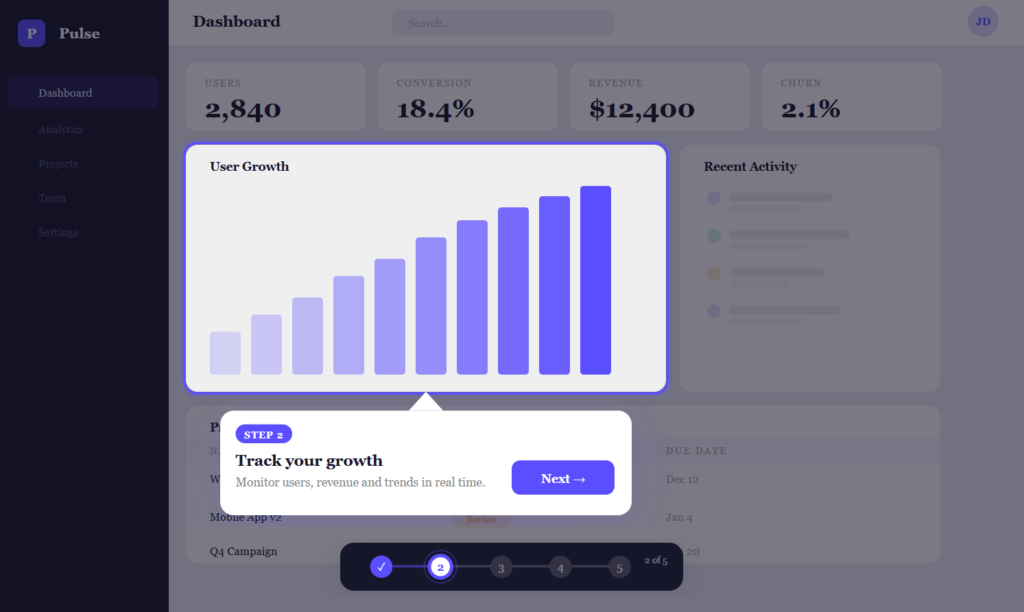
In-app messaging is one of the most direct levers you have for driving activation. Unlike email sequences that users can ignore, in-app messages meet users where they already are, inside the product, at the exact moment they need direction.
You don't need a full product redesign to do this well. Most activation gains come from messaging and sequencing changes, not UX work.
A well-timed message that tells a user what to do next removes the hesitation that causes drop-off during onboarding.
Guided tours take this a step further by walking users through the core functionality of your product in a structured sequence. The goal of a guided tour isn't to show users everything your product can do, it's to get them to their first meaningful outcome as fast as possible. A tour that tries to cover too much will overwhelm users rather than activate them.
Behavioral analytics triggers add intelligence to your in-app guidance by making it responsive to what users actually do rather than firing on a fixed schedule. If a user has completed step one of your onboarding but hasn't touched step two in 48 hours, a triggered message addressing that specific gap will outperform any generic follow-up.
This is where product usage data becomes a direct growth input rather than just a reporting tool.
The combination of these signals is also what allows you to identify product-qualified leads with precision. Repeated engagement with a specific feature, an upgrade to a higher usage tier, or actions that signal a user is hitting plan limits are all buying signals your sales team can act on immediately.
Routing those leads to sales at the right moment, with full context on what the user has already done in the product, is what makes product-led sales a faster and more efficient motion than cold outreach.
Design Growth Loops Inside the Product
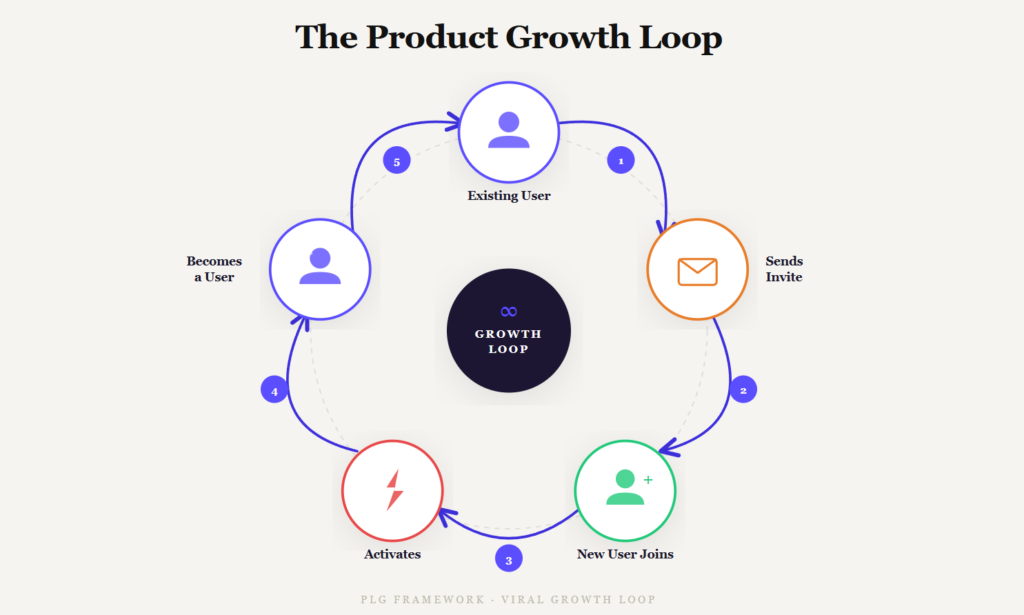
The most efficient customer acquisition channel you can build is one where your existing users bring in new users automatically. Growth loops make this possible by embedding acquisition mechanics directly into the product experience rather than relying entirely on paid channels or outbound sales.
A growth loop is a self-reinforcing cycle where user actions inside the product generate new user exposure, which brings in more users, who then repeat the same cycle. When designed well, these loops compound over time and reduce your dependence on external acquisition spend.
If you think in frameworks, this is where the classic models plug in. The AAARRR "pirate metrics" funnel (awareness, acquisition, activation, retention, referral, revenue) describes the stages each loop feeds. Nir Eyal's Hooked model (trigger, action, reward, investment) describes the habit cycle that keeps users returning often enough for the loop to spin.
A referral program is the fastest growth loop to implement because it converts your existing users into an active acquisition channel. When users invite teammates or colleagues into your product, every invitation is a warm introduction to someone who already has a reason to trust the recommendation.
To keep that trust intact, the incentive structure needs to be tied directly to the product's core value, such as unlocking extra storage or additional seats, rather than a generic discount that feels disconnected from what made the product worth sharing in the first place.
Word-of-mouth referrals work on the same principle but without a formal incentive structure driving them. They happen when your onboarding is fast enough that users reach value within a single session, and when your product solves a problem visibly enough that colleagues notice the results.
Network effects add another layer to your growth loops by making the product demonstrably more useful as more people join. A project management tool becomes more valuable when an entire team is on it, and a communication platform becomes stickier as more colleagues adopt it.
Brand advocates emerge from users who have experienced that compounding value firsthand and want to talk about it publicly. Giving those users specific outlets, including structured case studies, community forums, and co-marketing opportunities, turns their enthusiasm into a visible acquisition channel.
4. Align Sales and Customer Success With Product Signals
In a product-led growth model, your sales and customer success teams are most effective when they stop operating on assumptions and start working directly from what users are doing inside the product.
The companies that scale PLG successfully treat product data as the operating system for both teams, not just a reporting metric reviewed in quarterly business reviews.
Product-Led Sales in Practice
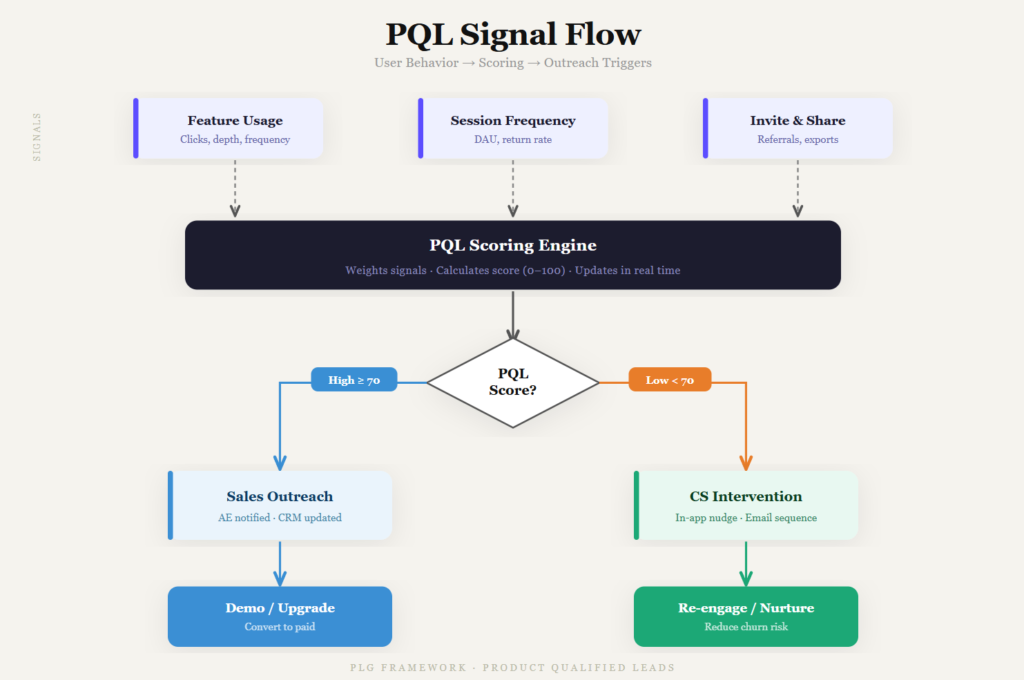
Product-led sales works by giving your sales team a prioritized list of users who have already demonstrated buying intent through their behavior in the product. Instead of cold outreach to leads who have never touched the product, sales reps engage users who have hit usage limits, repeatedly accessed premium features, or invited multiple teammates.
These users are your product-qualified leads, and they convert at a significantly higher rate than leads generated through traditional top-of-funnel marketing because the product has already done the convincing.
The sales conversation shifts from persuading someone to try the product to helping someone who already sees the value make the case internally for purchasing it.
This dynamic is also what compresses the sales cycle. When a rep enters a conversation with full context on what a user has done in the product, which features they use most, and where they're hitting friction, they can address objections and accelerate the decision without starting from scratch.
Sales and marketing alignment in a PLG model means both teams are working from the same product usage data to identify, prioritize, and engage high-intent users. Marketing uses that data to trigger the right nurture sequences, while sales uses it to time outreach precisely.
Customer Success as a Retention Driver
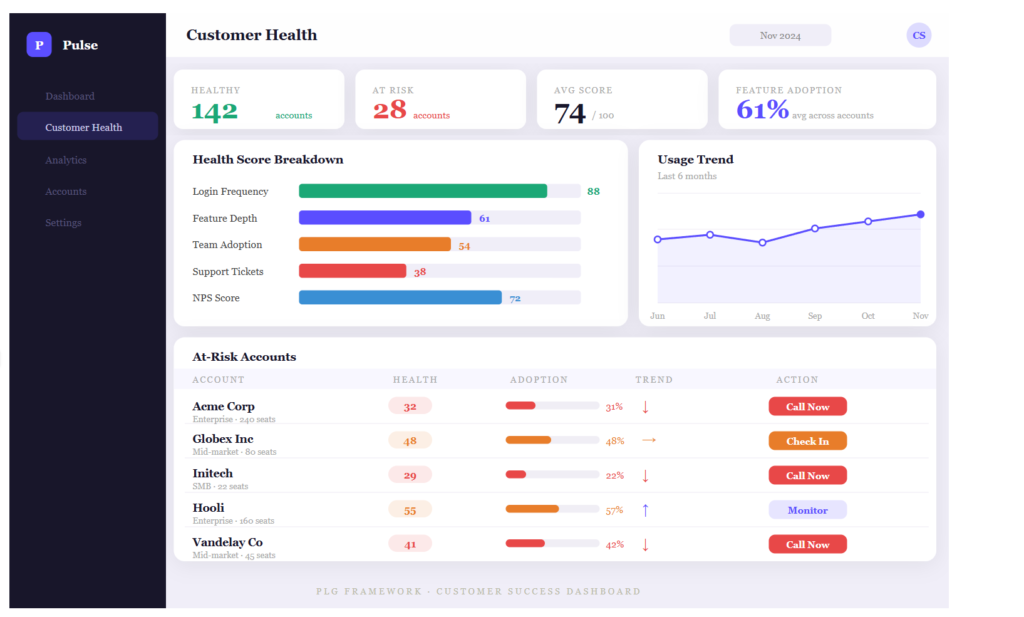
Customer success teams in a PLG company are not reactive support functions. They are proactive retention drivers who use product data to identify which accounts are thriving, which are at risk of churning, and where intervention will have the most impact on long-term revenue.
Working from product data means customer success managers can see exactly which features an account is using, how frequently they log in, and whether their usage has been growing or declining over the past 30 to 60 days. This gives them the context to have targeted, relevant conversations rather than generic check-in calls.
Effective customer success management workflows are built around these signals. When a customer's usage drops below a defined threshold, an automated alert triggers a success manager to reach out with a specific intervention, whether that's a training session on an underused feature or a conversation about their current goals.
This proactive approach directly increases customer lifetime value by catching churn risk early and turning at-risk accounts into stable, expanding ones. Accounts that receive timely, relevant outreach are also far more likely to expand into higher tiers or additional seats, which drives expansion revenue without new customer acquisition.
Improving your Net Promoter Score follows from the same discipline. Customers who feel that your team understands their usage and helps them get more value over time are the customers who give high scores and generate the word-of-mouth referrals that feed your growth loops.
5. Build the Right Product Analytics Infrastructure
Every decision in a product-led growth strategy should be driven by data rather than instinct. Onboarding changes, pricing adjustments, and sales outreach timing all produce better outcomes when they're grounded in what your product data is actually telling you.
Without a solid product analytics infrastructure underneath those decisions, the cost shows up in slower growth, higher churn, and wasted resources across every team.
The challenge most companies face isn't a lack of data but a lack of connected data. Marketing metrics sit in one platform, product usage data sits in another, and revenue data lives in a CRM that nobody has integrated with either.
The full picture of how users move from acquisition to activation to expansion is never visible in one place.
Track the Metrics That Actually Matter
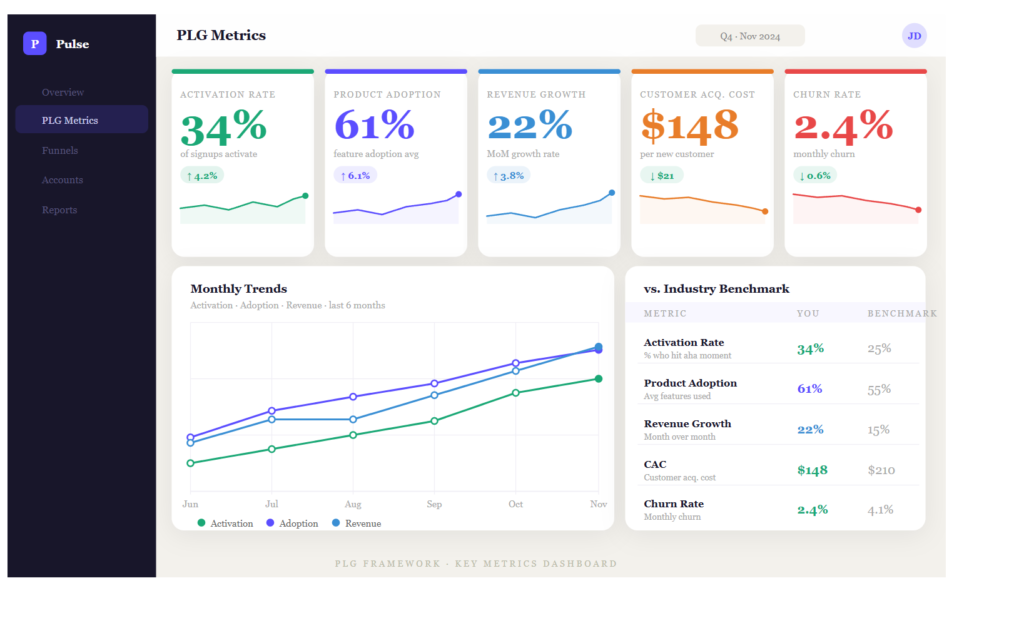
Five metrics carry most of the signal in a PLG motion. Here is what each one tells you, and what healthy looks like:
| Metric | What it tells you | Healthy signal |
|---|---|---|
| Activation rate | % of signups reaching first core value | 20–40% for self-serve SaaS (OpenView benchmarks) |
| Time to value (TTV) | How fast a new user experiences the core benefit | Minutes to days, and shrinking each quarter |
| Product adoption rate | Depth of feature engagement per account | Multiple features in weekly workflows |
| Net dollar retention (NDR) | Expansion minus churn across existing accounts | 100%+ solid; 130–150% is where top PLG companies sit |
| CAC vs. LTV | Whether product-driven channels are lowering acquisition cost | CAC falling as organic/referral share grows |
Your activation rate is the first metric to get right because it tells you what percentage of new signups are actually reaching the point where they experience your product's core value. High signup volume paired with a low activation rate means your onboarding is leaking users before they reach the outcome that would make them stay.
Product adoption rate measures how deeply users are engaging with your product's features over time. An account that uses one feature out of ten available is far more vulnerable to churn than one that has built workflows around multiple features.
Tracking adoption at the feature level gives you an early warning system for accounts that haven't fully committed to the product.
Tracking revenue growth in a PLG context means looking beyond total revenue to understand where growth is coming from. Separating new revenue from expansion revenue tells you whether growth is driven by acquiring new customers or by existing customers finding more value over time.
A healthy PLG company typically sees a significant portion of revenue growth coming from expansion.
Your customer acquisition cost needs to be measured against the lifetime value of the customers you're acquiring. A PLG model should, over time, drive your acquisition cost down as organic and product-driven channels grow. You won't know if that's happening without tracking both numbers and segmenting them by channel.
Retention and churn are the metrics that determine whether everything else you're doing is working. Strong acquisition and activation numbers mean very little if users are churning at a rate that prevents you from building a stable, compounding revenue base.
Turn Usage Data Into Continuous Optimization
Collecting metrics is only valuable if your team has a system for acting on them consistently. Platforms like Windsor.ai allow you to connect your marketing, product, and revenue data into a single pipeline, giving your team a unified view of the funnel without manually stitching together exports.
Customer feedback loops close the gap between what your data shows and what your users actually experience. Quantitative data tells you where users drop off, but qualitative feedback from in-app surveys, user interviews, and support conversations tells you why. Combining both gives you enough context to make the right changes.
Behavioral analytics experimentation means using what you know about how different user segments behave to form specific hypotheses and test them systematically. Rather than making broad changes to your onboarding and hoping for improvement, you isolate a single variable, run a controlled test, and measure the impact before rolling it out.
A/B testing within your analytics system should be a continuous practice rather than an occasional project. The teams that improve conversion and retention fastest always have an active test running, review results on a fixed cadence, and feed those learnings back into the next round of optimization.
Product-Led Growth Examples
The clearest way to understand PLG strategy is to look at how the companies that defined it actually run the motion:
- Slack: freemium with a network-effect core. Free workspaces spread inside companies team by team; the 10,000-message history limit becomes painful precisely when Slack has become the company's communication backbone, making the upgrade decision internal and inevitable.
- Dropbox: the canonical referral loop. Free storage for both referrer and invitee turned every user into an acquisition channel, and shared folders pulled non-users into the product as part of its core use.
- Calendly: the product is the marketing. Every free booking link a user sends is a live product demo delivered to exactly the kind of person who needs one. Acquisition is a side effect of usage.
- Atlassian: self-serve at enterprise scale. Jira and Confluence grew for a decade with transparent pricing, online checkout, and virtually no outbound sales, proving that even complex B2B software can sell itself when evaluation is friction-free.
- Figma: collaboration as distribution. Multiplayer design files mean inviting a colleague isn't a referral program, it's how the product works. Every share expands the user base and deepens the account.
The common thread: none of these companies bolted growth mechanics onto their product. The acquisition loop is the product's natural usage pattern. That's what you're looking for when you design your own.
How to Transition From Sales-Led to Product-Led Growth
Most companies don't start product-led. They retrofit PLG onto an existing sales motion, and the transition fails when it's treated as a pricing-page change instead of an operating change. The sequence that works:
- Open a self-serve entry point: a free trial or free tier alongside the demo form, with online checkout so smaller accounts can buy without ever talking to sales.
- Instrument the product first: you can't run PLG on gut feel. Define your activation event, track time to value, and wire product usage data somewhere every team can see it.
- Define product-qualified leads: agree with sales on the usage signals that mean "ready to buy" (seats added, limits hit, premium features explored) and route those accounts to reps with full context.
- Repoint sales at expansion: reps stop chasing cold lists and start working the accounts the product has already warmed: enterprise rollouts, multi-team expansion, procurement.
- Run the hybrid deliberately: self-serve converts the long tail while sales works the top accounts. The mistake is making them compete for the same deals instead of assigning each motion the segment it serves best.
Common Mistakes in Product-Led Growth Strategy
Most product-led growth strategies don't fail because the product isn't good enough. They fail because of execution gaps that compound over time and become harder to reverse the longer they go unaddressed. These are the mistakes that show up most consistently across PLG companies at every stage of growth.
-
Launching a freemium model without upgrade logic: Offering a free tier without a deliberate system for converting free users into paying customers is one of the most expensive mistakes a PLG company can make. If your free plan delivers enough value that users never feel the need to upgrade, you've built an acquisition channel that doesn't generate revenue.
-
Focusing on acquisition before activation: Pouring resources into bringing new users in before you've solved activation means you're filling a leaky bucket. Every user who signs up and doesn't reach your product's core value is a wasted acquisition cost, and scaling that problem with more spend only makes it more expensive.
-
Underinvesting in analytics: Without a proper product analytics infrastructure, your team is making growth decisions based on incomplete information. You won't catch churn risk, activation drop-off, or feature adoption gaps until they've already done significant damage to your revenue.
-
Poor cross-functional alignment: When sales, marketing, product, and customer success teams operate from different data sources and different definitions of success, the user experience suffers. A user who gets a sales call about a feature they already use daily signals that your teams aren't working from the same picture of the customer.
-
Ignoring product management ownership: Product management needs to own the PLG motion, not just contribute to it. When nobody owns the end-to-end user journey, critical decisions about onboarding, pricing, and in-app experience get made in silos, and the result is a fragmented experience that undermines customer satisfaction.
Measuring the Long-Term Impact of Your PLG Strategy
The metrics that matter most in a product-led growth model are not the ones that look impressive in a weekly report. They are the ones that tell you whether your PLG strategy is building a business that compounds over time, where each cohort retains better, expands faster, and costs less to acquire than the one before it.
Sustainable Revenue Growth
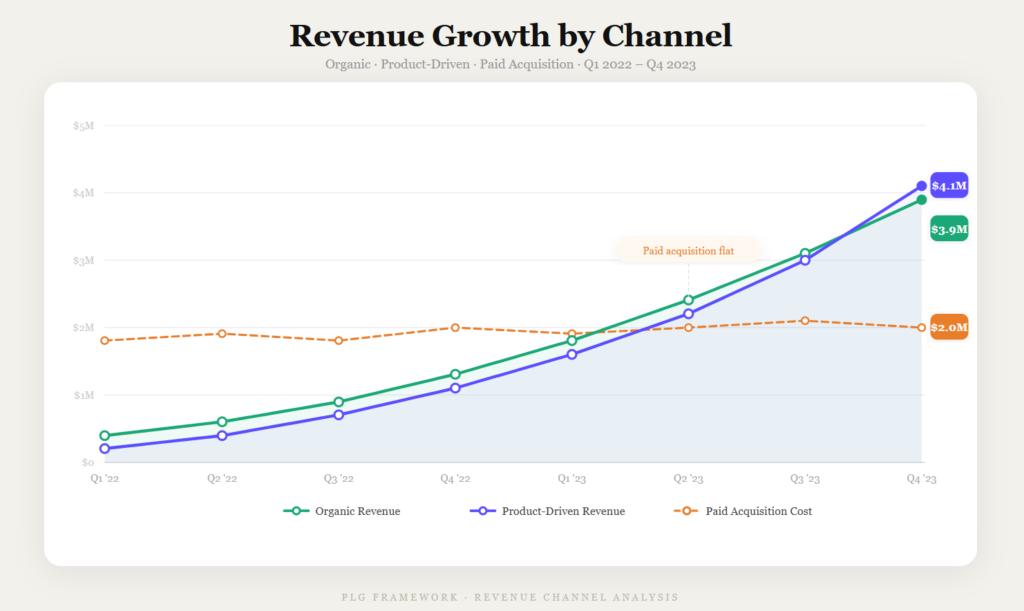
Revenue growth in a PLG company should become progressively less dependent on paid acquisition as the product matures. When your onboarding is tight, your activation rate is high, and your growth loops are working, a growing share of new revenue should come from organic channels, word-of-mouth, and product-driven virality.
Tracking revenue growth by channel over time tells you whether that shift is actually happening. If your paid acquisition costs are staying flat or rising while organic and product-driven revenue isn't growing proportionally, your growth loops aren't compounding the way a healthy PLG model should.
Expansion Revenue
Expansion revenue is the clearest signal that your product is delivering sustained value to your existing customer base. When users upgrade to higher tiers, add more seats, or purchase additional products, they're telling you that the value they're getting has grown beyond what their current plan covers.
Monitoring expansion revenue as a percentage of total revenue gives you a direct read on customer lifetime value trends across your user base. When that share is growing, the product is doing its job of converting activation into long-term, deepening engagement.
Customer Retention
Retention is the foundation that every other PLG metric rests on. Strong acquisition numbers, high activation rates, and healthy expansion revenue all lose their meaning if your churn rate is high enough to offset the gains.
That's why retention needs to be tracked at the cohort level rather than as a single aggregate number. Cohort-level analysis tells you whether the users you acquired in a given month are retaining better or worse than previous cohorts.
Consistent improvement in cohort retention over time is the clearest evidence that your onboarding, activation, and customer success motions are actually getting better.
Building a Product-Led Organization
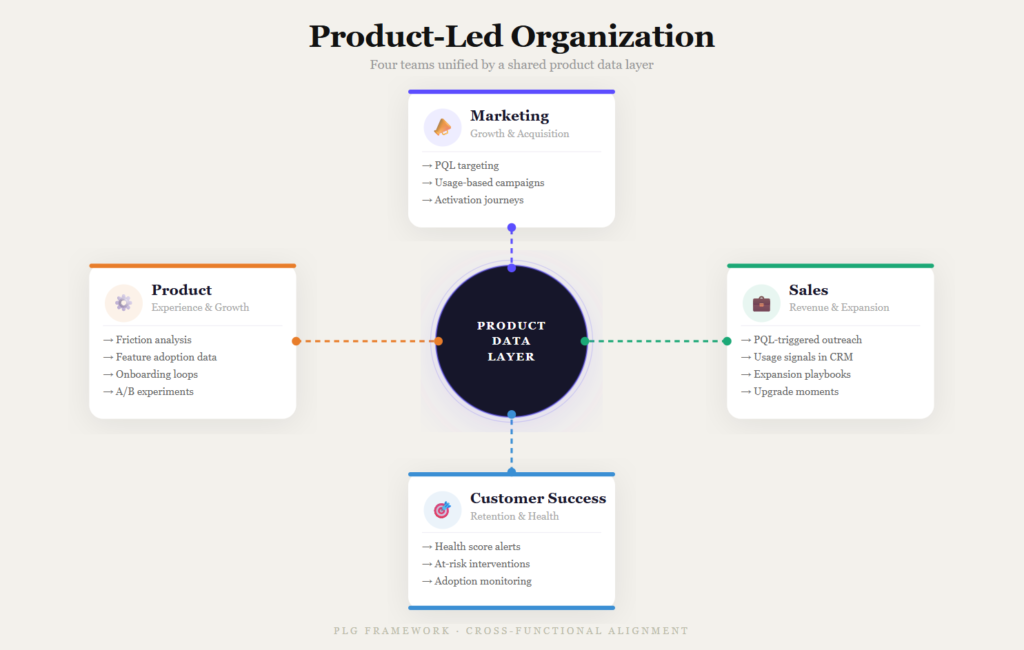
A product-led organization is one where every team, from marketing to sales to customer success to product, makes decisions based on the same product usage data and measures success against the same user outcomes.
Getting there requires more than installing analytics tools. It requires building shared definitions, shared dashboards, and shared accountability across every function that touches the user journey.
The companies that sustain PLG growth over the long term are the ones that treat it as an organizational discipline rather than a product feature. That means continuous experimentation, regular cross-functional reviews of retention data, and a leadership culture that prioritizes long-term user value over short-term acquisition volume.
Building a Sustainable Product-Led Growth Strategy
A product-led growth strategy is not a feature you ship or a pricing model you adopt. It is an operational system that spans every team in your company, every touchpoint in your user journey, and every decision about how your product creates and delivers value.
The companies that execute PLG successfully treat every part of that system as a variable worth testing. Onboarding flows, upgrade prompts, referral incentives, and customer success workflows all have better versions waiting to be found through disciplined experimentation.
The teams that find those versions fastest are the ones that build experimentation into their operating rhythm rather than treating it as a project they'll get to eventually.
Continuous iteration is what separates a PLG strategy that compounds over time from one that plateaus. Each improvement to your activation rate makes your acquisition spend more efficient, and each improvement to retention makes your expansion revenue more predictable.
Those gains stack on top of each other and widen the gap between you and competitors still running a sales-heavy go-to-market strategy.
The long-term competitive advantage of a well-executed PLG strategy is that it becomes increasingly difficult to replicate. Your growth loops, activation benchmarks, and expansion revenue playbooks are built through years of iteration that can't be copied overnight.
That accumulated operational knowledge is what turns a product-led growth strategy from a methodology into a durable, compounding business advantage.
Frequently Asked Questions
What is a product-led growth strategy?
A product-led growth (PLG) strategy is a go-to-market approach where the product itself, rather than a sales team, is the primary driver of customer acquisition, activation, retention, and expansion. Users sign up self-serve, reach the product's core value on their own, and upgrade when the product proves its worth, while sales and customer success act on product usage signals.
What is the relationship between friction and product-led growth?
Friction is the central constraint in product-led growth. Because there is no salesperson guiding users past confusing steps, every unnecessary form field, setup screen, or unclear next action directly reduces activation and revenue. PLG companies treat friction reduction as a core product discipline: they map the journey from signup to first value, measure drop-off at each step, and continuously shorten time to value.
How do product-led growth companies structure their pricing and freemium models?
Most PLG companies use one of three models: a free trial (full access for 7–14 days), freemium (a permanently free tier with paid tiers unlocking more usage or features), or a reverse trial (full paid access that drops to a free tier if the user doesn't upgrade). The right choice depends on how fast users reach value and whether free users compound acquisition through network effects. Pricing is tied to a value metric (seats, usage, or storage) so cost scales with the value received.
How do companies transition from a sales-led model to product-led growth?
Start by adding a self-serve entry point (trial or free tier) alongside the existing sales motion, instrument the product so activation and usage are measurable, and define product-qualified leads so sales prioritizes users already showing buying intent. Most companies run hybrid motions during the transition: self-serve converts smaller accounts while sales concentrates on expansion and enterprise deals surfaced by product signals.
How do you reduce churn in a product-led growth environment?
Track feature adoption and login frequency per account, set usage thresholds that flag at-risk accounts before renewal, and have customer success intervene with specific, data-informed help rather than generic check-ins. Cohort-level retention analysis shows whether onboarding and activation changes are actually improving retention over time.